Resume example
AI Engineer resume example
By the Resumade team · About our content
An AI Engineer resume must clear NLP-based ATS filters with precise tool names while showing hiring managers a clear throughline from model design to measurable business outcomes. This example does both by anchoring every bullet to a quantified result and naming exact frameworks recruiters search for.
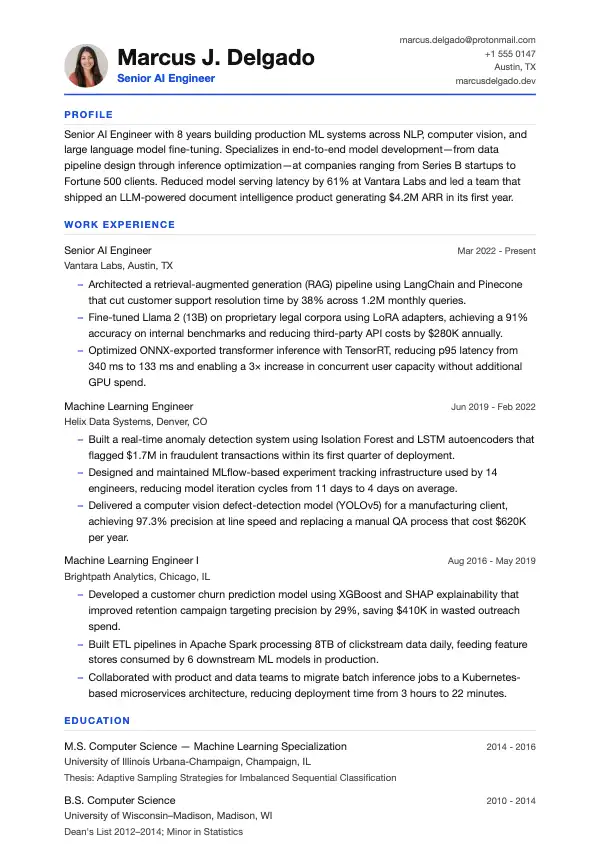
Template: Meridian
Read this resume as text
Marcus J. Delgado
Senior AI Engineer
marcus.delgado@protonmail.com · +1 555 0147 · Austin, TX · marcusdelgado.dev
- Profile
- Senior AI Engineer with 8 years building production ML systems across NLP, computer vision, and large language model fine-tuning. Specializes in end-to-end model development—from data pipeline design through inference optimization—at companies ranging from Series B startups to Fortune 500 clients. Reduced model serving latency by 61% at Vantara Labs and led a team that shipped an LLM-powered document intelligence product generating $4.2M ARR in its first year.
- Work Experience
Senior AI Engineer
Vantara Labs, Austin, TX · Mar 2022 - Present
- Architected a retrieval-augmented generation (RAG) pipeline using LangChain and Pinecone that cut customer support resolution time by 38% across 1.2M monthly queries.
- Fine-tuned Llama 2 (13B) on proprietary legal corpora using LoRA adapters, achieving a 91% accuracy on internal benchmarks and reducing third-party API costs by $280K annually.
- Optimized ONNX-exported transformer inference with TensorRT, reducing p95 latency from 340 ms to 133 ms and enabling a 3× increase in concurrent user capacity without additional GPU spend.
Machine Learning Engineer
Helix Data Systems, Denver, CO · Jun 2019 - Feb 2022
- Built a real-time anomaly detection system using Isolation Forest and LSTM autoencoders that flagged $1.7M in fraudulent transactions within its first quarter of deployment.
- Designed and maintained MLflow-based experiment tracking infrastructure used by 14 engineers, reducing model iteration cycles from 11 days to 4 days on average.
- Delivered a computer vision defect-detection model (YOLOv5) for a manufacturing client, achieving 97.3% precision at line speed and replacing a manual QA process that cost $620K per year.
Machine Learning Engineer I
Brightpath Analytics, Chicago, IL · Aug 2016 - May 2019
- Developed a customer churn prediction model using XGBoost and SHAP explainability that improved retention campaign targeting precision by 29%, saving $410K in wasted outreach spend.
- Built ETL pipelines in Apache Spark processing 8TB of clickstream data daily, feeding feature stores consumed by 6 downstream ML models in production.
- Collaborated with product and data teams to migrate batch inference jobs to a Kubernetes-based microservices architecture, reducing deployment time from 3 hours to 22 minutes.
- Education
M.S. Computer Science — Machine Learning Specialization
University of Illinois Urbana-Champaign, Champaign, IL · 2014 - 2016
Thesis: Adaptive Sampling Strategies for Imbalanced Sequential Classification
B.S. Computer Science
University of Wisconsin–Madison, Madison, WI · 2010 - 2014
Dean's List 2012–2014; Minor in Statistics
- Skills
- Python (PyTorch, TensorFlow, Hugging Face Transformers) · Large Language Model Fine-Tuning (LoRA, PEFT, RLHF) · Retrieval-Augmented Generation (RAG, LangChain, Pinecone) · MLOps & Model Serving (MLflow, TensorRT, ONNX, Triton) · Computer Vision (YOLOv5, OpenCV, torchvision) · Cloud Platforms (AWS SageMaker, GCP Vertex AI) · Data Engineering (Apache Spark, Kafka, dbt) · Containerization & Orchestration (Docker, Kubernetes, Helm) · AWS Certified Machine Learning – Specialty (2023)
- Links
- Portfolio: marcusdelgado.dev · GitHub: github.com/mjdelgado-ai · LinkedIn: linkedin.com/in/marcus-j-delgado
What makes this resume work
- The summary opens with seniority and years of experience in the first clause, immediately orienting the reader before naming two specializations and two headline metrics—no vague mission statements.
- Every experience bullet starts with a distinct action verb (Architected, Fine-tuned, Optimized) and closes with a dollar figure, percentage, or time saving, so the value delivered is never implicit.
- Skills are listed as compound entries pairing the category with specific tools (e.g., 'Python (PyTorch, TensorFlow, Hugging Face Transformers)'), which satisfies both human readers and keyword-matching ATS parsers in a single line.
- The education section includes thesis and honors details that signal depth of ML training without padding the resume with irrelevant coursework, which matters when competing against candidates from top-ranked programs.
Keywords that help you pass the ATS
Work the ones that fit your experience into your resume, naturally, not stuffed.
How to write an AI Engineer resume
Choose the right format for an AI Engineer resume
Use a reverse-chronological format. Hiring managers at tech companies and research labs want to see your most recent work first, and applicant tracking systems parse this layout most reliably. Keep the document to one page if you have under ten years of experience; two pages are acceptable for senior or staff-level roles with substantial publication or project histories.
Set margins to 0.75–1 inch, use a clean sans-serif font like Calibri or Inter at 10–11pt, and avoid tables or multi-column layouts that break ATS parsing. Place your name, LinkedIn URL, GitHub profile, and a portfolio or Hugging Face link in the header — recruiters at companies like Google DeepMind, OpenAI, or mid-size MLOps shops will click those links before the phone screen.
- Reverse-chronological order, most recent role first
- One page for under 10 years; two pages for senior/staff roles
- Include GitHub and portfolio links in the header
- No tables, text boxes, or graphics that confuse ATS
- File format: PDF unless the job posting specifies otherwise
Write a professional summary that lands interviews
Your summary sits directly below your contact information and should be three to four sentences that tell a recruiter exactly what you build, at what scale, and with which stack. Avoid vague phrases like 'passionate about technology.' Name the frameworks, model types, and business outcomes you deliver.
Here is an example of a strong summary: "ML Engineer with 6 years building and deploying production NLP and computer vision systems on AWS SageMaker and GCP Vertex AI. Reduced model inference latency by 38% at a Series B fintech by migrating pipelines from batch to real-time using Kafka and TensorFlow Serving. Experienced in fine-tuning large language models with RLHF and PEFT techniques, and in collaborating with product and data teams to ship models that move revenue metrics."
Write work-experience bullets that show impact
Each bullet should follow an action-verb → task → quantified result structure. Recruiters spend seconds scanning; numbers make bullets scannable and credible. Focus on model performance improvements, inference cost reductions, training time cuts, dataset scale, and downstream business metrics — not just the tools you used.
Avoid listing responsibilities. 'Responsible for maintaining ML pipelines' tells a hiring manager nothing. Show what you changed and what happened because of it.
- Rebuilt a real-time fraud detection model using XGBoost and feature stores on Feast, reducing false-positive rate by 22% and saving the business an estimated $1.4M annually in manual review costs.
- Designed and deployed a multi-modal image-text retrieval system using CLIP and FAISS on Kubernetes, cutting search latency from 420ms to 95ms at 10M daily queries while holding GPU spend flat.
Skills and certifications recruiters and ATS look for
Build a dedicated skills section organized by category: frameworks and libraries, cloud and MLOps platforms, languages, and data tooling. Paste keywords directly from job descriptions — terms like 'LLMOps,' 'RAG pipelines,' 'model quantization,' and 'distributed training' are now standard filters. Do not pad this section with generic tools like Microsoft Word.
Certifications that carry real weight with hiring teams include AWS Certified Machine Learning – Specialty, Google Professional Machine Learning Engineer, the Deep Learning Specialization from Coursera (Andrew Ng), and MLOps Specialization from DeepLearning.AI. Databricks Certified Machine Learning Professional is increasingly requested at data-platform-heavy companies. List the issuing body and year earned.
- Frameworks: PyTorch, TensorFlow, JAX, Hugging Face Transformers, LangChain
- MLOps: MLflow, Kubeflow, SageMaker Pipelines, Vertex AI, Weights & Biases, DVC
- Languages: Python (primary), SQL, Bash; C++ or Rust a plus for inference optimization
- Data: Spark, dbt, Airflow, Kafka, Snowflake
- Certifications: AWS ML Specialty, Google ML Engineer, Databricks ML Professional
Education, licenses, and extras
List your highest degree first: institution, degree, field of study, and graduation year. A master's or PhD in computer science, statistics, or a related field is common in this role, but it is not a hard filter at most companies — a strong portfolio and measurable experience outweigh credentials at many employers. If your thesis or capstone involved model development, name it briefly.
Under a separate 'Publications & Projects' section, list any peer-reviewed papers with conference names (NeurIPS, ICML, ICLR carry weight), open-source contributions with star counts if notable, and Kaggle rankings if you placed in the top 5%. Keep this section concise — two to five items maximum. Do not list every side project you have ever touched.
- List degree, institution, and year — omit GPA unless it is above 3.7 and you graduated within the last three years
- Include thesis title if it is directly relevant to the roles you are targeting
- Publications: use short citation format with venue name and year
- Open-source: link to GitHub repo and note stars or forks if significant
- Kaggle or competition rankings: include only top-5% finishes
Mistakes to avoid
- Listing tools without context — writing 'PyTorch, TensorFlow, Kubernetes' in a skills section with no evidence of how you used them at scale tells a technical recruiter nothing actionable.
- Omitting model performance metrics and defaulting to vague language like 'improved model accuracy,' which signals you either did not measure results or do not know how to communicate them.
- Burying your GitHub or portfolio link in the body of the resume instead of the header, causing time-pressed reviewers to miss the work samples that differentiate you from other candidates.
- Using a single generic resume for every application instead of mirroring the specific terminology in each job description, which causes ATS keyword filters to rank your resume below less-experienced candidates who did tailor their submissions.
Frequently asked questions
- Do I need a PhD to get hired as an AI Engineer?
- No. A PhD is expected for pure research roles at labs like DeepMind or FAIR, but the majority of industry AI Engineer positions — including senior and staff levels — are filled by candidates with bachelor's or master's degrees who have strong portfolios and production experience. Demonstrable work on deployed systems consistently outweighs academic credentials in engineering-focused hiring.
- How many pages should an AI Engineer resume be?
- One page is standard for engineers with under ten years of experience. Two pages are acceptable — and sometimes expected — at the senior or staff level when you have publications, significant open-source contributions, or a long list of production systems to document. Never pad a one-page resume to two pages just to appear more experienced.
- Should I include personal projects and Kaggle competitions on my AI Engineer resume?
- Yes, if they demonstrate skills directly relevant to the roles you are targeting and if the results are noteworthy — a top-5% Kaggle finish or an open-source project with meaningful adoption are both worth including. Limit this section to two to five items and always link to the work. Listing a project without a link or measurable outcome adds clutter without adding credibility.
Make it yours in minutes
Open this example in the builder, swap in your details, and export a clean, ATS-ready resume.
Once your resume is ready
More for this application
- Template style
- Software Engineer resume templates