Resume example
Data Engineer resume example
By the Resumade team · About our content
A Data Engineer resume must clear automated keyword filters for cloud platforms and pipeline tools, then prove to a hiring manager that you ship reliable, scalable systems — this example does both by anchoring every bullet in production-scale outcomes.
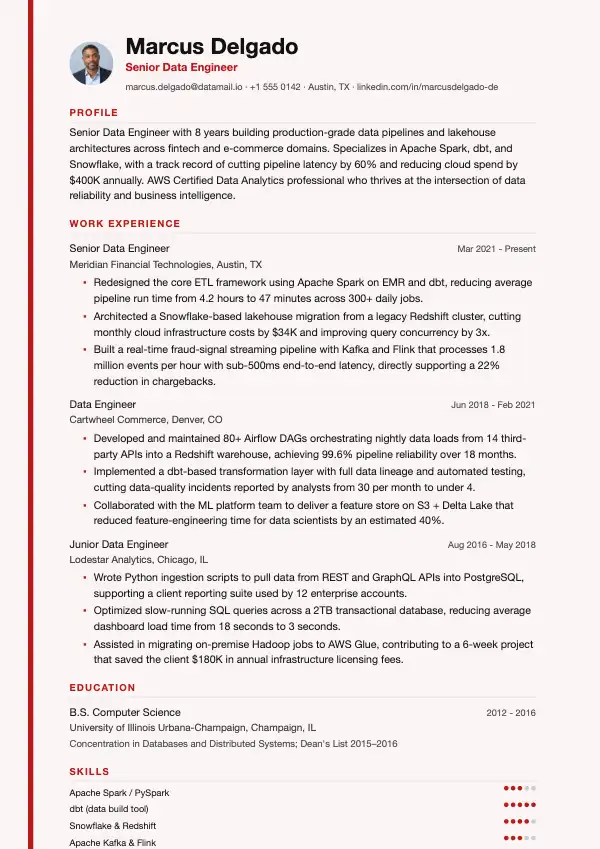
Template: Cadence
Read this resume as text
Marcus Delgado
Senior Data Engineer
marcus.delgado@datamail.io · +1 555 0142 · Austin, TX · linkedin.com/in/marcusdelgado-de
- Profile
- Senior Data Engineer with 8 years building production-grade data pipelines and lakehouse architectures across fintech and e-commerce domains. Specializes in Apache Spark, dbt, and Snowflake, with a track record of cutting pipeline latency by 60% and reducing cloud spend by $400K annually. AWS Certified Data Analytics professional who thrives at the intersection of data reliability and business intelligence.
- Work Experience
Senior Data Engineer
Meridian Financial Technologies, Austin, TX · Mar 2021 - Present
- Redesigned the core ETL framework using Apache Spark on EMR and dbt, reducing average pipeline run time from 4.2 hours to 47 minutes across 300+ daily jobs.
- Architected a Snowflake-based lakehouse migration from a legacy Redshift cluster, cutting monthly cloud infrastructure costs by $34K and improving query concurrency by 3x.
- Built a real-time fraud-signal streaming pipeline with Kafka and Flink that processes 1.8 million events per hour with sub-500ms end-to-end latency, directly supporting a 22% reduction in chargebacks.
Data Engineer
Cartwheel Commerce, Denver, CO · Jun 2018 - Feb 2021
- Developed and maintained 80+ Airflow DAGs orchestrating nightly data loads from 14 third-party APIs into a Redshift warehouse, achieving 99.6% pipeline reliability over 18 months.
- Implemented a dbt-based transformation layer with full data lineage and automated testing, cutting data-quality incidents reported by analysts from 30 per month to under 4.
- Collaborated with the ML platform team to deliver a feature store on S3 + Delta Lake that reduced feature-engineering time for data scientists by an estimated 40%.
Junior Data Engineer
Lodestar Analytics, Chicago, IL · Aug 2016 - May 2018
- Wrote Python ingestion scripts to pull data from REST and GraphQL APIs into PostgreSQL, supporting a client reporting suite used by 12 enterprise accounts.
- Optimized slow-running SQL queries across a 2TB transactional database, reducing average dashboard load time from 18 seconds to 3 seconds.
- Assisted in migrating on-premise Hadoop jobs to AWS Glue, contributing to a 6-week project that saved the client $180K in annual infrastructure licensing fees.
- Education
B.S. Computer Science
University of Illinois Urbana-Champaign, Champaign, IL · 2012 - 2016
Concentration in Databases and Distributed Systems; Dean's List 2015–2016
- Skills
- Apache Spark / PySpark · dbt (data build tool) · Snowflake & Redshift · Apache Kafka & Flink · AWS (EMR, Glue, S3, Lambda) · Apache Airflow · Python & SQL · Delta Lake / Iceberg · AWS Certified Data Analytics – Specialty
- Links
- LinkedIn: linkedin.com/in/marcusdelgado-de · GitHub: github.com/mdelgado-data · Portfolio: marcusdelgado.dev
What makes this resume work
- Each bullet opens with a strong action verb (Redesigned, Architected, Implemented) and closes with a concrete number — latency, cost, or reliability — so the impact is impossible to skim past.
- Skills are listed as specific versioned tools and certifications rather than broad categories, which matches the exact strings recruiters enter into ATS search fields.
- The three-role arc from Junior to Senior DE tells a clear progression story, signaling to hiring managers that growth was earned through increasing scope and ownership, not just tenure.
- The summary front-loads seniority, domain specialization, and two headline results in three sentences, giving a recruiter everything they need to decide on a phone screen before reading a single bullet.
Keywords that help you pass the ATS
Work the ones that fit your experience into your resume, naturally, not stuffed.
How to write a Data Engineer resume
Choose the right format for a Data Engineer resume
Use a reverse-chronological format. Recruiters and ATS systems both expect it, and hiring managers at companies like Databricks, Snowflake, or a Fortune 500 data team want to scan your most recent stack immediately. A functional or hybrid format raises flags and obscures career progression.
Keep the resume to one page if you have fewer than ten years of experience; two pages is acceptable beyond that. Use clean section headers, consistent font sizing (10–12pt body, 14–16pt name), and enough white space so a recruiter on a quick skim can locate your tech stack and employer names without effort.
- Standard sections in order: Contact Info, Summary, Skills, Work Experience, Education, Certifications
- File format: PDF unless the job posting explicitly requests a .docx
- Margins: 0.5–1 inch; avoid tables and text boxes that break ATS parsing
- Name your file: FirstName-LastName-DataEngineer-Resume.pdf
Write a professional summary that positions you immediately
Your summary sits at the top and does one job: tell the hiring manager what kind of data engineer you are and what scale you operate at. Skip objectives and personal adjectives. Lead with years of experience, your core platform (Spark, dbt, Kafka, etc.), and one concrete outcome.
Example: "Data Engineer with 6 years of experience designing and maintaining large-scale batch and streaming pipelines on AWS using Apache Spark, Kafka, and dbt. Reduced average pipeline latency by 40% at a 50M-user SaaS company by migrating from a monolithic ETL system to an event-driven architecture on Kinesis. Comfortable owning the full lifecycle from ingestion to BI-layer delivery."
Write work-experience bullets that prove impact with numbers
Each bullet should follow an action-result structure: what you built or changed, and what measurably happened. Avoid vague verbs like 'assisted with' or 'worked on.' Use 'built,' 'migrated,' 'reduced,' 'automated,' or 'designed.' Quantify storage volumes (TB/PB), pipeline counts, cost savings in dollars, latency improvements in milliseconds or percentage, or data freshness SLAs.
Recruiters at data-heavy companies (Airbnb, Lyft, financial services, healthcare tech) specifically look for evidence of scale and ownership. If you touched a pipeline that processed 10 billion events a day, say so.
- Redesigned the Airflow DAG architecture for 200+ daily ETL jobs, cutting average job failure rate from 12% to under 1% and saving 15 hours of on-call engineering time per week.
- Built a real-time fraud-detection data pipeline on GCP using Dataflow and BigQuery, processing 4 TB of transaction data daily with end-to-end latency under 800 ms, directly enabling a 22% reduction in fraud losses.
Skills and certifications recruiters and ATS systems look for
Create a dedicated Skills section that lists tools explicitly, because ATS systems parse exact strings. Group them by category so a human reader can absorb them quickly: pipeline orchestration, cloud platforms, storage and warehousing, languages, and data modeling. Do not list every tool you have ever opened; include what you can discuss in depth in an interview.
Certifications carry real weight in this field, particularly for cloud platforms. The AWS Certified Data Engineer – Associate (launched 2023), Google Professional Data Engineer, and Databricks Certified Data Engineer Associate are the three most recognized. Snowflake SnowPro Core and dbt Analytics Engineering certification are increasingly requested in job postings.
- Languages: Python, SQL, Scala (list the ones you write production code in)
- Orchestration: Apache Airflow, Prefect, Dagster
- Processing: Apache Spark, Flink, dbt, Kafka, Dataflow
- Cloud & warehousing: AWS (Glue, Redshift, Kinesis), GCP (BigQuery, Pub/Sub), Azure (Synapse, Data Factory), Snowflake
- Formats & storage: Parquet, Delta Lake, Iceberg, S3, HDFS
Education, licenses, and extras that round out the resume
A bachelor's degree in Computer Science, Software Engineering, Statistics, or a related quantitative field is the standard expectation. List your degree, institution, and graduation year; omit GPA unless you graduated within the last two years and it is above 3.5. A master's degree in Data Science or CS is a differentiator at research-heavy companies and in senior roles, but it is not a gate for most mid-level positions.
Under a separate Certifications section, list the credential name, issuing body, and expiration or issue year. If you have open-source contributions (a public dbt package, a Spark plugin on GitHub), a technical blog with measurable readership, or conference talks at events like Data Council or dbt Coalesce, add a brief Projects or Publications section. These signal depth and community credibility that a job title alone cannot.
Mistakes to avoid
- Listing every tool from a tutorial or online course rather than only the technologies you have used in a production or project environment creates credibility problems the moment a technical interviewer asks a follow-up question.
- Writing pipeline descriptions without scale context — saying 'built ETL pipelines' instead of specifying data volume, frequency, and business impact — makes your experience indistinguishable from a junior candidate's.
- Omitting cloud certifications or listing expired ones, since AWS, GCP, and Databricks credentials have become a baseline filter in many job postings and ATS keyword screens.
- Using a resume template with multi-column layouts, embedded graphics, or text boxes, which cause ATS parsers to scramble your content and can bury an otherwise strong application.
Frequently asked questions
- Should a Data Engineer resume include a portfolio or GitHub link?
- Yes, if your GitHub contains substantive work — real pipelines, dbt models, or Spark jobs, not just cloned tutorials. Place the URL in your contact header next to LinkedIn. A sparse or private GitHub is worse than no link at all, so only include it if the repositories are public and demonstrate production-quality thinking.
- How do I write a Data Engineer resume if I'm transitioning from a Software Engineer or Data Analyst role?
- Lead with transferable technical depth: SQL optimization, Python scripting, API integrations, or any ETL work you touched, even informally. Add a certification like the AWS Certified Data Engineer – Associate or complete a capstone project building an end-to-end pipeline and list it under Projects. Frame your summary around the pipeline and infrastructure skills you already have rather than the title you are leaving.
- What is the right length for a Data Engineer resume with 8 years of experience?
- Two pages is appropriate at that experience level, provided both pages are dense with relevant content — not padded with responsibilities that read like a job description. Trim roles older than ten years to a single line or omit them entirely, and cut any bullets that do not demonstrate scale, ownership, or measurable outcome.
Make it yours in minutes
Open this example in the builder, swap in your details, and export a clean, ATS-ready resume.
Once your resume is ready
More for this application
- Template style
- Software Engineer resume templates