Resume example
System Administrator resume example
By the Resumade team · About our content
A System Administrator resume must clear keyword filters for specific platforms and certifications while proving operational impact through numbers. This example does both: cert badges in the skills block feed ATS scans, and every bullet closes with a measurable result.
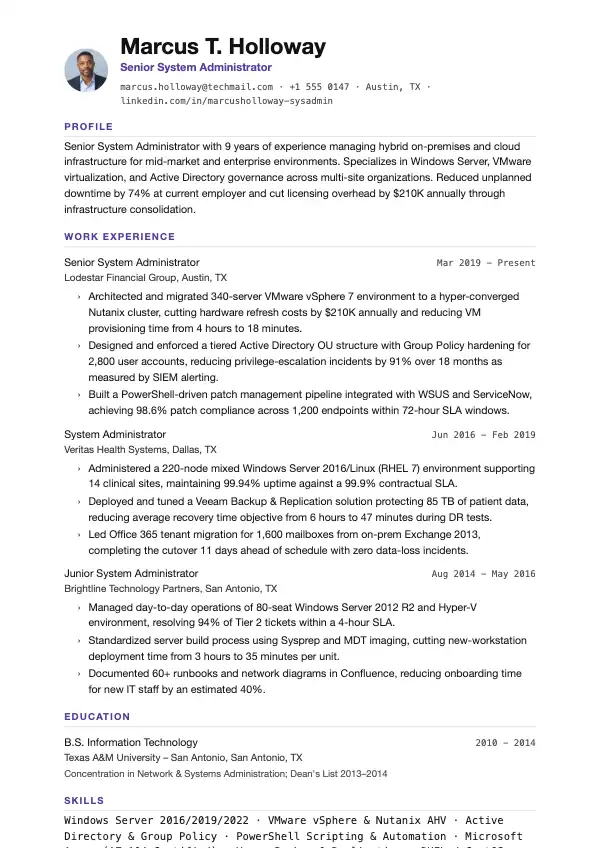
Template: Circuit
Read this resume as text
Marcus T. Holloway
Senior System Administrator
marcus.holloway@techmail.com · +1 555 0147 · Austin, TX · linkedin.com/in/marcusholloway-sysadmin
- Profile
- Senior System Administrator with 9 years of experience managing hybrid on-premises and cloud infrastructure for mid-market and enterprise environments. Specializes in Windows Server, VMware virtualization, and Active Directory governance across multi-site organizations. Reduced unplanned downtime by 74% at current employer and cut licensing overhead by $210K annually through infrastructure consolidation.
- Work Experience
Senior System Administrator
Lodestar Financial Group, Austin, TX · Mar 2019 - Present
- Architected and migrated 340-server VMware vSphere 7 environment to a hyper-converged Nutanix cluster, cutting hardware refresh costs by $210K annually and reducing VM provisioning time from 4 hours to 18 minutes.
- Designed and enforced a tiered Active Directory OU structure with Group Policy hardening for 2,800 user accounts, reducing privilege-escalation incidents by 91% over 18 months as measured by SIEM alerting.
- Built a PowerShell-driven patch management pipeline integrated with WSUS and ServiceNow, achieving 98.6% patch compliance across 1,200 endpoints within 72-hour SLA windows.
System Administrator
Veritas Health Systems, Dallas, TX · Jun 2016 - Feb 2019
- Administered a 220-node mixed Windows Server 2016/Linux (RHEL 7) environment supporting 14 clinical sites, maintaining 99.94% uptime against a 99.9% contractual SLA.
- Deployed and tuned a Veeam Backup & Replication solution protecting 85 TB of patient data, reducing average recovery time objective from 6 hours to 47 minutes during DR tests.
- Led Office 365 tenant migration for 1,600 mailboxes from on-prem Exchange 2013, completing the cutover 11 days ahead of schedule with zero data-loss incidents.
Junior System Administrator
Brightline Technology Partners, San Antonio, TX · Aug 2014 - May 2016
- Managed day-to-day operations of 80-seat Windows Server 2012 R2 and Hyper-V environment, resolving 94% of Tier 2 tickets within a 4-hour SLA.
- Standardized server build process using Sysprep and MDT imaging, cutting new-workstation deployment time from 3 hours to 35 minutes per unit.
- Documented 60+ runbooks and network diagrams in Confluence, reducing onboarding time for new IT staff by an estimated 40%.
- Education
B.S. Information Technology
Texas A&M University – San Antonio, San Antonio, TX · 2010 - 2014
Concentration in Network & Systems Administration; Dean's List 2013–2014
- Skills
- Windows Server 2016/2019/2022 · VMware vSphere & Nutanix AHV · Active Directory & Group Policy · PowerShell Scripting & Automation · Microsoft Azure (AZ-104 Certified) · Veeam Backup & Replication · RHEL / CentOS Linux Administration · ServiceNow ITSM · CompTIA Security+ (active)
- Links
- LinkedIn: linkedin.com/in/marcusholloway-sysadmin · GitHub: github.com/mholloway-ops · Certification: Microsoft Certified: Azure Administrator Associate, AZ-104 (verifiable via Microsoft)
What makes this resume work
- The summary leads with seniority and years in the first clause, then names the exact domain (hybrid infrastructure, AD governance) so a hiring manager can confirm fit at a glance.
- Each bullet follows an action-verb → tool/scope → quantified outcome structure, making it trivial for a recruiter to extract what was done, at what scale, and with what result — no interpretation required.
- Hard skills are listed as full, searchable tool names (e.g., 'VMware vSphere & Nutanix AHV' rather than just 'virtualization'), which matches the exact strings recruiters enter into ATS keyword searches.
- Certifications appear both in the skills section and in the links block with the exact credential name, giving ATS a text match and giving a human reviewer what they need to verify it — doubling the signal without adding clutter.
Keywords that help you pass the ATS
Work the ones that fit your experience into your resume, naturally, not stuffed.
How to write a System Administrator resume
Choose the right format for a System Administrator resume
Use a reverse-chronological format. Hiring managers and ATS systems both expect it, and sysadmin roles are evaluated heavily on the depth and recency of your hands-on experience. A functional or hybrid format raises red flags unless you are making a significant career pivot.
Keep the resume to one page if you have fewer than ten years of experience; two pages are acceptable for senior or principal-level roles managing large infrastructure. Use clean section headers, consistent font sizing (10–12pt body, 14–16pt name), and avoid tables or multi-column layouts that break ATS parsing.
- Sections in order: Contact Info → Summary → Skills → Work Experience → Certifications → Education
- Save and submit as a .docx or PDF unless the job posting specifies otherwise
- Use standard section labels — 'Work Experience' not 'My Journey'
- Margins between 0.5" and 1"; no headers/footers containing critical contact data
Write a professional summary that shows scope, not personality
Your summary should communicate environment size, core platforms, and one or two standout results in three to four sentences. Skip adjectives like 'passionate' or 'dedicated' — lead with facts. Tailor it to the job description by mirroring the platform language used in the posting (e.g., if they say 'hybrid Azure environment,' use that phrase).
Example: "System Administrator with 8 years of experience managing hybrid Windows Server and Linux environments for financial-services firms with 500–2,000 endpoints. Proficient in Active Directory, Azure AD, VMware vSphere, and Ansible. Reduced mean time to resolution by 34% by implementing a Zabbix-based monitoring stack. CompTIA Security+ and Microsoft AZ-104 certified."
Write work-experience bullets that prove impact with numbers
Every bullet should follow an action-result structure and include at least one metric — uptime percentage, ticket volume, time saved, cost reduced, server count, or user base. Vague bullets like 'Managed servers and handled tickets' are invisible to both recruiters and ATS. Be specific about the tools, versions, and scale involved.
If you lack hard numbers, estimate conservatively and note it — '~40 servers,' 'approximately 300 users.' That is still more credible than nothing.
- Automated patch management across 120 Windows Server 2019/2022 nodes using WSUS and PowerShell scripts, cutting manual patching time from 18 hours to under 2 hours per monthly cycle.
- Migrated on-premises Exchange 2016 environment (850 mailboxes) to Microsoft 365 over six weeks with zero data loss and less than 30 minutes of aggregate user downtime.
List the skills and certifications recruiters and ATS actually search for
Build a dedicated Skills section and populate it with the specific tools and platforms from the job description. Do not list soft skills here — save those for your summary or bullets. ATS systems keyword-match against the job posting, so 'Active Directory' and 'AD' are not interchangeable; use the exact form the employer uses.
Certifications belong in their own section with the issuing body and expiration or issue year. Expired certs should be removed unless they are foundational (e.g., MCSA) and you plan to note the successor credential.
- Operating systems: Windows Server 2016/2019/2022, RHEL/CentOS, Ubuntu
- Virtualization & cloud: VMware vSphere/ESXi, Hyper-V, Azure (AZ-104), AWS (SAA-C03)
- Automation & config management: PowerShell, Bash, Ansible, Terraform
- Monitoring & ITSM: Zabbix, Nagios, PRTG, ServiceNow, Jira
- High-value certifications: CompTIA Server+, Security+, Microsoft AZ-104, Red Hat RHCSA, Cisco CCNA
Education, licenses, and extras that round out the resume
A bachelor's degree in Computer Science, Information Technology, or a related field is preferred but not required for most mid-level sysadmin roles — certifications and demonstrated experience often outweigh a degree. List your highest degree with institution, graduation year, and GPA only if it is 3.5 or above and you graduated within the last five years.
Add a Projects or Homelab section if you are early in your career or changing specializations. Mention the specific tools and what you built or proved — 'Built a three-node Proxmox cluster running pfSense, Pi-hole, and a self-hosted GitLab instance' tells a hiring manager far more than 'personal lab experience.' Include links to GitHub or a personal documentation site if the work is public and clean.
Mistakes to avoid
- Listing every technology you have ever touched instead of the ones relevant to the target role makes your skills section unreadable and dilutes ATS keyword density.
- Writing bullets that describe job duties rather than outcomes — 'Responsible for backups' tells a recruiter nothing about whether the backups actually worked or how large the environment was.
- Omitting version numbers and environment scale, which forces hiring managers to assume the smallest possible scope of your experience.
- Placing certifications only in the skills section rather than a dedicated Certifications section, which causes ATS systems to miss them during structured parsing.
Frequently asked questions
- Should a System Administrator resume include a homelab?
- Yes, especially if you have fewer than five years of professional experience or are pursuing a specialization you have not held a formal title in. Describe it concretely — list the hardware or hypervisor, the services you run, and what problem you were solving. Keep it to two or three bullets under a 'Projects' section rather than inflating it into a full work-experience entry.
- How many jobs should I list on a System Administrator resume?
- List the last ten to fifteen years of relevant experience, which typically means three to five positions. Roles older than fifteen years can be condensed into a single line or dropped entirely unless they contain a unique credential or technology still in use. Contract and consulting stints can be grouped under a single consulting header to avoid the appearance of job-hopping.
- Do System Administrator resumes need a cover letter?
- Submit one whenever the application allows it, even if marked optional — some hiring managers read cover letters closely, especially when they are choosing between otherwise similar candidates. Use it to explain context your resume cannot, such as a gap, a pivot from help desk to infrastructure, or why you are targeting a smaller company after a large-enterprise role. Keep it to three short paragraphs and under 300 words.
Make it yours in minutes
Open this example in the builder, swap in your details, and export a clean, ATS-ready resume.
Once your resume is ready
More for this application
- Template style
- Software Engineer resume templates