Resume example
Network Administrator resume example
By the Resumade team · About our content
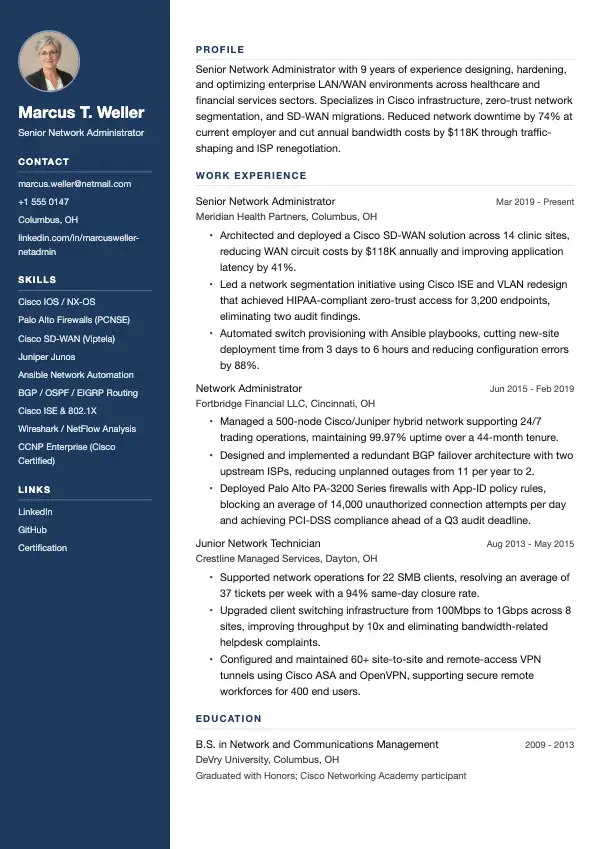
A Network Administrator resume must prove infrastructure ownership and measurable reliability to both ATS filters and hiring managers who skim quickly. This example leads with dollar and uptime figures, surfaces vendor-specific cert terms, and structures each role around outcomes rather than task lists.
Template: Harbor
Read this resume as text
Marcus T. Weller
Senior Network Administrator
marcus.weller@netmail.com · +1 555 0147 · Columbus, OH · linkedin.com/in/marcusweller-netadmin
- Profile
- Senior Network Administrator with 9 years of experience designing, hardening, and optimizing enterprise LAN/WAN environments across healthcare and financial services sectors. Specializes in Cisco infrastructure, zero-trust network segmentation, and SD-WAN migrations. Reduced network downtime by 74% at current employer and cut annual bandwidth costs by $118K through traffic-shaping and ISP renegotiation.
- Work Experience
Senior Network Administrator
Meridian Health Partners, Columbus, OH · Mar 2019 - Present
- Architected and deployed a Cisco SD-WAN solution across 14 clinic sites, reducing WAN circuit costs by $118K annually and improving application latency by 41%.
- Led a network segmentation initiative using Cisco ISE and VLAN redesign that achieved HIPAA-compliant zero-trust access for 3,200 endpoints, eliminating two audit findings.
- Automated switch provisioning with Ansible playbooks, cutting new-site deployment time from 3 days to 6 hours and reducing configuration errors by 88%.
Network Administrator
Fortbridge Financial LLC, Cincinnati, OH · Jun 2015 - Feb 2019
- Managed a 500-node Cisco/Juniper hybrid network supporting 24/7 trading operations, maintaining 99.97% uptime over a 44-month tenure.
- Designed and implemented a redundant BGP failover architecture with two upstream ISPs, reducing unplanned outages from 11 per year to 2.
- Deployed Palo Alto PA-3200 Series firewalls with App-ID policy rules, blocking an average of 14,000 unauthorized connection attempts per day and achieving PCI-DSS compliance ahead of a Q3 audit deadline.
Junior Network Technician
Crestline Managed Services, Dayton, OH · Aug 2013 - May 2015
- Supported network operations for 22 SMB clients, resolving an average of 37 tickets per week with a 94% same-day closure rate.
- Upgraded client switching infrastructure from 100Mbps to 1Gbps across 8 sites, improving throughput by 10x and eliminating bandwidth-related helpdesk complaints.
- Configured and maintained 60+ site-to-site and remote-access VPN tunnels using Cisco ASA and OpenVPN, supporting secure remote workforces for 400 end users.
- Education
B.S. in Network and Communications Management
DeVry University, Columbus, OH · 2009 - 2013
Graduated with Honors; Cisco Networking Academy participant
- Skills
- Cisco IOS / NX-OS · Palo Alto Firewalls (PCNSE) · Cisco SD-WAN (Viptela) · Juniper Junos · Ansible Network Automation · BGP / OSPF / EIGRP Routing · Cisco ISE & 802.1X · Wireshark / NetFlow Analysis · CCNP Enterprise (Cisco Certified)
- Links
- LinkedIn · GitHub · Certification
What makes this resume work
- The summary front-loads years of experience, two named verticals, and two quantified results — giving a hiring manager a reason to keep reading before they reach a single bullet point.
- Every bullet opens with a strong past-tense action verb (Architected, Designed, Automated) and closes with a concrete number, making it easy to skim and immediately understand scope and impact.
- The skills section lists full vendor-specific tool names and cert designations (PCNSE, CCNP Enterprise, Cisco ISE) exactly as recruiters type them into ATS search fields, not vague categories like 'networking' or 'security'.
- Including a GitHub profile signals that this candidate writes automation scripts and maintains documentation publicly — a differentiator that separates senior administrators from those who only operate GUIs.
Keywords that help you pass the ATS
Work the ones that fit your experience into your resume, naturally, not stuffed.
How to write a Network Administrator resume
Choose the right format for a Network Administrator resume
Use a reverse-chronological format. Hiring managers in networking expect to see your most recent role first, and applicant tracking systems (ATS) used by enterprise IT departments parse this layout most reliably. A functional or hybrid format raises red flags unless you are making a significant career pivot.
Keep the resume to one page if you have fewer than ten years of experience, two pages if you have more. Use standard section headers — Summary, Experience, Skills, Education, Certifications — so ATS software does not misread your sections. Stick to clean fonts like Calibri or Arial at 10–12pt and leave enough white space that a network manager skimming between tickets can find what they need at a glance.
- Margins: 0.5–1 inch on all sides
- File format: .docx or PDF, depending on the job posting instructions
- Section order: Summary → Skills → Experience → Certifications → Education
- Avoid tables, text boxes, and graphics — ATS systems often drop content inside them
Write a professional summary that passes the first scan
Your summary sits at the top and does one job: convince a hiring manager to keep reading. Lead with your years of experience, your core specialization (LAN/WAN, cloud networking, security, data center), and one or two measurable achievements. Skip objectives and personal mission statements.
A strong example: "Network Administrator with 7 years of experience managing Cisco and Juniper infrastructure across multi-site enterprise environments. Reduced network downtime by 34% over two years by redesigning VLAN segmentation and implementing redundant failover paths. Holds active CCNA and CompTIA Network+ certifications; currently pursuing CCNP Enterprise."
Write work-experience bullets that show impact, not just duties
Every bullet should follow an action verb → task → result structure. Quantify wherever you can: uptime percentages, ticket resolution times, number of endpoints managed, bandwidth improvements, cost savings. Recruiters and network engineering managers are technical — vague bullets like 'managed network equipment' get ignored.
Pull exact tool names from the job description and mirror them in your bullets if they genuinely match your experience. If the posting says 'Palo Alto firewalls' and you have used them, say so explicitly rather than writing 'enterprise firewalls.'
- Administered a 1,200-node Cisco Catalyst switching environment across 6 office locations, maintaining 99.97% uptime over 18 consecutive months.
- Cut mean time to resolution (MTTR) for network incidents from 4.2 hours to 1.8 hours by deploying SolarWinds NPM dashboards and standardizing escalation runbooks.
Skills and certifications recruiters and ATS systems look for
Create a dedicated Skills section and list tools and technologies by category rather than in a single undifferentiated block. ATS systems keyword-match against job descriptions, so specificity matters. Certifications belong in both a standalone Certifications section and woven into your summary — do not bury them.
Include the full certification name, issuing body, and expiration or earned date. An expired CCNA still signals foundational knowledge but flag it honestly; list it as 'CCNA (Cisco, exp. 2022)' rather than omitting it entirely.
- Routing & Switching: BGP, OSPF, EIGRP, STP, VLANs, MPLS
- Hardware: Cisco Catalyst/Nexus, Juniper EX/SRX, Aruba, Ubiquiti
- Security: Palo Alto NGFW, Cisco ASA, pfSense, 802.1X, VPN (IPsec/SSL)
- Monitoring & Management: SolarWinds NPM, PRTG, Nagios, Wireshark, Ansible
- Certifications: CompTIA Network+, CompTIA Security+, Cisco CCNA, CCNP Enterprise, Juniper JNCIA, AWS Advanced Networking Specialty
Education, licenses, and extras that strengthen your candidacy
List your highest degree first with institution, degree name, and graduation year. A bachelor's in Computer Science, Information Technology, or a related field is common but not always required — if you lack a degree, strong certifications and experience outweigh it for most mid-market employers. Do not list your GPA unless you graduated in the last two years and it is above 3.5.
Add a brief section for professional development or affiliations if space allows: membership in NANOG, participation in local Cisco user groups, or completed training on platforms like CBT Nuggets or INE signals that you stay current. If you hold a DoD 8570 baseline certification such as CompTIA Security+ and are applying to government or defense contractors, call that out explicitly — it is a hiring prerequisite for many of those roles.
Mistakes to avoid
- Listing certifications only in the Education section causes ATS systems to miss them as standalone keywords — put them in their own Certifications section.
- Using generic phrases like 'responsible for network maintenance' instead of specifying the technology stack and a measurable outcome wastes your most valuable resume real estate.
- Omitting version numbers or product lines — writing 'Cisco switches' instead of 'Cisco Catalyst 9300 series' — makes it impossible for a technical hiring manager to gauge your actual depth of experience.
- Neglecting to tailor the Skills section to each job posting means your resume may not clear ATS keyword filters even when you are fully qualified for the role.
Frequently asked questions
- Should I list every certification I have ever earned on my Network Administrator resume?
- List certifications that are current, relevant, or prestigious enough to signal foundational knowledge even if expired. An active CCNP is worth prominent placement; a CompTIA A+ from fifteen years ago with no renewal adds little for a senior network role. Prioritize depth over volume — five relevant certifications beat a wall of entry-level badges.
- How do I show experience with cloud networking if most of my background is on-premises?
- Highlight any hybrid connectivity work you have done, such as configuring AWS Direct Connect, Azure ExpressRoute, or site-to-site VPNs into cloud environments. If your hands-on cloud experience is limited, list completed training or associate-level cloud certifications like AWS Solutions Architect Associate and frame them honestly as in-progress skills rather than core competencies.
- What metrics should a Network Administrator include if their company does not track formal KPIs?
- Estimate responsibly using data you do have access to: number of managed devices, number of sites or users supported, average ticket volume, or downtime incidents per quarter. Even approximate figures like 'supported 800+ endpoints across 3 locations' are more useful to a hiring manager than no numbers at all. Just do not fabricate specifics you cannot back up in an interview.
Make it yours in minutes
Open this example in the builder, swap in your details, and export a clean, ATS-ready resume.
Once your resume is ready
More for this application
- Template style
- Software Engineer resume templates