Resume example
Bartender resume example
By the Resumade team · About our content
A strong Bartender resume must clear ATS keyword filters for certifications and operational skills while showing a hiring manager real revenue and efficiency impact. This example does both with metric-anchored bullets and a skills block built around terms recruiters actually search.
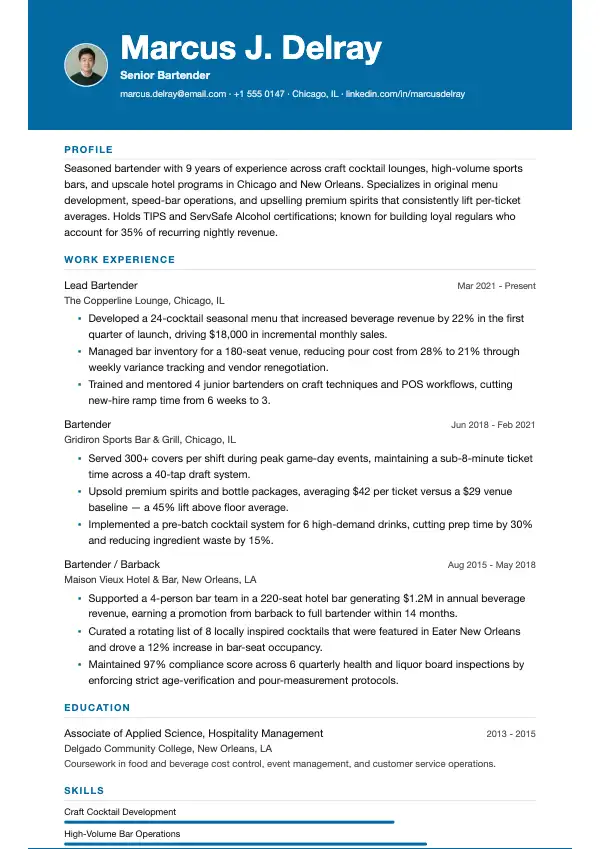
Template: Aurora
Read this resume as text
Marcus J. Delray
Senior Bartender
marcus.delray@email.com · +1 555 0147 · Chicago, IL · linkedin.com/in/marcusdelray
- Profile
- Seasoned bartender with 9 years of experience across craft cocktail lounges, high-volume sports bars, and upscale hotel programs in Chicago and New Orleans. Specializes in original menu development, speed-bar operations, and upselling premium spirits that consistently lift per-ticket averages. Holds TIPS and ServSafe Alcohol certifications; known for building loyal regulars who account for 35% of recurring nightly revenue.
- Work Experience
Lead Bartender
The Copperline Lounge, Chicago, IL · Mar 2021 - Present
- Developed a 24-cocktail seasonal menu that increased beverage revenue by 22% in the first quarter of launch, driving $18,000 in incremental monthly sales.
- Managed bar inventory for a 180-seat venue, reducing pour cost from 28% to 21% through weekly variance tracking and vendor renegotiation.
- Trained and mentored 4 junior bartenders on craft techniques and POS workflows, cutting new-hire ramp time from 6 weeks to 3.
Bartender
Gridiron Sports Bar & Grill, Chicago, IL · Jun 2018 - Feb 2021
- Served 300+ covers per shift during peak game-day events, maintaining a sub-8-minute ticket time across a 40-tap draft system.
- Upsold premium spirits and bottle packages, averaging $42 per ticket versus a $29 venue baseline — a 45% lift above floor average.
- Implemented a pre-batch cocktail system for 6 high-demand drinks, cutting prep time by 30% and reducing ingredient waste by 15%.
Bartender / Barback
Maison Vieux Hotel & Bar, New Orleans, LA · Aug 2015 - May 2018
- Supported a 4-person bar team in a 220-seat hotel bar generating $1.2M in annual beverage revenue, earning a promotion from barback to full bartender within 14 months.
- Curated a rotating list of 8 locally inspired cocktails that were featured in Eater New Orleans and drove a 12% increase in bar-seat occupancy.
- Maintained 97% compliance score across 6 quarterly health and liquor board inspections by enforcing strict age-verification and pour-measurement protocols.
- Education
Associate of Applied Science, Hospitality Management
Delgado Community College, New Orleans, LA · 2013 - 2015
Coursework in food and beverage cost control, event management, and customer service operations.
- Skills
- Craft Cocktail Development · High-Volume Bar Operations · Inventory & Pour Cost Management · TIPS Certified · ServSafe Alcohol Certified · POS Systems (Toast, Aloha, Square) · Draught Beer & Keg Management · Wine & Spirit Upselling · Pre-Batch & Mise en Place Techniques
- Links
- LinkedIn: linkedin.com/in/marcusdelray · Certification: TIPS and ServSafe Alcohol certificates (copies on request)
What makes this resume work
- Every bullet in this resume ends with a concrete number — dollar amounts, percentages, or time savings — so hiring managers can immediately quantify the candidate's impact rather than inferring it.
- The skills section front-loads certifications (TIPS, ServSafe Alcohol) and names specific POS platforms, which are the exact strings hospitality ATS systems are configured to match.
- The summary opens with seniority and years of experience in the first clause, giving both automated screeners and speed-reading managers an instant signal that this is a senior-level candidate.
- Progression from barback to bartender to lead bartender is shown across three roles, demonstrating a clear upward trajectory that validates the 'Senior Bartender' title without requiring a separate career-summary callout.
Keywords that help you pass the ATS
Work the ones that fit your experience into your resume, naturally, not stuffed.
How to write a Bartender resume
Choose the right format for a Bartender resume
Use a reverse-chronological format unless you have fewer than two years of experience, in which case a combination format lets you lead with a skills section before listing your work history. Keep the resume to one page if you have under ten years of experience; two pages is acceptable for senior bar managers or head bartenders with extensive venue history.
Stick to clean, single-column layouts that parse correctly through applicant tracking systems used by hotel groups, restaurant chains, and hospitality staffing agencies. Avoid graphics, icons, and tables — they scramble ATS parsing. Use standard section headers: Summary, Experience, Skills, Certifications, Education.
- Font: Calibri, Garamond, or Arial at 10–12pt body, 14–16pt name
- Margins: 0.75–1 inch on all sides
- File format: PDF unless the job posting specifically requests .docx
- Section order: Summary → Experience → Skills → Certifications → Education
Write a professional summary that sells your bar persona
Your summary sits at the top and replaces an objective statement. Write three to four sentences that cover your years of experience, the types of venues you've worked (craft cocktail bar, high-volume nightclub, hotel lobby bar, fine dining), your signature strengths, and one quantifiable result. Tailor it to each job — a speakeasy and a sports bar want very different things.
Example: "High-volume bartender with 7 years of experience across craft cocktail lounges and 400-seat sports bars in Chicago. Consistently ranked in the top 10% for upsell revenue at The Landmark Grille, averaging $1,200 in nightly sales. TIPS-certified and trained in classic and contemporary cocktail programs. Known for sub-4-minute ticket times during peak rushes without sacrificing guest experience."
Write work-experience bullets that show output, not just duties
Hiring managers skim dozens of resumes that all say 'mixed cocktails and provided excellent customer service.' Yours needs numbers: average nightly covers, sales figures, tip percentages, speed metrics, or inventory savings. Start every bullet with a strong action verb — Crafted, Upsold, Managed, Reduced, Trained — and follow it with a result wherever possible.
If you don't have exact figures, estimate conservatively and note the context (e.g., 'during 300-cover weekend service'). Vague bullets get skipped; specific bullets get interviews.
- Crafted and executed a rotating seasonal cocktail menu of 12 original recipes, increasing beverage attachment rate by 18% over two quarters at a 200-seat gastropub.
- Managed weekly liquor orders and inventory reconciliation for a $15,000 par-value bar, reducing pour cost from 24% to 19% within six months.
Skills and certifications recruiters and ATS systems look for
Bartending resumes need two types of skills: hard skills tied to specific tools and techniques, and soft skills that reflect service culture. List certifications by their exact official name so ATS keyword matching works correctly. Many multi-unit operators and hotel groups search applicants for TIPS or ServSafe, so spell those out where they are easy to find.
POS systems are a frequent ATS filter — name the exact platforms you've used. Aloha, Toast, Micros, and Lightspeed are the most common in US venues.
- Certifications: TIPS (Training for Intervention ProcedureS), ServSafe Alcohol, BASSET (Illinois), RBS (California), Cicerone Certified Beer Server, BarSmarts
- Techniques: classic and modern cocktail preparation, flair bartending, draft beer maintenance, wine service, cold brew and espresso programs
- POS systems: Toast, Aloha, Micros 3700, Lightspeed, Square
- Inventory tools: BevSpot, Partender, MarketMan
- Soft skills worth listing: conflict de-escalation, upselling, team training, bilingual service (if applicable)
Education, licenses, and extras that round out your resume
A college degree is rarely required for bartending roles, but list any hospitality, culinary arts, or business coursework — especially if you're targeting management-track positions. What matters more are alcohol server certifications or permits, which vary by state — some states require servers to complete approved training, often within a set period after hire. List your certification, the issuing state, and the expiration date.
Extras worth including: completion of a recognized bartending school program (New York Bartending School, ABC Bartending School), any sommelier or spirits certifications (such as WSET Level 2), and language skills if you work in tourist-heavy markets. A brief 'Additional' section can also note competition wins, featured press mentions, or guest bartending at notable events.
- List any state alcohol server certification or permit with its expiration date (e.g., 'Illinois BASSET Certification, exp. 04/2028')
- Include bartending school only if you have fewer than three years of professional experience
- WSET Level 2 or 3 is a strong differentiator for hotel bars and fine dining
Mistakes to avoid
- Listing 'responsible for making drinks' as a bullet instead of quantifying output — every bartender makes drinks; show how many, how fast, and how profitably.
- Omitting the specific POS systems you've used, which causes your resume to fail ATS keyword filters at chain restaurants and hotel groups that screen for platform experience.
- Forgetting to include state alcohol service certifications by their exact legal name, which matters most in states that require alcohol server training.
- Using a resume template with text boxes or columns that look polished in Word but export to garbled text when parsed by ATS software used by larger hospitality employers.
Frequently asked questions
- Do I need a bartending school certificate on my resume?
- Only if you have fewer than two to three years of professional bar experience and need to demonstrate foundational training. Once you have solid venue experience, school credentials carry little weight and can actually make you look junior. Replace that space with certifications like TIPS, ServSafe Alcohol, or a Cicerone credential instead.
- How do I write a bartender resume with no experience?
- Lead with transferable roles: serving, barback work, barista positions, or any customer-facing job that involved cash handling or high-volume service. Complete a TIPS or ServSafe Alcohol certification before you apply — it signals seriousness and satisfies a common employer requirement. Use a combination format that puts a skills section above your work history so your relevant abilities appear before your limited experience.
- Should I include tip income or total earnings on a bartender resume?
- Never list personal earnings on a resume. Instead, reference sales metrics you influenced — average nightly sales volume, upsell rates, or beverage revenue figures — which demonstrate your business impact without crossing into inappropriate personal financial disclosure. Phrases like 'consistently averaged $1,400 in nightly sales across 5-night shifts' are specific, professional, and relevant.
Make it yours in minutes
Open this example in the builder, swap in your details, and export a clean, ATS-ready resume.
Once your resume is ready
More for this application
- Template style
- Simple resume templates