Resume example
Restaurant Server resume example
By the Resumade team · About our content
A strong Restaurant Server resume must clear ATS keyword filters for service certifications and POS systems, then prove value to a hiring manager through revenue and guest-score metrics. This example does both.
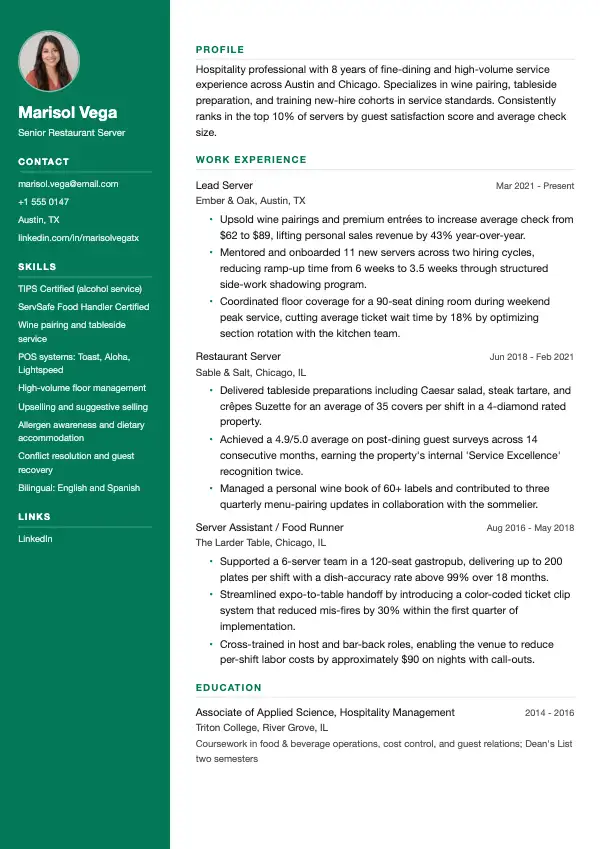
Template: Two column
Read this resume as text
Marisol Vega
Senior Restaurant Server
marisol.vega@email.com · +1 555 0147 · Austin, TX · linkedin.com/in/marisolvegatx
- Profile
- Hospitality professional with 8 years of fine-dining and high-volume service experience across Austin and Chicago. Specializes in wine pairing, tableside preparation, and training new-hire cohorts in service standards. Consistently ranks in the top 10% of servers by guest satisfaction score and average check size.
- Work Experience
Lead Server
Ember & Oak, Austin, TX · Mar 2021 - Present
- Upsold wine pairings and premium entrées to increase average check from $62 to $89, lifting personal sales revenue by 43% year-over-year.
- Mentored and onboarded 11 new servers across two hiring cycles, reducing ramp-up time from 6 weeks to 3.5 weeks through structured side-work shadowing program.
- Coordinated floor coverage for a 90-seat dining room during weekend peak service, cutting average ticket wait time by 18% by optimizing section rotation with the kitchen team.
Restaurant Server
Sable & Salt, Chicago, IL · Jun 2018 - Feb 2021
- Delivered tableside preparations including Caesar salad, steak tartare, and crêpes Suzette for an average of 35 covers per shift in a 4-diamond rated property.
- Achieved a 4.9/5.0 average on post-dining guest surveys across 14 consecutive months, earning the property's internal 'Service Excellence' recognition twice.
- Managed a personal wine book of 60+ labels and contributed to three quarterly menu-pairing updates in collaboration with the sommelier.
Server Assistant / Food Runner
The Larder Table, Chicago, IL · Aug 2016 - May 2018
- Supported a 6-server team in a 120-seat gastropub, delivering up to 200 plates per shift with a dish-accuracy rate above 99% over 18 months.
- Streamlined expo-to-table handoff by introducing a color-coded ticket clip system that reduced mis-fires by 30% within the first quarter of implementation.
- Cross-trained in host and bar-back roles, enabling the venue to reduce per-shift labor costs by approximately $90 on nights with call-outs.
- Education
Associate of Applied Science, Hospitality Management
Triton College, River Grove, IL · 2014 - 2016
Coursework in food & beverage operations, cost control, and guest relations; Dean's List two semesters
- Skills
- TIPS Certified (alcohol service) · ServSafe Food Handler Certified · Wine pairing and tableside service · POS systems: Toast, Aloha, Lightspeed · High-volume floor management · Upselling and suggestive selling · Allergen awareness and dietary accommodation · Conflict resolution and guest recovery · Bilingual: English and Spanish
- Links
What makes this resume work
- The summary leads with seniority and years of experience, then names two concrete specialisms—wine pairing and new-hire training—so a manager knows the candidate's tier before reading a single bullet.
- Every bullet anchors a task to a number: percentage lifts, dollar figures, cover counts, or time savings, making contributions verifiable rather than vague.
- Certifications (TIPS, ServSafe) and POS platforms (Toast, Aloha, Lightspeed) appear in the skills section as discrete, searchable terms that match the exact strings hospitality ATS tools scan for.
- The career arc moves logically from food runner to server to lead server, demonstrating growth within the industry and giving the hiring manager a narrative of increasing responsibility without any unexplained gaps.
Keywords that help you pass the ATS
Work the ones that fit your experience into your resume, naturally, not stuffed.
How to write a Restaurant Server resume
Choose the right format for a Restaurant Server resume
Restaurant managers read resumes fast, so yours needs to be scannable at a glance. Use a reverse-chronological format: your most recent job at the top, clean section headers, and a single page unless you have more than eight years of continuous serving experience.
Stick to standard fonts like Calibri or Arial at 10–12 pt, half-inch margins, and no tables or text boxes that break applicant tracking systems used by larger restaurant groups and hotel dining operations. Save as a PDF unless the job posting specifically requests a Word file.
- One page for fewer than eight years of experience
- Reverse-chronological order only — functional formats raise red flags in hospitality
- Clear section order: Summary → Experience → Skills → Certifications → Education
- No photos, no decorative borders, no columns that collapse in ATS parsing
Write a professional summary that gets you an interview
Your summary sits at the top and replaces an objective statement. It should name your experience level, the style of service you know (fine dining, fast-casual, banquet), and one or two hard results. Keep it to two or three sentences — hiring managers at busy restaurants spend seconds on each resume.
Example: "Attentive fine-dining server with six years of experience in high-volume à la carte and tasting-menu environments, including a 120-cover upscale steakhouse. Consistently maintain a 4.9-star guest satisfaction rating on OpenTable and hold a current TIPS certification. Known for upselling wine pairings that increased per-table beverage revenue by 18% at current employer."
Write work-experience bullets that show impact
Each bullet should follow an action verb → task → measurable result structure. Quantify wherever you can: covers per shift, average check size, guest satisfaction scores, upsell percentages, or table turn times. Generic bullets like 'took orders and delivered food' tell a hiring manager nothing they don't already assume.
Pull numbers from OpenTable reviews, Toast POS sales reports, Yelp ratings, or any shift-end sales reports your manager shared with you. Even rough estimates ('approximately,' 'averaging') are better than no numbers at all.
- Managed a five-table section averaging 40 covers per shift in a 200-seat Italian restaurant, maintaining a table turn time of under 52 minutes during peak service.
- Upsold premium cocktails and dessert courses to 35% of tables, contributing to a $12 increase in the restaurant's average check size over one quarter.
Skills and certifications recruiters and ATS look for
List hard skills and certifications in a dedicated section. Fine-dining employers and multi-unit restaurant groups often search applications for specific keywords. Include the POS systems you have used by name, your alcohol service certification, and any food handler credentials.
Soft skills like 'team player' waste space. Replace them with specific competencies: tableside preparation, wine service, allergy protocol, or banquet service. If you speak a second language fluently, list it — it is a genuine differentiator in many US markets.
- POS systems: Toast, Aloha, Micros, Square, Lightspeed
- Certifications: TIPS (Training for Intervention ProcedureS), ServSafe Food Handler, SERVSAFE Alcohol, Cicerone Certified Beer Server
- Service styles: French service, Russian service, banquet plated service, wine service, tableside flambé
- Reservation and waitlist platforms: OpenTable, Resy, Yelp Waitlist
- Skills: upselling, menu memorization, allergy and dietary restriction management, cash handling, POS end-of-day reconciliation
Education, licenses, and extras
A high school diploma or GED is the baseline for most server roles. If you attended culinary school, a hospitality program, or completed sommelier coursework through the Court of Master Sommeliers or WSET, list it — it signals genuine investment in the craft and matters to fine-dining operators.
List your state food handler card and liquor license (where required, such as in California or Illinois) with their expiration dates so managers know you are currently compliant. If you have completed any formal wine, spirits, or coffee training — even a one-day barista course — include it under a 'Professional Development' line at the bottom.
- Include expiration dates on food handler cards and alcohol certifications
- WSET Level 2 or Court of Master Sommeliers Introductory Certificate are strong differentiators for upscale roles
- Relevant volunteer experience (catering events, charity galas) counts as real service experience
Mistakes to avoid
- Listing duties instead of results — writing 'responsible for taking orders' instead of quantifying covers served, upsell rates, or guest satisfaction scores makes your resume indistinguishable from every other applicant.
- Omitting POS system names — many restaurant groups search applicants for specific platforms like Toast or Micros, and a resume without them is easy to pass over.
- Letting alcohol certifications expire on the resume — listing a TIPS or ServSafe Alcohol credential without a current date signals to employers that you may not be legally permitted to serve, which is an immediate disqualifier.
- Using a one-size-fits-all resume for every application — a fast-casual burger spot and a Michelin-recognized tasting-menu restaurant want different things, so failing to adjust your summary and skills section for each role makes your resume read as generic to both.
Frequently asked questions
- Should a restaurant server resume be one page?
- Yes, in almost every case. Hiring managers in food service make fast decisions and rarely read past the first page for hourly roles. Keep it to one page unless you have more than eight years of continuous, relevant experience across multiple notable establishments.
- Do I need a cover letter for a server job?
- For corporate restaurant groups, hotel dining rooms, or fine-dining destinations, a short cover letter helps you stand out and lets you explain a gap or a shift from a different industry. For independent casual spots, it is rarely expected but never hurts. Keep it to three short paragraphs and mirror the tone of the restaurant's brand.
- How do I write a server resume with no experience?
- Lead with any customer-facing work — retail, barista, camp counselor, food runner, or busser roles all demonstrate the core skills restaurants hire for. Highlight your food handler certification, any TIPS training, and your availability, since flexibility on nights and weekends is a genuine selling point for entry-level candidates.
Make it yours in minutes
Open this example in the builder, swap in your details, and export a clean, ATS-ready resume.
Once your resume is ready
More for this application
- Template style
- Simple resume templates