Resume example
Biomedical Engineer resume example
By the Resumade team · About our content
A Biomedical Engineer resume must satisfy ATS filters tuned for regulatory and domain terms while proving to a hiring manager that you move devices from concept to clearance. This example does both: it leads with quantified V&V and FDA outcomes and embeds the exact ISO and CFR references recruiters search.
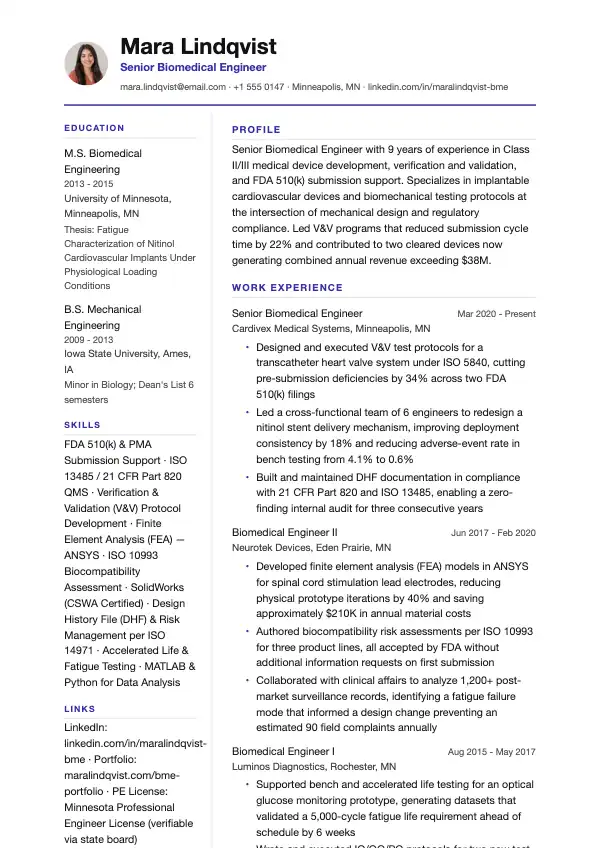
Template: Quadrant
Read this resume as text
Mara Lindqvist
Senior Biomedical Engineer
mara.lindqvist@email.com · +1 555 0147 · Minneapolis, MN · linkedin.com/in/maralindqvist-bme
- Profile
- Senior Biomedical Engineer with 9 years of experience in Class II/III medical device development, verification and validation, and FDA 510(k) submission support. Specializes in implantable cardiovascular devices and biomechanical testing protocols at the intersection of mechanical design and regulatory compliance. Led V&V programs that reduced submission cycle time by 22% and contributed to two cleared devices now generating combined annual revenue exceeding $38M.
- Work Experience
Senior Biomedical Engineer
Cardivex Medical Systems, Minneapolis, MN · Mar 2020 - Present
- Designed and executed V&V test protocols for a transcatheter heart valve system under ISO 5840, cutting pre-submission deficiencies by 34% across two FDA 510(k) filings
- Led a cross-functional team of 6 engineers to redesign a nitinol stent delivery mechanism, improving deployment consistency by 18% and reducing adverse-event rate in bench testing from 4.1% to 0.6%
- Built and maintained DHF documentation in compliance with 21 CFR Part 820 and ISO 13485, enabling a zero-finding internal audit for three consecutive years
Biomedical Engineer II
Neurotek Devices, Eden Prairie, MN · Jun 2017 - Feb 2020
- Developed finite element analysis (FEA) models in ANSYS for spinal cord stimulation lead electrodes, reducing physical prototype iterations by 40% and saving approximately $210K in annual material costs
- Authored biocompatibility risk assessments per ISO 10993 for three product lines, all accepted by FDA without additional information requests on first submission
- Collaborated with clinical affairs to analyze 1,200+ post-market surveillance records, identifying a fatigue failure mode that informed a design change preventing an estimated 90 field complaints annually
Biomedical Engineer I
Luminos Diagnostics, Rochester, MN · Aug 2015 - May 2017
- Supported bench and accelerated life testing for an optical glucose monitoring prototype, generating datasets that validated a 5,000-cycle fatigue life requirement ahead of schedule by 6 weeks
- Wrote and executed IQ/OQ/PQ protocols for two new test fixtures, achieving measurement system analysis (MSA) Gage R&R results below 10% for both systems
- Coordinated with contract manufacturers to resolve 14 open CAPAs within a single quarter, reducing backlog by 73% and restoring on-time delivery to 96%
- Education
M.S. Biomedical Engineering
University of Minnesota, Minneapolis, MN · 2013 - 2015
Thesis: Fatigue Characterization of Nitinol Cardiovascular Implants Under Physiological Loading Conditions
B.S. Mechanical Engineering
Iowa State University, Ames, IA · 2009 - 2013
Minor in Biology; Dean's List 6 semesters
- Skills
- FDA 510(k) & PMA Submission Support · ISO 13485 / 21 CFR Part 820 QMS · Verification & Validation (V&V) Protocol Development · Finite Element Analysis (FEA) — ANSYS · ISO 10993 Biocompatibility Assessment · SolidWorks (CSWA Certified) · Design History File (DHF) & Risk Management per ISO 14971 · Accelerated Life & Fatigue Testing · MATLAB & Python for Data Analysis
- Links
- LinkedIn: linkedin.com/in/maralindqvist-bme · Portfolio: maralindqvist.com/bme-portfolio · PE License: Minnesota Professional Engineer License (verifiable via state board)
What makes this resume work
- Every bullet opens with a strong action verb tied to a specific engineering output — protocol, model, assessment, dataset — so hiring managers immediately see deliverables rather than vague responsibilities.
- Regulatory standards (ISO 13485, ISO 10993, ISO 14971, 21 CFR Part 820) appear verbatim in context, matching the exact strings MedTech ATS systems and keyword-searching recruiters use to filter candidates.
- The summary front-loads seniority, device class experience, and two headline business results within three sentences, so a hiring manager skimming the summary has a reason to keep going.
- Education notes are used strategically — the M.S. thesis title signals deep nitinol and cardiovascular expertise without requiring a separate skills section entry, reinforcing the candidate's core specialization.
Keywords that help you pass the ATS
Work the ones that fit your experience into your resume, naturally, not stuffed.
How to write a Biomedical Engineer resume
Choose the right format for a Biomedical Engineer resume
Use a reverse-chronological format unless you are a new graduate or are making a significant pivot into a new biomedical specialty. Hiring managers at medical device companies, hospital systems, and research institutions expect to see your most recent role first, followed by a clear progression of increasing responsibility.
Keep your resume to one page if you have fewer than ten years of experience; two pages are acceptable for senior engineers with substantial project portfolios or publications. Use clean section headers, consistent 10–12pt font, and at least 0.5-inch margins. Avoid tables and text boxes — many applicant tracking systems used by companies like Medtronic, Stryker, and BD parse plain text only.
- One page for 0–9 years of experience; two pages maximum for senior roles
- Reverse-chronological order as the default structure
- No graphics, tables, or columns that break ATS parsing
- File format: PDF unless the job posting explicitly requests a Word document
Write a professional summary that speaks to the hiring manager
Your summary sits directly below your contact information and should be three to four sentences that connect your specific engineering background to the role you are targeting. Name the device category, regulatory environment, or clinical application you know best — vague summaries that could apply to any engineer get skipped.
Example: "Biomedical Engineer with 6 years of experience in Class II and Class III medical device development, specializing in orthopedic implant design and finite element analysis using ANSYS and SolidWorks. Experienced in 510(k) submission preparation, design verification and validation (V&V), and FDA 21 CFR Part 820 compliance. Reduced design iteration cycles by 30% at previous employer through structured DFMEA integration. Seeking to bring cross-functional R&D expertise to an implantable device team focused on accelerating regulatory clearance timelines."
Write work-experience bullets that show measurable impact
Each bullet should follow an action-verb + task + outcome structure. Quantify wherever possible — cycle times, cost reductions, test pass rates, submission timelines, and patient or device volume all count. Avoid vague phrases like 'assisted with' or 'responsible for'; own the work with direct verbs such as designed, validated, led, reduced, or submitted.
Biomedical engineering work often involves cross-functional collaboration, so name the teams (regulatory affairs, clinical, manufacturing) and the standards (ISO 13485, IEC 60601-1) you worked within. This signals domain fluency to both ATS and technical reviewers.
- Designed and validated a catheter tip assembly using SolidWorks and ANSYS, reducing prototype-to-test cycle time by 25% and achieving first-pass V&V success across all 18 design inputs.
- Led DFMEA and risk management documentation per ISO 14971 for a Class II cardiac monitoring device, contributing to a 510(k) clearance obtained 6 weeks ahead of the projected regulatory timeline.
List the skills and certifications recruiters and ATS systems look for
Create a dedicated skills section that includes both technical tools and regulatory competencies. ATS systems at large medical device OEMs are often configured to filter on specific terms, so match the language in the job posting closely. Separate hard skills from soft skills — recruiters scan the hard skills list first.
Certifications that add real weight include Certified Biomedical Equipment Technician (CBET) for clinical engineering roles, Six Sigma Green or Black Belt for manufacturing-adjacent positions, and RAC (Regulatory Affairs Certification) if you work closely with submissions. PMP is valued for senior project-lead roles.
- CAD and simulation: SolidWorks, CATIA, ANSYS, COMSOL Multiphysics
- Regulatory and quality: FDA 21 CFR Part 820, ISO 13485, ISO 14971, IEC 60601-1, 510(k) and PMA process
- Testing and data: MATLAB, LabVIEW, statistical process control (SPC), design of experiments (DOE)
- Certifications: CBET, RAC, Six Sigma Green Belt or Black Belt, PMP
- Clinical environments: EMR systems, DICOM, PACS (relevant for imaging or clinical engineering tracks)
Education, licenses, and extras that strengthen your candidacy
List your highest degree first: degree name, institution, graduation year. A B.S. or M.S. in Biomedical Engineering, Mechanical Engineering, Electrical Engineering, or a related field is standard. If your GPA was 3.5 or above and you graduated within the last three years, include it. For Ph.D. holders targeting industry roles, list your dissertation topic in one line — it signals domain depth without requiring a full academic CV.
Add a separate section for publications, patents, or conference presentations if you have them — even one peer-reviewed publication or a filed patent strengthens a research-track resume significantly. If you have clinical or hospital internship experience, list it under experience rather than burying it under education. Professional memberships such as IEEE EMBS or BMES are worth a single line at the bottom.
- Include thesis or dissertation title for graduate degrees when it is directly relevant to the target role
- List patents with patent number or 'patent pending' status
- BMES, IEEE Engineering in Medicine and Biology Society (EMBS) memberships signal professional engagement
Mistakes to avoid
- Using generic engineering language like 'strong problem-solving skills' instead of naming the specific device class, standard, or tool you applied.
- Omitting regulatory experience entirely when you have contributed to 510(k) submissions, DHFs, or ISO 13485 audits — even in a supporting role — because this is often a hard filter in job requirements.
- Listing MATLAB or SolidWorks under skills without demonstrating how you used them in your bullet points, which makes the claim unverifiable to a technical reviewer.
- Applying a one-size-fits-all resume to both clinical engineering roles (which prioritize CBET, CMMS platforms, and equipment management) and R&D roles (which prioritize V&V, DFMEA, and design tools) without tailoring the emphasis for each track.
Frequently asked questions
- Do I need a master's degree to get a biomedical engineering job in industry?
- No — most entry-level and mid-level roles at medical device companies require only a B.S. in biomedical, mechanical, or electrical engineering. A master's degree is more commonly expected for research-focused positions or roles at academic medical centers. Relevant internship experience, co-ops, and certifications often carry more weight than an advanced degree for manufacturing, quality, or field engineering tracks.
- How do I write a biomedical engineer resume with no experience?
- Lead with a strong summary that highlights your engineering coursework, capstone project, and any lab or internship exposure to medical devices or clinical environments. Create project bullets that follow the same action-verb and outcome format as work experience, and include the tools you used — SolidWorks, MATLAB, LabVIEW, or benchtop testing equipment. If you completed any FDA or ISO training through coursework or online programs, list it in your skills section.
- Should a biomedical engineer include publications on a resume for an industry job?
- Yes, but keep it concise — list up to three most relevant publications in a short section rather than a full academic bibliography. For industry roles, prioritize publications that demonstrate applied research, device testing, or clinical outcomes over purely theoretical work. If you have more than three, note 'additional publications available upon request' and maintain a full list on your LinkedIn profile.
Make it yours in minutes
Open this example in the builder, swap in your details, and export a clean, ATS-ready resume.
Once your resume is ready
More for this application
- Template style
- ATS-Friendly resume templates