Resume example
Business Analyst resume example
By the Resumade team · About our content
A Business Analyst resume must clear ATS keyword filters and immediately show hiring managers the scope and dollar impact of your analytical work. This example does both by leading with a quantified summary and structuring every bullet around a measurable outcome.
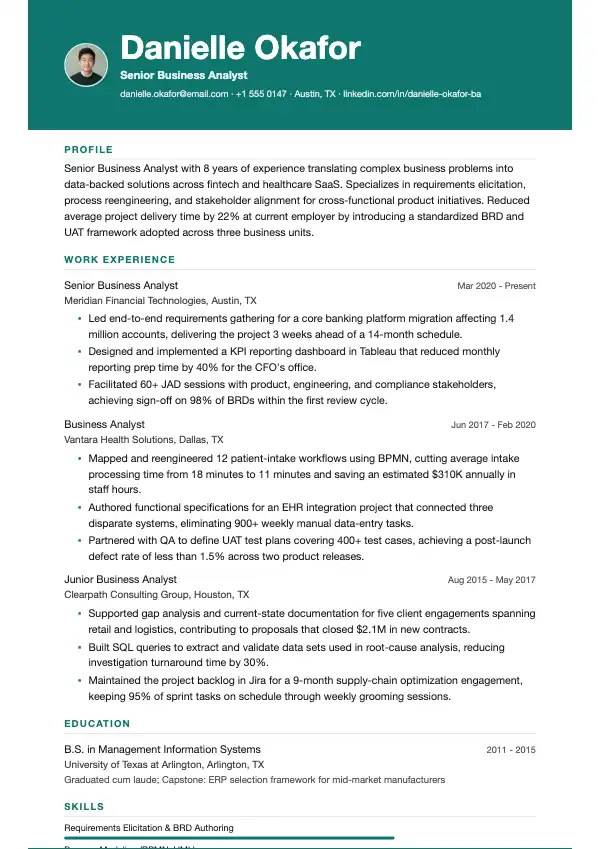
Template: Aurora
Read this resume as text
Danielle Okafor
Senior Business Analyst
danielle.okafor@email.com · +1 555 0147 · Austin, TX · linkedin.com/in/danielle-okafor-ba
- Profile
- Senior Business Analyst with 8 years of experience translating complex business problems into data-backed solutions across fintech and healthcare SaaS. Specializes in requirements elicitation, process reengineering, and stakeholder alignment for cross-functional product initiatives. Reduced average project delivery time by 22% at current employer by introducing a standardized BRD and UAT framework adopted across three business units.
- Work Experience
Senior Business Analyst
Meridian Financial Technologies, Austin, TX · Mar 2020 - Present
- Led end-to-end requirements gathering for a core banking platform migration affecting 1.4 million accounts, delivering the project 3 weeks ahead of a 14-month schedule.
- Designed and implemented a KPI reporting dashboard in Tableau that reduced monthly reporting prep time by 40% for the CFO's office.
- Facilitated 60+ JAD sessions with product, engineering, and compliance stakeholders, achieving sign-off on 98% of BRDs within the first review cycle.
Business Analyst
Vantara Health Solutions, Dallas, TX · Jun 2017 - Feb 2020
- Mapped and reengineered 12 patient-intake workflows using BPMN, cutting average intake processing time from 18 minutes to 11 minutes and saving an estimated $310K annually in staff hours.
- Authored functional specifications for an EHR integration project that connected three disparate systems, eliminating 900+ weekly manual data-entry tasks.
- Partnered with QA to define UAT test plans covering 400+ test cases, achieving a post-launch defect rate of less than 1.5% across two product releases.
Junior Business Analyst
Clearpath Consulting Group, Houston, TX · Aug 2015 - May 2017
- Supported gap analysis and current-state documentation for five client engagements spanning retail and logistics, contributing to proposals that closed $2.1M in new contracts.
- Built SQL queries to extract and validate data sets used in root-cause analysis, reducing investigation turnaround time by 30%.
- Maintained the project backlog in Jira for a 9-month supply-chain optimization engagement, keeping 95% of sprint tasks on schedule through weekly grooming sessions.
- Education
B.S. in Management Information Systems
University of Texas at Arlington, Arlington, TX · 2011 - 2015
Graduated cum laude; Capstone: ERP selection framework for mid-market manufacturers
- Skills
- Requirements Elicitation & BRD Authoring · Process Modeling (BPMN, UML) · SQL (PostgreSQL, SQL Server) · Tableau & Power BI · Agile / Scrum (Certified Scrum Master – CSM) · CBAP (Certified Business Analysis Professional) · Jira & Confluence · Stakeholder Management & JAD Facilitation · UAT Planning & Execution
- Links
- LinkedIn: linkedin.com/in/danielle-okafor-ba · Portfolio: danielle-okafor.notion.site/ba-portfolio
What makes this resume work
- The summary names seniority, years, and two specific domains (fintech and healthcare SaaS) in the first sentence, giving recruiters instant context without vague adjectives.
- Every experience bullet opens with a strong action verb and closes with a concrete number — percentages, dollar savings, or counts — so the value delivered is never ambiguous.
- Skills are listed as full phrases recruiters actually search ('Requirements Elicitation & BRD Authoring') rather than single words, improving both ATS match rate and scannability.
- Certifications (CBAP, CSM) appear inside the Skills section rather than a separate block, keeping the one-page layout tight while still surfacing credential keywords where ATS parsers expect them.
Keywords that help you pass the ATS
Work the ones that fit your experience into your resume, naturally, not stuffed.
How to write a Business Analyst resume
Choose the right format for a Business Analyst resume
Use a reverse-chronological format for almost every BA role. Hiring managers and applicant tracking systems both expect to see your most recent position first, and BA hiring is experience-heavy — recruiters want to know what industries you've worked in, what methodologies you've applied, and how long you stayed in each role before they read anything else.
Keep the resume to one page if you have fewer than eight years of experience; two pages is acceptable beyond that. Use clean section headers, consistent date formatting (Month YYYY), and at least 0.6-inch margins. Avoid tables and text boxes — many ATS platforms misread them and drop your content entirely.
- Standard section order: Contact Info → Summary → Work Experience → Skills → Education → Certifications
- Font: Calibri, Arial, or Georgia at 10–12 pt body text
- File format: a text-based PDF works for ATS uploads and email alike; switch to .docx only when a posting asks for Word
- Avoid headers/footers for contact info — some parsers skip them
Write a professional summary that frames your BA specialty
Your summary is three to four lines that tell a recruiter your domain focus (finance, healthcare, supply chain, SaaS), your methodology strengths (Agile, waterfall, hybrid), and one or two standout results. Generic phrases like 'results-driven professional' waste the space. Be specific about the type of BA work you do — requirements gathering, process improvement, data analysis, or product ownership — because these attract very different roles.
Example: "Business Analyst with 6 years in financial services, specializing in regulatory reporting and data pipeline requirements. Experienced in Agile/Scrum environments using JIRA and Confluence; facilitated requirements workshops that reduced rework by 30% on a $4M core-banking migration. CBAP-certified."
Write work-experience bullets that prove impact with numbers
Every bullet should follow an action → method → result structure. BAs often undersell themselves by listing tasks ('attended sprint ceremonies') instead of outcomes. Quantify wherever you can: cost saved, cycle time reduced, stakeholder count, project budget, defect rate, or adoption percentage. If you facilitated requirements, say how many stakeholders were involved and what the project was worth. If you built reports, say how many users relied on them.
Pull metrics from project trackers, post-mortems, or your own notes — even rough figures are better than none.
- Elicited and documented 140+ functional and non-functional requirements for a Salesforce CRM implementation serving 300 sales reps, cutting UAT defects by 42% compared to the prior release cycle.
- Modeled current-state and future-state processes in Lucidchart for an accounts-payable automation initiative, identifying $1.2M in annual savings that were approved by the CFO within one sprint review.
Skills and certifications recruiters and ATS systems look for
List hard skills in a dedicated Skills section so ATS can parse them cleanly. Separate tools from methodologies from soft skills — recruiters scan this section at a glance. Certifications belong here or in a standalone Certifications section immediately below Education; spell them out exactly as the issuing body does, because ATS systems match on exact strings.
Prioritize skills that appear in the job posting. If the role mentions SQL, Tableau, and SAP, those words need to be on your resume verbatim.
- Methodologies: Agile/Scrum, Kanban, Waterfall, SAFe, Six Sigma (DMAIC)
- Tools: JIRA, Confluence, Microsoft Visio, Lucidchart, Balsamiq, Azure DevOps, Miro
- Data & reporting: SQL, Tableau, Power BI, Excel (pivot tables, Power Query)
- Certifications: CBAP (IIBA), CCBA (IIBA), PMI-PBA, Certified Scrum Product Owner (CSPO), ITIL 4 Foundation
- Domain keywords: gap analysis, use cases, user stories, BRD, FRD, process mapping, stakeholder management, UAT
Education, licenses, and extras that strengthen a BA resume
List your highest degree first: degree name, major, institution, graduation year. GPA is optional and only worth including if it's above 3.5 and you graduated within the last three years. For BA roles, degrees in Business Administration, Information Systems, Computer Science, Finance, or Industrial Engineering are the most directly relevant, but any bachelor's degree is acceptable when paired with strong experience and certifications.
Add a brief Additional section for things that differentiate you: industry-specific training (HIPAA compliance, Basel III, FINRA), languages, or published process-improvement case studies. Volunteer work is worth including only if it involved analytical or project work — for example, serving as a data analyst for a nonprofit's fundraising operations.
- List certifications with issuing body and year earned (e.g., 'CBAP — IIBA, 2022')
- Include in-progress certifications with expected date: 'PMI-PBA (expected March 2027)'
- Omit high school once you have a college degree
Mistakes to avoid
- Writing requirement-gathering bullets as passive tasks ('was responsible for requirements') instead of active outcomes with stakeholder counts, project values, or defect-reduction percentages.
- Listing every tool you've ever touched rather than matching your skills section to the specific stack mentioned in the job description, which dilutes ATS keyword relevance.
- Leaving certifications like CBAP or PMI-PBA off the resume header or summary, where they signal seniority immediately, and burying them only at the bottom of the document.
- Using a one-size-fits-all resume across IT BA, business process BA, and data analyst roles, when each requires different keyword emphasis and a reframed summary to pass initial screening.
Frequently asked questions
- Should a Business Analyst resume include a portfolio or work samples?
- Yes, if you have shareable artifacts — process maps, sanitized BRDs, dashboard screenshots, or a GitHub repo with SQL scripts — link to a portfolio site or a LinkedIn featured section. Add the URL next to your name in the header. Many hiring managers for senior BA roles will look at samples before scheduling a screen.
- How do I write a BA resume if I'm transitioning from a different role?
- Lead with a summary that explicitly names the transfer — for example, 'Project Coordinator transitioning to Business Analyst with 4 years of requirements documentation and stakeholder facilitation experience.' Then reframe your existing bullets to highlight analytical tasks: data gathering, process documentation, gap analysis, or report building. Earning a CCBA or completing a SQL/Tableau course before you apply strengthens the case significantly.
- What's the difference between a Business Analyst resume and a Data Analyst resume?
- A BA resume emphasizes requirements elicitation, process modeling, stakeholder communication, and project delivery artifacts like BRDs and user stories. A Data Analyst resume centers on statistical analysis, data wrangling, visualization, and tools like Python, R, or advanced SQL. If you do both, tailor each version to the role: lead with process and documentation for BA jobs, and lead with data manipulation and insight generation for DA jobs.
Make it yours in minutes
Open this example in the builder, swap in your details, and export a clean, ATS-ready resume.
Once your resume is ready
More for this application
- Template style
- Creative resume templates