Resume example
Bookkeeper resume example
By the Resumade team · About our content
A strong Bookkeeper resume must clear ATS keyword filters on accounting tools and processes, then give hiring managers quantified proof of accuracy and efficiency. This example does both by leading every bullet with an action verb and a hard number.
Template: Bold
Read this resume as text
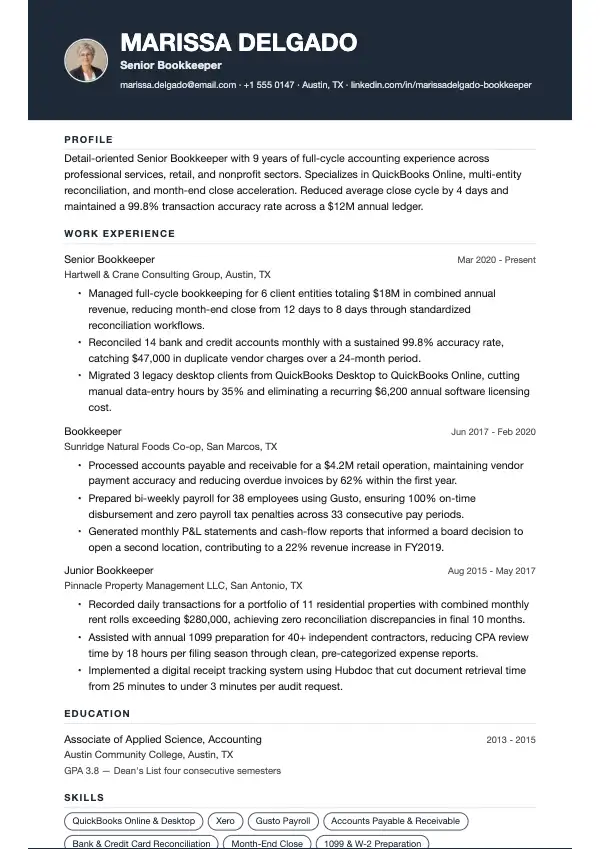
Marissa Delgado
Senior Bookkeeper
marissa.delgado@email.com · +1 555 0147 · Austin, TX · linkedin.com/in/marissadelgado-bookkeeper
- Profile
- Detail-oriented Senior Bookkeeper with 9 years of full-cycle accounting experience across professional services, retail, and nonprofit sectors. Specializes in QuickBooks Online, multi-entity reconciliation, and month-end close acceleration. Reduced average close cycle by 4 days and maintained a 99.8% transaction accuracy rate across a $12M annual ledger.
- Work Experience
Senior Bookkeeper
Hartwell & Crane Consulting Group, Austin, TX · Mar 2020 - Present
- Managed full-cycle bookkeeping for 6 client entities totaling $18M in combined annual revenue, reducing month-end close from 12 days to 8 days through standardized reconciliation workflows.
- Reconciled 14 bank and credit accounts monthly with a sustained 99.8% accuracy rate, catching $47,000 in duplicate vendor charges over a 24-month period.
- Migrated 3 legacy desktop clients from QuickBooks Desktop to QuickBooks Online, cutting manual data-entry hours by 35% and eliminating a recurring $6,200 annual software licensing cost.
Bookkeeper
Sunridge Natural Foods Co-op, San Marcos, TX · Jun 2017 - Feb 2020
- Processed accounts payable and receivable for a $4.2M retail operation, maintaining vendor payment accuracy and reducing overdue invoices by 62% within the first year.
- Prepared bi-weekly payroll for 38 employees using Gusto, ensuring 100% on-time disbursement and zero payroll tax penalties across 33 consecutive pay periods.
- Generated monthly P&L statements and cash-flow reports that informed a board decision to open a second location, contributing to a 22% revenue increase in FY2019.
Junior Bookkeeper
Pinnacle Property Management LLC, San Antonio, TX · Aug 2015 - May 2017
- Recorded daily transactions for a portfolio of 11 residential properties with combined monthly rent rolls exceeding $280,000, achieving zero reconciliation discrepancies in final 10 months.
- Assisted with annual 1099 preparation for 40+ independent contractors, reducing CPA review time by 18 hours per filing season through clean, pre-categorized expense reports.
- Implemented a digital receipt tracking system using Hubdoc that cut document retrieval time from 25 minutes to under 3 minutes per audit request.
- Education
Associate of Applied Science, Accounting
Austin Community College, Austin, TX · 2013 - 2015
GPA 3.8 — Dean's List four consecutive semesters
- Skills
- QuickBooks Online & Desktop · Xero · Gusto Payroll · Accounts Payable & Receivable · Bank & Credit Card Reconciliation · Month-End Close · 1099 & W-2 Preparation · Microsoft Excel (PivotTables, VLOOKUP) · Certified Bookkeeper (AIPB)
- Links
- LinkedIn: linkedin.com/in/marissadelgado-bookkeeper · Certification: AIPB Certified Bookkeeper, 2018 (verifiable via AIPB)
What makes this resume work
- The summary front-loads seniority, domain breadth, and two headline metrics — a 4-day close reduction and 99.8% accuracy — so a hiring manager grasps value before reading a single bullet.
- Skills are listed as discrete, searchable terms (e.g., 'Bank & Credit Card Reconciliation,' '1099 & W-2 Preparation') rather than vague categories, which directly matches the phrases recruiters type into ATS search fields.
- Every experience bullet contains at least one dollar figure, percentage, or count, making impact concrete and comparable across candidates rather than relying on subjective descriptors.
- The career arc from Junior Bookkeeper to Senior Bookkeeper across three distinct industries — property management, retail co-op, and consulting — signals both upward progression and versatile adaptability without requiring a separate career-objective statement.
Keywords that help you pass the ATS
Work the ones that fit your experience into your resume, naturally, not stuffed.
How to write a Bookkeeper resume
Choose the right format for a Bookkeeper resume
Use a reverse-chronological format unless you are making a career pivot or have fewer than two years of experience. Bookkeeping is a field where employers want to see a steady track record of handling accounts, so leading with your most recent role signals stability and growth.
Keep your resume to one page if you have under ten years of experience; two pages are acceptable for senior bookkeepers managing multiple entities or large payroll runs. Use clean section headers, consistent date formatting (MM/YYYY), and at least 0.75-inch margins. Avoid tables and text boxes — many applicant tracking systems used by accounting firms and mid-size businesses parse these incorrectly.
- Standard sections: Contact info, Summary, Work Experience, Skills, Education, Certifications
- Font: 10–12 pt in Arial, Calibri, or Georgia — nothing decorative
- File format: Save and submit as a PDF unless the job posting specifies .docx
- No headshot, no personal pronouns, no 'References available upon request'
Write a professional summary that earns a second look
Your summary sits at the top and does one job: convince a hiring manager to keep reading. In three to four sentences, state your years of experience, the industries you've worked in, the software you know cold, and one or two measurable contributions. Skip objective statements and vague claims like 'detail-oriented professional.'
Here is a strong example for a mid-level bookkeeper: "Full-charge bookkeeper with 7 years of experience supporting construction and professional-services firms with up to $12M in annual revenue. Proficient in QuickBooks Online, Xero, and ADP Workforce Now. Managed AP/AR, monthly close, and sales-tax filings across three states. Reduced month-end close time from 10 days to 6 by standardizing reconciliation workflows."
Write work-experience bullets that show impact, not just duties
Bookkeeping resumes often read like job descriptions — 'Responsible for accounts payable' tells an employer nothing useful. Start every bullet with a past-tense action verb and attach a number wherever you can: dollar volumes, number of accounts, transaction counts, error rates, or time saved. If you maintained confidentiality over payroll for 85 employees, say so.
Quantify the scope of each role: how many vendors, what revenue size company, how many bank accounts you reconciled monthly. Hiring managers at small businesses and CPA firms use these details to judge whether your experience matches their complexity.
- Processed 300+ vendor invoices per month in QuickBooks Desktop, maintaining a 99.6% on-time payment rate and capturing $18,000 annually in early-pay discounts.
- Reconciled 14 bank and credit-card accounts monthly for a $8M retail client, cutting unresolved variances from an average of $4,200 to under $300 within the first quarter.
Skills and certifications recruiters and ATS systems look for
Bookkeeping job postings are highly keyword-driven. Pull the exact software names and task terminology from each posting and mirror them in your skills section. Generic terms like 'Microsoft Office' add little; 'Excel pivot tables' and 'VLOOKUP' are more specific and more searchable.
Certifications matter more than a degree in this field. The AIPB Certified Bookkeeper (CB) credential and the NACPB Bookkeeping Certification are the two most recognized in the US. If you work with small businesses, a QuickBooks ProAdvisor certification is widely respected and free to pursue through Intuit.
- Software: QuickBooks Online/Desktop, Xero, FreshBooks, Sage 50, Wave, ADP, Gusto, Bill.com, Expensify
- Core tasks to list: accounts payable, accounts receivable, bank reconciliation, payroll processing, month-end close, general ledger, 1099 preparation, sales tax filing, job costing
- Certifications: AIPB Certified Bookkeeper (CB), NACPB Bookkeeping Certification, QuickBooks ProAdvisor, Xero Advisor Certified
- Soft skills worth including: multi-entity experience, confidentiality with sensitive data, high-volume transaction management
Education, licenses, and extras that strengthen your candidacy
A bachelor's degree is not required to be hired as a bookkeeper, and many employers prefer demonstrated hands-on experience over a four-year degree. List your highest level of education — whether that is a high school diploma, an associate's in accounting, or a bachelor's — along with the institution and graduation year. If you completed relevant coursework (cost accounting, payroll administration, tax fundamentals), list it under the degree.
Add a separate Certifications section if you hold the CB or NACPB credential so it is not buried under Education. If you are a notary, bilingual, or experienced with industry-specific software like Foundation for construction or Buildium for property management, note it — these details differentiate you in niche markets.
- Associate of Applied Science in Accounting — community college credentials are fully respected in this field
- Continuing education through AIPB or NACPB shows commitment to current standards
- Industry-specific software (e.g., Clio for legal, Timberline/Sage 300 for construction) belongs in both Skills and Education extras
Mistakes to avoid
- Listing QuickBooks as a skill without specifying the version (Online vs. Desktop) or your depth of use, since employers treat these as distinct products with different workflows.
- Using vague duty-based language like 'handled accounts payable' instead of quantifying invoice volume, vendor count, or payment accuracy rates.
- Omitting the revenue size or entity count of employers you have supported, which makes it impossible for a hiring manager to gauge whether your experience matches their complexity.
- Leaving certifications like QuickBooks ProAdvisor or the AIPB Certified Bookkeeper credential buried inside a paragraph instead of calling them out in a dedicated, scannable section.
Frequently asked questions
- Do I need a degree to get a bookkeeping job?
- No — most bookkeeping positions in the US prioritize software proficiency and verifiable experience over a four-year degree. An associate's degree in accounting or a recognized certification like the AIPB Certified Bookkeeper credential can carry equal or greater weight. Focus on demonstrating measurable results and listing the specific tools you have used.
- Should I include my QuickBooks ProAdvisor certification on my resume?
- Yes, always. The QuickBooks ProAdvisor certification is widely recognized by small-business owners and CPA firms and signals that you have been tested on the platform, not just self-taught. List it in a dedicated Certifications section with the certification level (Core, Advanced, or Payroll) and the year you earned or last renewed it.
- How do I write a bookkeeper resume if I am self-employed or freelance?
- Treat your freelance practice as a business entry in your work-experience section, using a title like 'Freelance Bookkeeper' or 'Independent Bookkeeping Consultant' with your operating dates. Describe the types and sizes of clients you served — industries, revenue ranges, number of accounts — without naming clients if confidentiality applies. Quantify your work the same way you would for a salaried role.
Make it yours in minutes
Open this example in the builder, swap in your details, and export a clean, ATS-ready resume.
Once your resume is ready
More for this application
- Template style
- Professional resume templates