Resume example
Financial Analyst resume example
By the Resumade team · About our content
A Senior Financial Analyst resume must clear ATS keyword filters for modeling tools and finance methodologies, then prove ROI to a hiring manager at first glance. This example does both by leading with a CFA credential, stacking quantified bullets, and grouping skills around terms recruiters actually search.
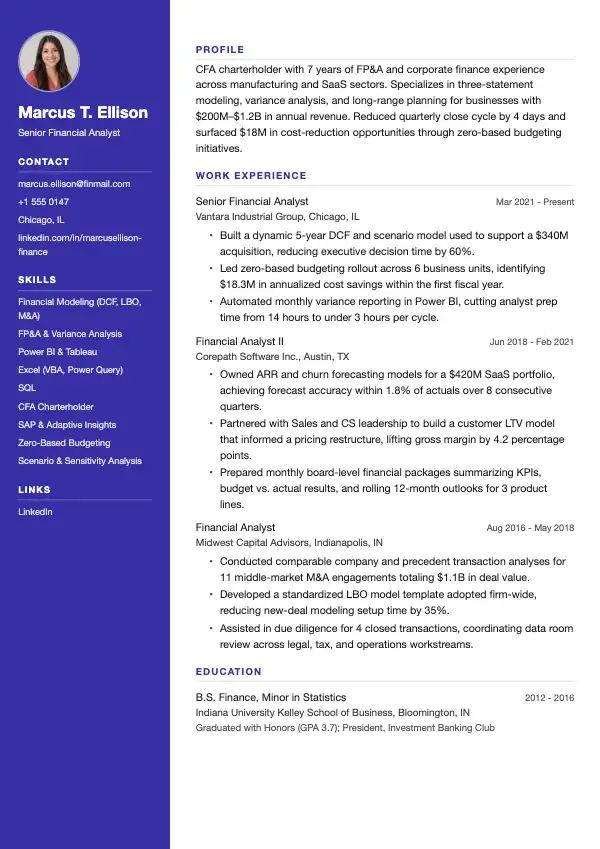
Template: Two column
Read this resume as text
Marcus T. Ellison
Senior Financial Analyst
marcus.ellison@finmail.com · +1 555 0147 · Chicago, IL · linkedin.com/in/marcusellison-finance
- Profile
- CFA charterholder with 7 years of FP&A and corporate finance experience across manufacturing and SaaS sectors. Specializes in three-statement modeling, variance analysis, and long-range planning for businesses with $200M–$1.2B in annual revenue. Reduced quarterly close cycle by 4 days and surfaced $18M in cost-reduction opportunities through zero-based budgeting initiatives.
- Work Experience
Senior Financial Analyst
Vantara Industrial Group, Chicago, IL · Mar 2021 - Present
- Built a dynamic 5-year DCF and scenario model used to support a $340M acquisition, reducing executive decision time by 60%.
- Led zero-based budgeting rollout across 6 business units, identifying $18.3M in annualized cost savings within the first fiscal year.
- Automated monthly variance reporting in Power BI, cutting analyst prep time from 14 hours to under 3 hours per cycle.
Financial Analyst II
Corepath Software Inc., Austin, TX · Jun 2018 - Feb 2021
- Owned ARR and churn forecasting models for a $420M SaaS portfolio, achieving forecast accuracy within 1.8% of actuals over 8 consecutive quarters.
- Partnered with Sales and CS leadership to build a customer LTV model that informed a pricing restructure, lifting gross margin by 4.2 percentage points.
- Prepared monthly board-level financial packages summarizing KPIs, budget vs. actual results, and rolling 12-month outlooks for 3 product lines.
Financial Analyst
Midwest Capital Advisors, Indianapolis, IN · Aug 2016 - May 2018
- Conducted comparable company and precedent transaction analyses for 11 middle-market M&A engagements totaling $1.1B in deal value.
- Developed a standardized LBO model template adopted firm-wide, reducing new-deal modeling setup time by 35%.
- Assisted in due diligence for 4 closed transactions, coordinating data room review across legal, tax, and operations workstreams.
- Education
B.S. Finance, Minor in Statistics
Indiana University Kelley School of Business, Bloomington, IN · 2012 - 2016
Graduated with Honors (GPA 3.7); President, Investment Banking Club
- Skills
- Financial Modeling (DCF, LBO, M&A) · FP&A & Variance Analysis · Power BI & Tableau · Excel (VBA, Power Query) · SQL · CFA Charterholder · SAP & Adaptive Insights · Zero-Based Budgeting · Scenario & Sensitivity Analysis
- Links
What makes this resume work
- The summary names seniority, years of experience, sector breadth, and two headline numbers in three sentences — giving recruiters an instant snapshot without filler adjectives.
- Every bullet opens with a strong action verb and closes with a specific metric (dollar amount, percentage, or time saved), making impact scannable and credible rather than descriptive.
- Skills are listed as discrete, searchable terms — 'DCF, LBO, M&A' and 'Power BI & Tableau' — mirroring exact phrases that appear in job postings and ATS query strings.
- Progression across three roles (boutique advisory → high-growth SaaS → large industrial) demonstrates versatility in deal work, recurring-revenue modeling, and enterprise FP&A — broadening the candidate's match rate across job types.
Keywords that help you pass the ATS
Work the ones that fit your experience into your resume, naturally, not stuffed.
How to write a Financial Analyst resume
Choose the right format for a Financial Analyst resume
Use a reverse-chronological format. Recruiters spend about seven seconds on an initial scan (Ladders eye-tracking study, 2018), so your most recent and relevant roles need to appear immediately. A functional or hybrid format raises red flags for experienced recruiters in this field.
Keep the resume to one page if you have under ten years of experience, two pages if you have more. Use clean section headers, consistent font sizing (10–12 pt body, 13–14 pt name), and enough white space to avoid a wall-of-text effect. Save as a PDF unless the job posting explicitly requests a Word file, which some applicant tracking systems still require.
- Sections in order: Contact Info → Summary → Work Experience → Skills → Education → Certifications
- Margins between 0.5 and 1 inch; avoid tables and text boxes that ATS parsers misread
- File name: FirstLast_FinancialAnalyst_Resume.pdf
Write a professional summary that earns a second look
Your summary sits at the top and does one job: convince a recruiter to keep reading. Three to four sentences max. State your years of experience, your specialty (FP&A, equity research, credit, corporate development), one or two hard skills, and a concrete result. Skip phrases like 'results-driven' or 'team player.'
Example: "CFA Level II candidate with six years of FP&A experience at a Fortune 500 consumer goods company. Built the three-statement model and rolling 13-week cash flow forecast that reduced working capital by $4.2M in fiscal 2023. Proficient in Adaptive Insights, SAP, and advanced Excel (Power Query, dynamic arrays). Seeking a senior analyst role where financial modeling directly informs capital allocation decisions."
Write work-experience bullets that show impact, not just duties
Each bullet should follow an action verb → task → quantified result structure. Recruiters in finance are numbers people; vague bullets like 'assisted with budgeting' get ignored. Pull figures from your actual work: variance percentages, dollar amounts, time saved, headcount supported, or portfolio size. If a number is confidential, use a range or a percentage change instead of omitting it entirely.
Prioritize bullets that show modeling, forecasting, business partnering, and analytical depth. Three to five bullets per role is the right density.
- Built a bottoms-up revenue forecast model in Excel and Anaplan covering 14 product lines; improved forecast accuracy from 78% to 93% over two annual cycles.
- Partnered with supply chain leadership to analyze $38M in COGS variances, identifying $6.1M in avoidable freight costs that were eliminated in the following fiscal year.
Skills and certifications recruiters and ATS systems look for
Financial Analyst job descriptions are keyword-heavy. Your skills section needs to reflect the actual tools and competencies listed in postings you are targeting. Split the section into two or three subsections — Technical Skills, Financial Tools, and Certifications — rather than one undifferentiated list.
Certifications carry real weight in this field. The CFA designation is the gold standard for investment and research roles. The CPA matters for accounting-adjacent FP&A positions. The FMVA (Financial Modeling & Valuation Analyst) from CFI is increasingly recognized for corporate finance roles. List in-progress credentials with expected completion dates.
- Modeling & Analysis: DCF, LBO, comparable company analysis, scenario and sensitivity analysis, Monte Carlo simulation
- Tools: Excel (advanced), Power BI, Tableau, SAP, Oracle Hyperion, Adaptive Insights, Anaplan, Bloomberg Terminal, FactSet
- Certifications: CFA (Levels I–III), CPA, FMVA, Series 65/66 (for buy-side or wealth management roles)
- Languages: SQL for pulling data from financial databases; Python (pandas, NumPy) increasingly expected at tech-adjacent firms
Education, licenses, and extras that round out your profile
List your degree, institution, graduation year, and GPA if it is 3.5 or above and you graduated within the last five years. Relevant majors are Finance, Accounting, Economics, Mathematics, and Statistics. An MBA from a recognized program belongs at the top of the education section, above your undergraduate degree.
Below education, add a short Additional section for items that do not fit elsewhere: relevant coursework (only if you are early-career), professional memberships like CFA Institute or AFP, languages, or a link to a public financial model portfolio on GitHub. Do not include hobbies unless they are directly relevant — competitive trading, for example, is worth a line.
- B.S. Finance, University of Illinois Urbana-Champaign, May 2019, GPA 3.7/4.0
- Include expected CFA exam dates: 'CFA Level II Candidate — sitting May 2027'
- A GitHub or Google Drive link to a clean, well-documented DCF or LBO model can differentiate you from equally credentialed candidates
Mistakes to avoid
- Listing Excel as a skill without specifying level or functions — write 'Advanced Excel (VLOOKUP, INDEX-MATCH, Power Query, pivot tables)' so recruiters and ATS can actually parse it.
- Using dollar figures without context — '$500M portfolio' means nothing without saying whether you managed, analyzed, or reported on it.
- Omitting in-progress CFA or CPA credentials — hiring managers actively look for candidates pursuing these designations, so leaving them off costs you screening points.
- Copying the job description's language verbatim into your summary or bullets — ATS may flag keyword stuffing, and human reviewers recognize it immediately.
Frequently asked questions
- Should a Financial Analyst resume include a GPA?
- Include your GPA only if it is 3.5 or higher and you graduated within the past five years. Investment banks and some asset managers still screen for GPA at the entry level, but it carries almost no weight once you have two or more years of work experience. Drop it after that point and let your accomplishments speak instead.
- How important is the CFA designation on a Financial Analyst resume?
- For equity research, portfolio management, and buy-side roles, the CFA is close to a prerequisite at the senior level and a strong differentiator at the junior level. For corporate FP&A or financial planning roles, it matters less than demonstrated modeling skills and tool proficiency. Always list your current CFA level and next exam date even if you have not yet passed all three levels.
- What is the right length for a Financial Analyst resume?
- One page for analysts with fewer than ten years of experience; two pages for senior analysts, managers, or anyone with a CFA and an MBA. Finance hiring managers are not impressed by length — they are impressed by density of relevant, quantified accomplishments. If you are padding to fill a second page, cut it back to one.
Make it yours in minutes
Open this example in the builder, swap in your details, and export a clean, ATS-ready resume.
Once your resume is ready
More for this application
- Cover letter example
- Financial Analyst Cover Letter Example
- Template style
- Professional resume templates