Resume example
Civil Engineer resume example
By the Resumade team · About our content
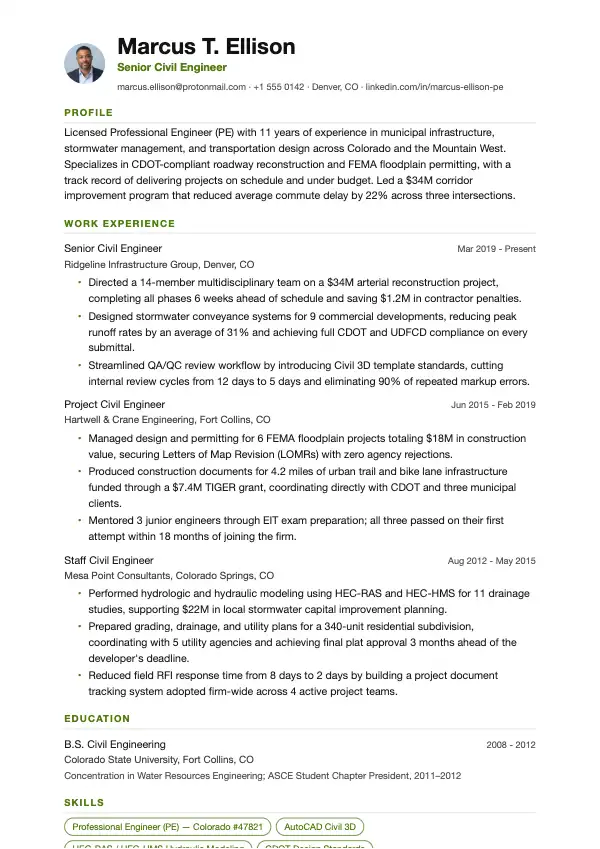
A Civil Engineer resume must clear ATS keyword filters for licensure and software tools, then prove to a hiring manager that you deliver projects on time and within budget. This example does both by leading with a PE credential, quantifying every bullet, and grouping domain-specific skills for instant scanner recognition.
Template: Signet
Read this resume as text
Marcus T. Ellison
Senior Civil Engineer
marcus.ellison@protonmail.com · +1 555 0142 · Denver, CO · linkedin.com/in/marcus-ellison-pe
- Profile
- Licensed Professional Engineer (PE) with 11 years of experience in municipal infrastructure, stormwater management, and transportation design across Colorado and the Mountain West. Specializes in CDOT-compliant roadway reconstruction and FEMA floodplain permitting, with a track record of delivering projects on schedule and under budget. Led a $34M corridor improvement program that reduced average commute delay by 22% across three intersections.
- Work Experience
Senior Civil Engineer
Ridgeline Infrastructure Group, Denver, CO · Mar 2019 - Present
- Directed a 14-member multidisciplinary team on a $34M arterial reconstruction project, completing all phases 6 weeks ahead of schedule and saving $1.2M in contractor penalties.
- Designed stormwater conveyance systems for 9 commercial developments, reducing peak runoff rates by an average of 31% and achieving full CDOT and UDFCD compliance on every submittal.
- Streamlined QA/QC review workflow by introducing Civil 3D template standards, cutting internal review cycles from 12 days to 5 days and eliminating 90% of repeated markup errors.
Project Civil Engineer
Hartwell & Crane Engineering, Fort Collins, CO · Jun 2015 - Feb 2019
- Managed design and permitting for 6 FEMA floodplain projects totaling $18M in construction value, securing Letters of Map Revision (LOMRs) with zero agency rejections.
- Produced construction documents for 4.2 miles of urban trail and bike lane infrastructure funded through a $7.4M TIGER grant, coordinating directly with CDOT and three municipal clients.
- Mentored 3 junior engineers through EIT exam preparation; all three passed on their first attempt within 18 months of joining the firm.
Staff Civil Engineer
Mesa Point Consultants, Colorado Springs, CO · Aug 2012 - May 2015
- Performed hydrologic and hydraulic modeling using HEC-RAS and HEC-HMS for 11 drainage studies, supporting $22M in local stormwater capital improvement planning.
- Prepared grading, drainage, and utility plans for a 340-unit residential subdivision, coordinating with 5 utility agencies and achieving final plat approval 3 months ahead of the developer's deadline.
- Reduced field RFI response time from 8 days to 2 days by building a project document tracking system adopted firm-wide across 4 active project teams.
- Education
B.S. Civil Engineering
Colorado State University, Fort Collins, CO · 2008 - 2012
Concentration in Water Resources Engineering; ASCE Student Chapter President, 2011–2012
- Skills
- Professional Engineer (PE) — Colorado #47821 · AutoCAD Civil 3D · HEC-RAS / HEC-HMS Hydraulic Modeling · CDOT Design Standards · FEMA LOMR / Floodplain Permitting · Stormwater Management & UDFCD Compliance · Roadway & Intersection Geometric Design · MicroStation / OpenRoads Designer · ArcGIS for Infrastructure Mapping
- Links
- LinkedIn: linkedin.com/in/marcus-ellison-pe · PE License: Colorado Professional Engineer License #47821 (verifiable via state board)
What makes this resume work
- The PE license number appears in the skills section rather than buried in a footnote, so ATS systems parsing for 'Professional Engineer' or 'PE' flag it immediately alongside domain terms like CDOT and FEMA.
- Every bullet follows a cause-and-effect structure — action verb, scope or scale, then a hard number — which lets hiring managers compare Marcus's output directly against their own project benchmarks without reading between the lines.
- The summary names a headline result ($34M program, 22% delay reduction) in the third sentence, giving a recruiter on a quick first scan a concrete reason to keep reading before they reach the experience section.
- The education note about the ASCE chapter presidency signals leadership without a separate section, keeping the one-page-equivalent density high and avoiding the padding that weakens entry-level-style resumes carried into senior roles.
Keywords that help you pass the ATS
Work the ones that fit your experience into your resume, naturally, not stuffed.
How to write a Civil Engineer resume
Choose the right format for a Civil Engineer resume
Use a reverse-chronological format unless you are switching specialties or returning after a gap. Hiring managers at engineering firms and public agencies scan for a clear project timeline, so burying your most recent work hurts you immediately.
Keep the resume to one page if you have fewer than ten years of experience; two pages are acceptable for senior engineers with extensive project portfolios. Use clean section headers, consistent fonts (Arial or Calibri at 10–12 pt), and leave enough white space so the document is readable on screen and in print.
- Margins between 0.5 and 1 inch; avoid tables and text boxes that break ATS parsing
- List your PE license and any active certifications in the header or directly below your name for immediate visibility
- Save and submit as a PDF unless the job posting specifically requests a Word file
Write a professional summary that lands interviews
Your summary is three to four lines at the top of the resume. It should name your specialty (transportation, structural, geotechnical, water resources, etc.), your years of experience, and one or two concrete outcomes. Skip objectives and generic phrases like 'results-driven professional.'
Example: "Licensed PE with 9 years of experience in municipal infrastructure and transportation design. Led roadway and drainage projects totaling $47M in construction value across Texas and Oklahoma. Proficient in AutoCAD Civil 3D, MicroStation, and HEC-RAS; experienced with TXDOT and FHWA submittal processes. Known for delivering projects on schedule through proactive stakeholder coordination and constructability reviews."
Write work-experience bullets that show real impact
Each bullet should follow an action-verb + task + measurable result structure. Recruiters and project managers want to see project scale (dollar value, square footage, lane-miles), your specific role, and the outcome. Avoid vague statements like 'assisted with design' or 'worked on bridge projects.'
Pull numbers from your timesheets, project closeout reports, or proposals. If exact figures are confidential, use ranges or percentages.
- Designed storm sewer and detention pond system for a 340-acre mixed-use development in Harris County, reducing peak runoff by 22% and achieving permit approval 6 weeks ahead of schedule
- Managed geotechnical investigation and pavement design for 14.3 lane-miles of county road rehabilitation, keeping the $3.8M project within budget and cutting contractor RFIs by 30% through detailed plan set reviews
Skills and certifications recruiters and ATS systems look for
Recruiters for civil engineering roles search their ATS by keyword, and resumes that match the posting's terms rank higher. Mirror the language in the job description and include both spelled-out terms and common abbreviations (e.g., 'Geographic Information Systems (GIS)'). Organize your skills section by category: software, technical competencies, and regulatory knowledge.
Certifications carry significant weight, especially PE licensure. List the state, license number, and expiration year. EIT/FE status is worth including if you are early-career. Industry credentials like PMP, ENV SP, or PTOE signal specialization and leadership.
- Software: AutoCAD Civil 3D, MicroStation, HEC-RAS, HEC-HMS, STAAD.Pro, Bentley OpenRoads, ArcGIS, Primavera P6, Microsoft Project
- Technical: LRFD bridge design, stormwater management, grading and drainage, traffic impact analysis, geotechnical reporting, construction administration
- Regulatory: AASHTO standards, FHWA guidelines, NPDES permitting, NEPA documentation, local DOT design manuals
- Certifications to list: PE (state and number), EIT/FE, PMP, LEED AP, ENV SP, Erosion Control certification (CESSWI or CPESC)
Education, licenses, and extras that strengthen your resume
List your degree, institution, and graduation year. For civil engineers, your degree discipline matters: note B.S. Civil Engineering, M.S. Structural Engineering, etc. GPA is optional after five years of experience; include it if it was 3.5 or above and you are early-career. Relevant coursework is rarely needed unless you are a new graduate.
Add a brief section for professional affiliations (ASCE, APWA, ITE, NSPE), publications or conference presentations, and any relevant continuing education. If you have managed subconsultants or held a project manager title, make that explicit in your experience bullets rather than just listing it as a skill.
- List PE license under both Education and your header/summary so it appears twice without being redundant
- Include committee work or chapter officer roles in ASCE or APWA — firms value engineers who are active in the profession
- If you hold a security clearance or have experience with federal agency projects (USACE, FHWA, EPA), note it explicitly
Mistakes to avoid
- Listing software like AutoCAD without specifying the version or module (Civil 3D vs. vanilla AutoCAD signals very different skill levels to a hiring manager).
- Describing project involvement without clarifying your actual role — whether you led the design, performed QA/QC review, or supported a senior engineer changes everything about how the experience is evaluated.
- Omitting PE license state and number, which forces recruiters to verify eligibility manually and can push your application to the bottom of the pile.
- Using a generic skills list that copies the job description verbatim without tying those skills to specific projects or outcomes in your experience section.
Frequently asked questions
- Should a civil engineer list every project they have worked on?
- No. Select six to ten projects that best match the role you are targeting and highlight them with metrics in your experience bullets. If you have a long project history, consider adding a one-page project list as a separate attachment — many firms request this anyway as part of their proposal process.
- Does a PE license need to be on a civil engineer resume if it is still pending?
- Yes, but be precise. Write 'PE Exam Passed — License Pending, Texas' or 'EIT, Texas Board of Professional Engineers and Land Surveyors, 2023' so the hiring manager knows exactly where you stand. Misrepresenting your licensure status is a serious professional and legal risk.
- How important is it to tailor a civil engineering resume for each application?
- Very important, especially when applying to both public-sector agencies and private consulting firms, which prioritize different things. A DOT application values regulatory knowledge and QA/QC experience; a private firm often cares more about client-facing skills and project delivery speed. Adjust your summary and top bullet points to reflect what each employer emphasizes in the posting.
Make it yours in minutes
Open this example in the builder, swap in your details, and export a clean, ATS-ready resume.
Once your resume is ready
More for this application
- Template style
- Professional resume templates