Resume example
UX Designer resume example
By the Resumade team · About our content
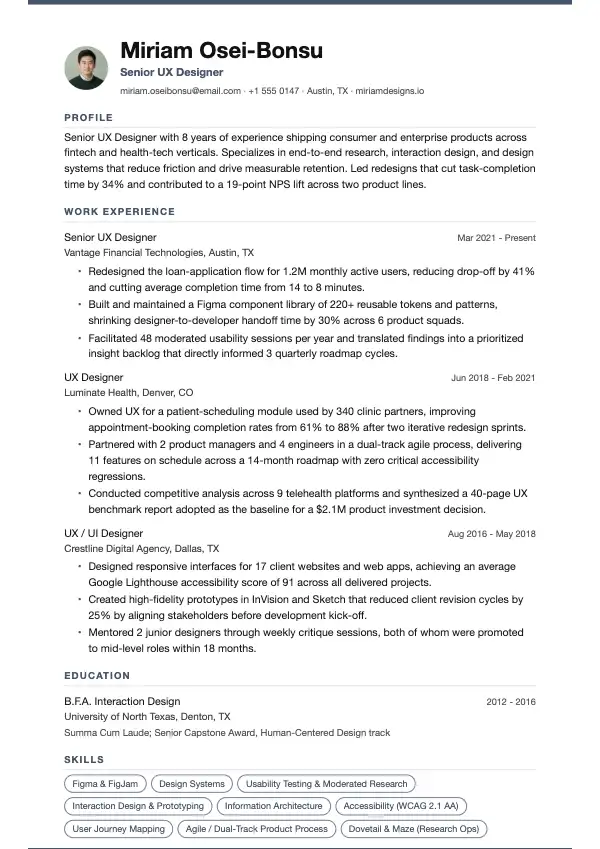
A strong UX Designer resume must prove research rigor and shipped impact in the same breath — not just list tools. This example leads every bullet with an action verb tied to a real outcome, and surfaces ATS-critical terms like usability testing, design systems, and accessibility without keyword stuffing.
Template: Ribbon
Read this resume as text
Miriam Osei-Bonsu
Senior UX Designer
miriam.oseibonsu@email.com · +1 555 0147 · Austin, TX · miriamdesigns.io
- Profile
- Senior UX Designer with 8 years of experience shipping consumer and enterprise products across fintech and health-tech verticals. Specializes in end-to-end research, interaction design, and design systems that reduce friction and drive measurable retention. Led redesigns that cut task-completion time by 34% and contributed to a 19-point NPS lift across two product lines.
- Work Experience
Senior UX Designer
Vantage Financial Technologies, Austin, TX · Mar 2021 - Present
- Redesigned the loan-application flow for 1.2M monthly active users, reducing drop-off by 41% and cutting average completion time from 14 to 8 minutes.
- Built and maintained a Figma component library of 220+ reusable tokens and patterns, shrinking designer-to-developer handoff time by 30% across 6 product squads.
- Facilitated 48 moderated usability sessions per year and translated findings into a prioritized insight backlog that directly informed 3 quarterly roadmap cycles.
UX Designer
Luminate Health, Denver, CO · Jun 2018 - Feb 2021
- Owned UX for a patient-scheduling module used by 340 clinic partners, improving appointment-booking completion rates from 61% to 88% after two iterative redesign sprints.
- Partnered with 2 product managers and 4 engineers in a dual-track agile process, delivering 11 features on schedule across a 14-month roadmap with zero critical accessibility regressions.
- Conducted competitive analysis across 9 telehealth platforms and synthesized a 40-page UX benchmark report adopted as the baseline for a $2.1M product investment decision.
UX / UI Designer
Crestline Digital Agency, Dallas, TX · Aug 2016 - May 2018
- Designed responsive interfaces for 17 client websites and web apps, achieving an average Google Lighthouse accessibility score of 91 across all delivered projects.
- Created high-fidelity prototypes in InVision and Sketch that reduced client revision cycles by 25% by aligning stakeholders before development kick-off.
- Mentored 2 junior designers through weekly critique sessions, both of whom were promoted to mid-level roles within 18 months.
- Education
B.F.A. Interaction Design
University of North Texas, Denton, TX · 2012 - 2016
Summa Cum Laude; Senior Capstone Award, Human-Centered Design track
- Skills
- Figma & FigJam · Design Systems · Usability Testing & Moderated Research · Interaction Design & Prototyping · Information Architecture · Accessibility (WCAG 2.1 AA) · User Journey Mapping · Agile / Dual-Track Product Process · Dovetail & Maze (Research Ops)
- Links
- Portfolio: miriamdesigns.io · LinkedIn: linkedin.com/in/miriam-osei-bonsu · Case Studies: miriamdesigns.io/case-studies
What makes this resume work
- Every bullet opens with a past-tense action verb and closes with a quantified result — percentages, user counts, or time savings — giving hiring managers immediate proof of scope and impact rather than a list of responsibilities.
- The skills section names specific tools (Figma, Dovetail, Maze) alongside process competencies (dual-track agile, WCAG 2.1 AA), which satisfies both ATS keyword filters and the senior designer bar that reviewers apply manually.
- The summary front-loads seniority, domain specialization, and two headline metrics in three sentences, so a recruiter on a quick skim gets the full value proposition before reading a single bullet.
- Career progression is self-evident — agency generalist to health-tech mid-level to fintech senior — which tells a coherent story of growth without needing a cover letter to explain the trajectory.
Keywords that help you pass the ATS
Work the ones that fit your experience into your resume, naturally, not stuffed.
How to write a UX Designer resume
Choose the right format for a UX Designer resume
Use a reverse-chronological format unless you are making a lateral move from an unrelated field. Hiring managers and applicant tracking systems at companies like Google, Salesforce, and mid-size agencies all expect to see your most recent role first, with a clear progression of scope and responsibility.
Keep the resume to one page if you have fewer than eight years of experience; two pages are acceptable beyond that. Use a clean, single-column or modest two-column layout — avoid heavy visual design treatments on the resume itself. Recruiters scan in seconds, and a portfolio link does the visual storytelling for you.
- Set margins between 0.5" and 1", use 10–12pt body text in a readable sans-serif such as Inter or Calibri
- Include a live portfolio URL in the header — make it a shortened, trackable link if possible
- Save and submit as a PDF unless the job posting explicitly asks for .docx
- Put your name, city/state (not full address), phone, email, LinkedIn, and portfolio on one header line or two
Write a professional summary that frames your UX specialization
Skip the objective statement. Write a three-to-four sentence summary that names your UX discipline (research, product design, service design, design systems), your years of experience, the types of products or industries you know, and one concrete outcome. Tailor it to each role by mirroring the language in the job description.
Example: "Product UX Designer with 6 years designing B2B SaaS platforms across fintech and HR tech. Proficient in end-to-end design from discovery through handoff using Figma and Maze. Reduced onboarding drop-off by 34% at a 500-person fintech startup by redesigning a five-step flow into a progressive disclosure model. Comfortable leading design sprints and collaborating directly with engineering in two-week Agile cycles."
Write work-experience bullets that show impact, not activity
Each bullet should follow an action verb → method or tool → measurable result structure. Avoid listing responsibilities like 'responsible for wireframing.' Instead, describe what you did, how you did it, and what changed as a result. Quantify with task-completion rates, time-on-task improvements, NPS deltas, conversion lifts, error-rate reductions, or velocity gains for engineering teams.
If you lack hard metrics, use scope indicators: number of users affected, number of screens or flows delivered, team size, or sprint cadence. Recruiters at companies using structured hiring scorecards specifically look for evidence of business impact alongside craft.
- Redesigned the mobile checkout flow in Figma for a 2.1M-user e-commerce app, reducing cart abandonment by 22% over one quarter as measured in Mixpanel
- Conducted 18 moderated usability sessions in UserTesting and synthesized findings into an affinity map that cut engineering rework by 40% on a flagship dashboard feature
Skills and certifications recruiters and ATS systems look for
List tools and methods explicitly because ATS systems parse keyword matches before a human ever reads your resume. Organize your skills section into two or three subcategories — Design Tools, Research Methods, and Collaboration/Handoff — rather than dumping everything into one undifferentiated list.
Certifications matter most when you are early-career or pivoting. The Nielsen Norman Group UX Certificate (especially with specialization tracks like UX Research or UX Management) is the most recognized in the US market. Google UX Design Certificate on Coursera signals foundational knowledge but carries less weight at senior levels. Interaction Design Foundation certificates are acceptable filler. Certified Scrum Product Owner (CSPO) or SAFe training helps if you work in large Agile organizations.
- Design tools: Figma, Sketch, Adobe XD, Protopie, Framer
- Research tools: Maze, UserTesting, Lookback, Optimal Workshop, Dovetail
- Handoff and collaboration: Zeroheight, Storybook, Jira, Confluence, Notion
- Methods: usability testing, card sorting, tree testing, journey mapping, heuristic evaluation, design sprints
- Soft skills worth naming: cross-functional facilitation, stakeholder presentation, accessibility (WCAG 2.1 AA)
Education, licenses, and extras that round out the resume
List your highest degree, institution, and graduation year. Majors in HCI, graphic design, cognitive psychology, or information science are directly relevant; list them plainly. If your degree is unrelated, follow it with a bootcamp or certificate that bridges the gap. Do not list GPA unless you graduated within the past two years and it is above 3.5.
Add an Awards or Recognition section only if the item is externally verifiable — a Webby, an ADC nomination, or a published case study in a known outlet. Include a Speaking or Publications line if you have presented at Config, UXPA, or similar conferences. List accessibility credentials such as CPACC if you have them; they are increasingly requested in job descriptions at enterprise companies.
- Relevant degrees: B.S./M.S. in Human-Computer Interaction, Interaction Design, Cognitive Science, Graphic Design
- Bootcamps worth listing: General Assembly UX Design Immersive, Springboard UX Career Track
- Volunteer design work for nonprofits counts as experience if it produced a shipped product
Mistakes to avoid
- Submitting a visually over-designed resume with custom layouts, icons, and color blocks that confuse ATS parsers and distract from your portfolio, which is the correct place to demonstrate visual craft.
- Listing tools without context — writing 'Figma, Sketch, InVision' in a skills section tells a recruiter nothing about the complexity or scale of work you have done with those tools.
- Omitting the portfolio link or linking to a password-protected Behance or Notion page without including the password, which causes recruiters to skip to the next candidate.
- Using research-heavy titles like 'UX Researcher' when your bullets describe only delivery work, or vice versa, creating a mismatch that raises red flags during recruiter phone screens.
Frequently asked questions
- Should a UX Designer resume include a portfolio or case studies?
- Your resume should include a portfolio link in the header — not case study text within the resume itself. Keep case study details for the portfolio site and the interview. A URL that goes directly to your strongest project is more effective than a homepage link.
- How do I write a UX Designer resume with no professional experience?
- Lead with a capstone or bootcamp project that shipped or was tested with real users, and treat it exactly like a job entry with a project title, date range, and impact-focused bullets. Supplement with freelance work, volunteer projects, or a strong NN/g or Google UX certificate, and make your portfolio do the heavy lifting.
- What is the difference between a UX Designer resume and a Product Designer resume?
- The titles are used interchangeably at many companies, but 'Product Designer' often signals broader ownership — including visual design, design systems, and closer collaboration with product managers — while 'UX Designer' can skew toward research and information architecture. Mirror the exact title used in the job posting to pass ATS keyword matching, and let your bullets clarify your actual scope.
Make it yours in minutes
Open this example in the builder, swap in your details, and export a clean, ATS-ready resume.
Once your resume is ready
More for this application
- Cover letter example
- UX Designer Cover Letter Example
- Template style
- Designer resume templates