Resume example
DevOps Engineer resume example
By the Resumade team · About our content
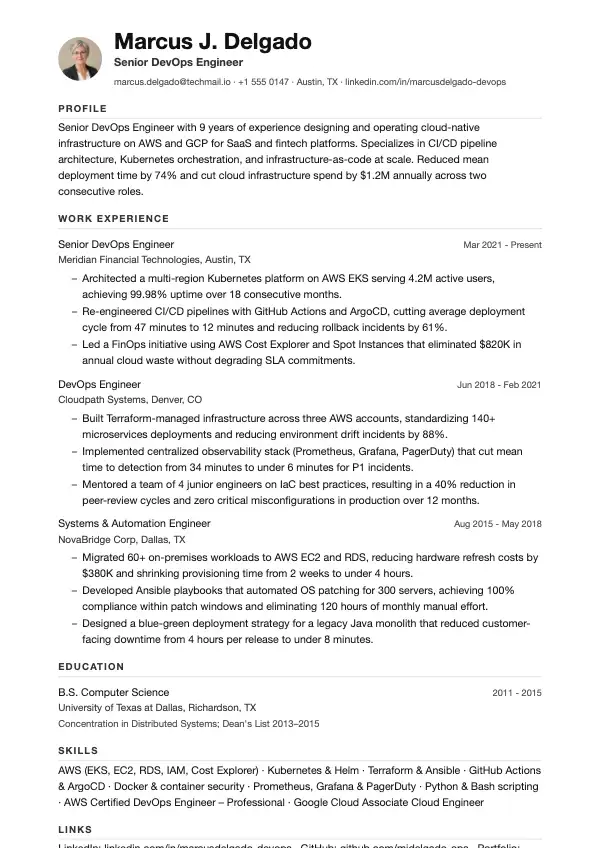
A DevOps resume must clear keyword filters for cloud platforms and tooling, then immediately prove impact to the hiring manager. This example does both: hard skills are named precisely for ATS, and every bullet closes with a number.
Template: Wren
Read this resume as text
Marcus J. Delgado
Senior DevOps Engineer
marcus.delgado@techmail.io · +1 555 0147 · Austin, TX · linkedin.com/in/marcusdelgado-devops
- Profile
- Senior DevOps Engineer with 9 years of experience designing and operating cloud-native infrastructure on AWS and GCP for SaaS and fintech platforms. Specializes in CI/CD pipeline architecture, Kubernetes orchestration, and infrastructure-as-code at scale. Reduced mean deployment time by 74% and cut cloud infrastructure spend by $1.2M annually across two consecutive roles.
- Work Experience
Senior DevOps Engineer
Meridian Financial Technologies, Austin, TX · Mar 2021 - Present
- Architected a multi-region Kubernetes platform on AWS EKS serving 4.2M active users, achieving 99.98% uptime over 18 consecutive months.
- Re-engineered CI/CD pipelines with GitHub Actions and ArgoCD, cutting average deployment cycle from 47 minutes to 12 minutes and reducing rollback incidents by 61%.
- Led a FinOps initiative using AWS Cost Explorer and Spot Instances that eliminated $820K in annual cloud waste without degrading SLA commitments.
DevOps Engineer
Cloudpath Systems, Denver, CO · Jun 2018 - Feb 2021
- Built Terraform-managed infrastructure across three AWS accounts, standardizing 140+ microservices deployments and reducing environment drift incidents by 88%.
- Implemented centralized observability stack (Prometheus, Grafana, PagerDuty) that cut mean time to detection from 34 minutes to under 6 minutes for P1 incidents.
- Mentored a team of 4 junior engineers on IaC best practices, resulting in a 40% reduction in peer-review cycles and zero critical misconfigurations in production over 12 months.
Systems & Automation Engineer
NovaBridge Corp, Dallas, TX · Aug 2015 - May 2018
- Migrated 60+ on-premises workloads to AWS EC2 and RDS, reducing hardware refresh costs by $380K and shrinking provisioning time from 2 weeks to under 4 hours.
- Developed Ansible playbooks that automated OS patching for 300 servers, achieving 100% compliance within patch windows and eliminating 120 hours of monthly manual effort.
- Designed a blue-green deployment strategy for a legacy Java monolith that reduced customer-facing downtime from 4 hours per release to under 8 minutes.
- Education
B.S. Computer Science
University of Texas at Dallas, Richardson, TX · 2011 - 2015
Concentration in Distributed Systems; Dean's List 2013–2015
- Skills
- AWS (EKS, EC2, RDS, IAM, Cost Explorer) · Kubernetes & Helm · Terraform & Ansible · GitHub Actions & ArgoCD · Docker & container security · Prometheus, Grafana & PagerDuty · Python & Bash scripting · AWS Certified DevOps Engineer – Professional · Google Cloud Associate Cloud Engineer
- Links
- LinkedIn: linkedin.com/in/marcusdelgado-devops · GitHub: github.com/mjdelgado-ops · Portfolio: marcusdelgado.dev
What makes this resume work
- Every experience bullet opens with a strong action verb and closes with a quantified outcome — percentages, dollar figures, or time savings — so hiring managers can assess ROI at a glance.
- The skills section names specific AWS services in parentheses rather than listing 'AWS' alone, which matches the granular search strings recruiters actually use in ATS platforms.
- The summary front-loads seniority, years, and two headline metrics in three sentences, giving screeners an instant reason to keep reading before they reach the job history.
- Certifications are embedded in the skills list rather than buried in a separate section, ensuring they appear in keyword scans and stay visible during a recruiter’s first quick scan.
Keywords that help you pass the ATS
Work the ones that fit your experience into your resume, naturally, not stuffed.
How to write a DevOps Engineer resume
Choose the right format for a DevOps Engineer resume
Use a reverse-chronological format. Hiring managers and applicant tracking systems both expect it, and DevOps roles reward demonstrated progression — from junior sysadmin or developer to someone owning CI/CD pipelines and cloud infrastructure at scale. A functional or hybrid format raises red flags unless you are making a significant career pivot.
Keep the resume to one page if you have under ten years of experience; two pages is acceptable beyond that. Use clean section headers, consistent spacing, and a single readable font like Calibri or Georgia at 10–11 pt. Avoid tables, columns, and graphics — many ATS parsers choke on them, and DevOps job postings frequently route through Workday or Greenhouse before a human ever sees your file.
- File format: a text-based PDF preserves layout and parses well in modern ATS platforms; send .docx if the posting asks for it
- Sections in order: Contact Info → Summary → Skills → Work Experience → Education → Certifications
- Put the Skills section above Work Experience so ATS keyword matching hits it early
- Include your GitHub profile URL and LinkedIn URL in the header — both are expected in this field
Write a professional summary that lands interviews
Your summary is three to four sentences. It should name your years of experience, the cloud platforms you know best, your strongest technical domain (infrastructure automation, container orchestration, SRE practices, etc.), and one concrete outcome. Skip phrases like 'results-driven' or 'passionate about DevOps' — they waste space and signal nothing.
Example: "DevOps Engineer with 7 years of experience building and operating cloud-native infrastructure on AWS and GCP. Reduced mean time to recovery (MTTR) from 45 minutes to under 8 minutes by implementing centralized observability with Datadog and PagerDuty. Proficient in Terraform, Kubernetes, and GitHub Actions; led migration of 60+ microservices from on-prem VMs to EKS with zero downtime. AWS Certified DevOps Engineer – Professional."
Write work-experience bullets that prove impact
Every bullet should follow an action-metric-context structure: what you did, the measurable result, and the tool or scale involved. Avoid vague statements like 'managed CI/CD pipelines' — every DevOps candidate says that. Quantify deployment frequency, uptime improvements, cost reductions, incident response times, or team size. If you cannot find an exact number, estimate and note it is approximate.
Recruiters spend about seven seconds on an initial scan (Ladders eye-tracking study, 2018). Lead each bullet with a strong past-tense verb: Automated, Reduced, Migrated, Architected, Implemented, Eliminated.
- Automated infrastructure provisioning with Terraform and Ansible across 3 AWS accounts, cutting environment spin-up time from 4 hours to 18 minutes and eliminating manual configuration drift
- Designed and maintained a Kubernetes-based deployment platform on EKS serving 120 million monthly requests at 99.97% uptime, reducing per-deployment rollout time by 65% through blue-green release automation in ArgoCD
Skills and certifications recruiters and ATS look for
DevOps job descriptions are highly tool-specific. Mirror the exact terminology from the posting — 'Helm charts' not just 'Kubernetes packaging,' 'Prometheus/Grafana stack' not just 'monitoring.' Group your skills by category so both humans and parsers can navigate them quickly.
Certifications carry real weight in DevOps hiring, especially at mid-to-senior levels. List them with the issuing body and year earned. If a cert is expired, either renew it before applying or omit it — listing an expired AWS cert is a common trust-breaker.
- Cloud platforms: AWS (EC2, EKS, RDS, Lambda, IAM, VPC), GCP, Azure
- IaC and configuration management: Terraform, Pulumi, Ansible, CloudFormation
- CI/CD: Jenkins, GitHub Actions, GitLab CI, CircleCI, ArgoCD, Spinnaker
- Containers and orchestration: Docker, Kubernetes, Helm, Istio
- High-value certifications: AWS Certified DevOps Engineer – Professional, CKA (Certified Kubernetes Administrator), HashiCorp Terraform Associate, Google Professional Cloud DevOps Engineer, AWS Solutions Architect – Associate
Education, licenses, and extras
A bachelor's degree in Computer Science, Information Systems, or a related field is common but not universal in DevOps hiring — certifications and a strong GitHub portfolio often carry equal or greater weight. List your degree with institution, graduation year, and GPA only if it is 3.5 or above and you graduated within the last five years.
Add an 'Open Source & Projects' section if you have meaningful GitHub contributions, published Terraform modules, or Helm charts with real adoption. Include a link and one-line description of what the project does and its usage scale. This section regularly differentiates candidates at the senior level.
- List certifications in a dedicated section with full name, issuing body, and year (e.g., 'CKA – Cloud Native Computing Foundation, 2023')
- Include relevant coursework only if you are entry-level and the topics directly map to the job description
- Security clearances, if applicable, belong in the header or summary — never buried at the bottom
Mistakes to avoid
- Listing tools without context — writing 'Kubernetes, Terraform, Jenkins' in a bullet with no indication of scale, ownership level, or outcome tells a recruiter nothing useful.
- Using infrastructure-as-code file names or internal project codenames that only make sense inside your current company, leaving reviewers unable to evaluate your actual scope.
- Omitting on-call and incident-response experience, which senior DevOps and SRE hiring managers treat as a core competency, not a footnote.
- Claiming certifications you have not renewed — AWS, CKA, and HashiCorp certs expire and recruiters increasingly verify them through Credly or the issuing body's public registry.
Frequently asked questions
- Should a DevOps Engineer resume include a GitHub link?
- Yes, and it should be active. Recruiters and hiring managers in DevOps routinely check GitHub profiles to verify that your claimed skills appear in real code. Pin your strongest repositories — Terraform modules, Helm charts, or pipeline configurations — and make sure the README explains what each project does and why.
- How do I write a DevOps resume if my background is mostly sysadmin or traditional IT ops?
- Reframe your existing experience around automation, reliability, and delivery speed rather than ticket resolution or hardware maintenance. Highlight any scripting (Bash, Python), version control usage, or infrastructure tooling you have touched, even informally. Earning the HashiCorp Terraform Associate or AWS Solutions Architect – Associate certification before applying significantly closes the credibility gap.
- What salary range should I target, and does it affect how I write the resume?
- Mid-level DevOps Engineers in the US typically earn $115,000–$150,000; senior and staff-level roles with Kubernetes and multi-cloud experience often reach $160,000–$200,000 at larger companies. Your resume itself should not mention salary, but calibrating your bullet points to reflect the scope and scale expected at your target level — team size, traffic volume, infrastructure complexity — signals to recruiters that you belong in that compensation band.
Make it yours in minutes
Open this example in the builder, swap in your details, and export a clean, ATS-ready resume.
Once your resume is ready
More for this application
- Template style
- Software Engineer resume templates