Resume example
Cybersecurity Analyst resume example
By the Resumade team · About our content
A Cybersecurity Analyst resume must clear ATS keyword filters for certifications, tools, and frameworks while proving to a hiring manager that you stop real threats — not just describe them. This example does both by leading every bullet with a quantified outcome and front-loading credentials in the skills block.
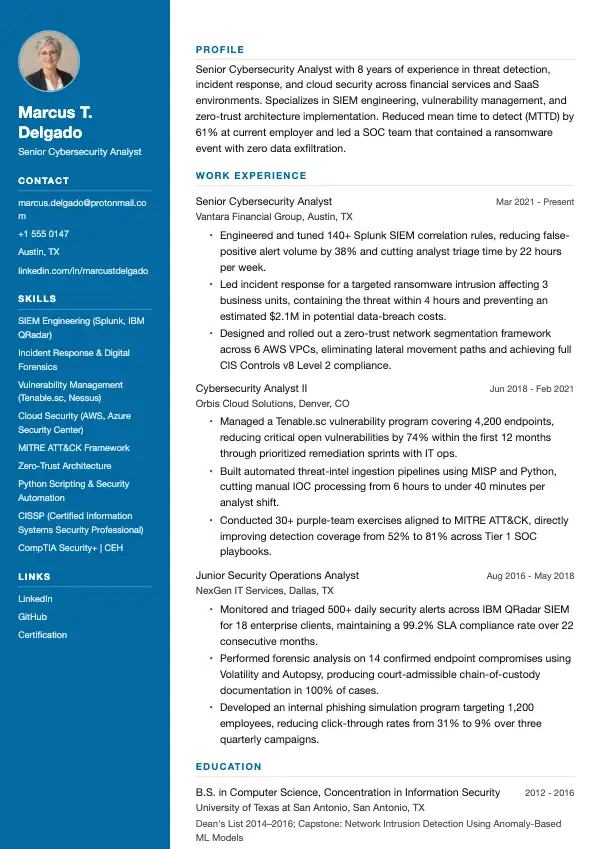
Template: Harbor
Read this resume as text
Marcus T. Delgado
Senior Cybersecurity Analyst
marcus.delgado@protonmail.com · +1 555 0147 · Austin, TX · linkedin.com/in/marcustdelgado
- Profile
- Senior Cybersecurity Analyst with 8 years of experience in threat detection, incident response, and cloud security across financial services and SaaS environments. Specializes in SIEM engineering, vulnerability management, and zero-trust architecture implementation. Reduced mean time to detect (MTTD) by 61% at current employer and led a SOC team that contained a ransomware event with zero data exfiltration.
- Work Experience
Senior Cybersecurity Analyst
Vantara Financial Group, Austin, TX · Mar 2021 - Present
- Engineered and tuned 140+ Splunk SIEM correlation rules, reducing false-positive alert volume by 38% and cutting analyst triage time by 22 hours per week.
- Led incident response for a targeted ransomware intrusion affecting 3 business units, containing the threat within 4 hours and preventing an estimated $2.1M in potential data-breach costs.
- Designed and rolled out a zero-trust network segmentation framework across 6 AWS VPCs, eliminating lateral movement paths and achieving full CIS Controls v8 Level 2 compliance.
Cybersecurity Analyst II
Orbis Cloud Solutions, Denver, CO · Jun 2018 - Feb 2021
- Managed a Tenable.sc vulnerability program covering 4,200 endpoints, reducing critical open vulnerabilities by 74% within the first 12 months through prioritized remediation sprints with IT ops.
- Built automated threat-intel ingestion pipelines using MISP and Python, cutting manual IOC processing from 6 hours to under 40 minutes per analyst shift.
- Conducted 30+ purple-team exercises aligned to MITRE ATT&CK, directly improving detection coverage from 52% to 81% across Tier 1 SOC playbooks.
Junior Security Operations Analyst
NexGen IT Services, Dallas, TX · Aug 2016 - May 2018
- Monitored and triaged 500+ daily security alerts across IBM QRadar SIEM for 18 enterprise clients, maintaining a 99.2% SLA compliance rate over 22 consecutive months.
- Performed forensic analysis on 14 confirmed endpoint compromises using Volatility and Autopsy, producing court-admissible chain-of-custody documentation in 100% of cases.
- Developed an internal phishing simulation program targeting 1,200 employees, reducing click-through rates from 31% to 9% over three quarterly campaigns.
- Education
B.S. in Computer Science, Concentration in Information Security
University of Texas at San Antonio, San Antonio, TX · 2012 - 2016
Dean's List 2014–2016; Capstone: Network Intrusion Detection Using Anomaly-Based ML Models
- Skills
- SIEM Engineering (Splunk, IBM QRadar) · Incident Response & Digital Forensics · Vulnerability Management (Tenable.sc, Nessus) · Cloud Security (AWS, Azure Security Center) · MITRE ATT&CK Framework · Zero-Trust Architecture · Python Scripting & Security Automation · CISSP (Certified Information Systems Security Professional) · CompTIA Security+ | CEH
- Links
- LinkedIn · GitHub · Certification
What makes this resume work
- Every experience bullet opens with a strong action verb and closes with a specific number — percentages, dollar figures, or time savings — so hiring managers can immediately gauge the candidate's real-world impact rather than inferring it.
- Certifications (CISSP, CEH, Security+) appear in the skills section rather than buried in a footer, which ensures they surface in ATS keyword scans that recruiters run before a human ever reads the document.
- The summary names seniority level, years of experience, two distinct specialisms, and two headline results in three sentences — giving a time-pressed recruiter everything they need to decide on a phone screen without reading further.
- MITRE ATT&CK, zero-trust, and specific tool names (Splunk, Tenable.sc, MISP, Volatility) are woven into bullets contextually, which satisfies both keyword-matching algorithms and technical hiring managers who will scrutinize tool depth.
Keywords that help you pass the ATS
Work the ones that fit your experience into your resume, naturally, not stuffed.
How to write a Cybersecurity Analyst resume
Choose the right format for a Cybersecurity Analyst resume
Use a reverse-chronological format unless you are transitioning into cybersecurity from a completely unrelated field. Hiring managers and applicant tracking systems (ATS) both expect this structure, and security operations centers (SOCs) in particular want to see a clear timeline of your hands-on experience.
Keep the resume to one page if you have fewer than ten years of experience; two pages are acceptable for senior analysts or those with extensive incident-response history. Use clean section headers, consistent fonts (Arial or Calibri at 10–12pt), and avoid tables or graphics that break ATS parsing.
- Sections in order: Contact Info → Summary → Work Experience → Skills → Certifications → Education
- File format: submit a text-based PDF unless the posting requests a .docx
- Margins: 0.75–1 inch; no headers or footers containing critical contact data
- Tailor keywords to each job description — SIEM tool names, compliance frameworks, and attack types vary by employer
Write a professional summary that earns a second look
Your summary sits directly under your name and contact info and should be three to four sentences that answer: what level analyst you are, what environments you protect, and one or two quantifiable wins. Skip phrases like 'results-driven professional' and lead with your actual specialty — threat hunting, vulnerability management, cloud security, or incident response.
Example: "Cybersecurity Analyst with five years of experience protecting financial-sector infrastructure across hybrid AWS and on-premises environments. Proficient in Splunk SIEM, CrowdStrike Falcon, and NIST 800-53 compliance workflows. Reduced mean time to detect (MTTD) by 34% over 18 months by building custom correlation rules and automating tier-1 alert triage. CompTIA Security+ and CEH certified."
Write work-experience bullets that prove impact
Every bullet should follow an action-verb → task → measurable result structure. Avoid describing job duties in vague terms; instead, name the specific tools, frameworks, and threat types you worked with. Recruiters scan for Splunk, QRadar, Sentinel, Tenable Nessus, Qualys, Palo Alto, CrowdStrike, and similar platform names — include them naturally in context.
Quantify wherever possible: number of endpoints monitored, alerts triaged per day, vulnerabilities remediated, reduction in false-positive rates, or compliance audit pass rates. If exact numbers are confidential, use ranges or percentages.
- Investigated and contained a ransomware intrusion across 1,200 endpoints using CrowdStrike Falcon and Splunk, reducing dwell time from 72 hours to under 8 hours and preventing an estimated $2.1M in operational downtime.
- Conducted monthly vulnerability scans with Tenable Nessus across 3,400 assets, prioritized remediation using CVSS scoring, and drove critical patch compliance from 61% to 94% within two quarters.
Skills and certifications recruiters and ATS systems look for
Build a dedicated Skills section that lists tools, platforms, and frameworks in plain text — not a graphic bar chart. ATS cannot read visual skill meters. Group items logically: SIEM & monitoring, endpoint security, network security, cloud security, compliance frameworks, and scripting languages.
Certifications carry significant weight in cybersecurity hiring. List them in a separate Certifications section with the full name, issuing body, and year obtained. Entry-level roles prioritize CompTIA Security+; mid-level roles look for CEH, CySA+, or GIAC GSEC; senior and specialized roles favor CISSP, OSCP, GPEN, or cloud-security certs like AWS Security Specialty or Microsoft SC-200.
- SIEM platforms: Splunk, IBM QRadar, Microsoft Sentinel, LogRhythm
- Endpoint & threat tools: CrowdStrike Falcon, Carbon Black, SentinelOne, Tenable Nessus, Qualys
- Frameworks: NIST CSF, NIST 800-53, MITRE ATT&CK, ISO 27001, CIS Controls
- Scripting: Python, PowerShell, Bash (show GitHub links if you have detection scripts or automation tools)
- Cloud: AWS Security Hub, Azure Defender, GCP Security Command Center
Education, licenses, and extras that strengthen your candidacy
List your highest degree first with school name, degree, major, and graduation year. A bachelor's in Computer Science, Information Systems, or Cybersecurity is the baseline expectation at most mid-size and enterprise employers, though demonstrated skills and certifications can offset a non-technical degree. If you completed a cybersecurity bootcamp from a recognized provider (SANS, Evolvent, etc.), list it under Education or a separate Training section.
Add an optional Projects or CTF Competitions section if you have fewer than three years of professional experience. Mention specific platforms like Hack The Box, TryHackMe, or PicoCTF along with any top-10 finishes or notable flags. Active security clearances (Secret, TS/SCI) belong in a dedicated Clearance line near the top of your resume — many federal and defense contractor roles filter on this before reading anything else.
- List active clearance level and polygraph status prominently if applying to government or defense roles
- Include a link to your LinkedIn profile and, if relevant, a GitHub repository with sanitized detection scripts or lab projects
- CPE credits and active certification maintenance dates signal that your skills are current
Mistakes to avoid
- Listing certifications you are 'studying for' rather than ones you have already earned — recruiters treat this as padding and it damages credibility.
- Using generic security buzzwords like 'monitored threats' or 'ensured security' without naming the specific tools, threat types, or outcomes involved.
- Omitting the MITRE ATT&CK framework and relevant compliance standards (NIST, PCI-DSS, HIPAA) even when your daily work touched them, so your resume ranks low when a recruiter searches for those frameworks.
- Burying an active security clearance anywhere other than the top of the resume, causing federal and defense contractor hiring managers to miss the most screening-critical detail on the document.
Frequently asked questions
- Do I need a degree to get a Cybersecurity Analyst job?
- A bachelor's degree is listed as a requirement in the majority of job postings, but many employers will substitute relevant certifications — particularly CISSP, OSCP, or a GIAC credential — combined with demonstrable hands-on experience. If you lack a four-year degree, lean heavily on certifications, a strong projects section, and documented lab or CTF work to compensate.
- How do I write a Cybersecurity Analyst resume with no experience?
- Focus on transferable technical skills from IT help desk, network administration, or system administration roles, since these are common entry paths into security. Build out a Projects section using Hack The Box or TryHackMe write-ups, earn at minimum CompTIA Security+ and Network+, and apply to SOC Tier 1 analyst or junior security analyst roles rather than targeting mid-level positions immediately.
- Should I tailor my Cybersecurity Analyst resume for every job?
- Yes — job descriptions vary significantly in the tools they require, the compliance frameworks they reference, and the threat environments they operate in (cloud, OT/ICS, healthcare, finance). Mirror the exact tool names and framework abbreviations from each posting in your skills and bullet points, because ATS systems match on specific strings and a generic resume will rank lower than a tailored one.
Make it yours in minutes
Open this example in the builder, swap in your details, and export a clean, ATS-ready resume.
Once your resume is ready
More for this application
- Template style
- Two-Column resume templates