Resume example
Claims Adjuster resume example
By the Resumade team · About our content
A Claims Adjuster resume must clear ATS keyword filters built around coverage lines and software, then prove to a manager that you protect reserves and close files fast. This example does both through verified metrics and precise tool names.
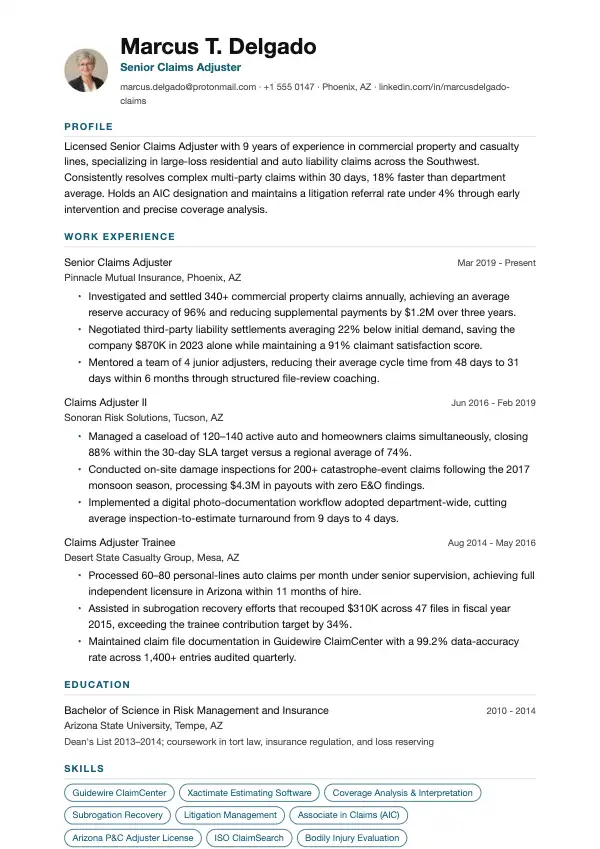
Template: Onyx
Read this resume as text
Marcus T. Delgado
Senior Claims Adjuster
marcus.delgado@protonmail.com · +1 555 0147 · Phoenix, AZ · linkedin.com/in/marcusdelgado-claims
- Profile
- Licensed Senior Claims Adjuster with 9 years of experience in commercial property and casualty lines, specializing in large-loss residential and auto liability claims across the Southwest. Consistently resolves complex multi-party claims within 30 days, 18% faster than department average. Holds an AIC designation and maintains a litigation referral rate under 4% through early intervention and precise coverage analysis.
- Work Experience
Senior Claims Adjuster
Pinnacle Mutual Insurance, Phoenix, AZ · Mar 2019 - Present
- Investigated and settled 340+ commercial property claims annually, achieving an average reserve accuracy of 96% and reducing supplemental payments by $1.2M over three years.
- Negotiated third-party liability settlements averaging 22% below initial demand, saving the company $870K in 2023 alone while maintaining a 91% claimant satisfaction score.
- Mentored a team of 4 junior adjusters, reducing their average cycle time from 48 days to 31 days within 6 months through structured file-review coaching.
Claims Adjuster II
Sonoran Risk Solutions, Tucson, AZ · Jun 2016 - Feb 2019
- Managed a caseload of 120–140 active auto and homeowners claims simultaneously, closing 88% within the 30-day SLA target versus a regional average of 74%.
- Conducted on-site damage inspections for 200+ catastrophe-event claims following the 2017 monsoon season, processing $4.3M in payouts with zero E&O findings.
- Implemented a digital photo-documentation workflow adopted department-wide, cutting average inspection-to-estimate turnaround from 9 days to 4 days.
Claims Adjuster Trainee
Desert State Casualty Group, Mesa, AZ · Aug 2014 - May 2016
- Processed 60–80 personal-lines auto claims per month under senior supervision, achieving full independent licensure in Arizona within 11 months of hire.
- Assisted in subrogation recovery efforts that recouped $310K across 47 files in fiscal year 2015, exceeding the trainee contribution target by 34%.
- Maintained claim file documentation in Guidewire ClaimCenter with a 99.2% data-accuracy rate across 1,400+ entries audited quarterly.
- Education
Bachelor of Science in Risk Management and Insurance
Arizona State University, Tempe, AZ · 2010 - 2014
Dean's List 2013–2014; coursework in tort law, insurance regulation, and loss reserving
- Skills
- Guidewire ClaimCenter · Xactimate Estimating Software · Coverage Analysis & Interpretation · Subrogation Recovery · Litigation Management · Associate in Claims (AIC) · Arizona P&C Adjuster License · ISO ClaimSearch · Bodily Injury Evaluation
- Links
- LinkedIn: linkedin.com/in/marcusdelgado-claims · License: Arizona Property & Casualty Adjuster License (verifiable via state insurance department)
What makes this resume work
- The summary leads with seniority, a named designation (AIC), and a concrete cycle-time stat — giving hiring managers a reason to keep reading before they reach the first bullet.
- Every bullet pairs an action verb with a dollar figure, percentage, or file count, making it impossible for a reviewer to dismiss the candidate as vague or unproven.
- Hard skills are listed as exact tool names and license types — 'Guidewire ClaimCenter' and 'Xactimate' — matching the search strings recruiters enter in applicant tracking systems.
- The career arc from Trainee to Senior Adjuster at three distinct employers shows deliberate progression and breadth across personal lines, commercial property, and catastrophe response.
Keywords that help you pass the ATS
Work the ones that fit your experience into your resume, naturally, not stuffed.
How to write a Claims Adjuster resume
Choose the right format for a Claims Adjuster resume
Use a reverse-chronological format unless you are making a lateral move into claims from an unrelated field, in which case a hybrid format lets you lead with a skills section before your work history. Recruiters spend about seven seconds on an initial scan (Ladders eye-tracking study, 2018), so your most recent role and its impact need to appear in the top third of page one.
Keep the resume to one page if you have fewer than ten years of experience; two pages are acceptable for senior adjusters or those handling complex commercial or catastrophe lines. Use clean section headers, consistent date formatting (MM/YYYY), and at least 0.6-inch margins. Avoid tables and text boxes — many applicant tracking systems used in insurance, including Workday and iCIMS, parse these poorly.
- Reverse-chronological: best for most adjusters with steady carrier or TPA experience
- Hybrid: useful if you are transitioning from law, healthcare billing, or auto body repair
- File format: a text-based PDF, or .docx if the posting asks for it
- Font: Calibri, Garamond, or Arial at 10–12 pt; bold only for headers and job titles
Write a professional summary that positions your claims specialty
Your summary should state your line of claims (auto liability, workers' comp, property, medical malpractice, etc.), your years of experience, and one quantified achievement. Hiring managers need to know immediately whether you handle first-party or third-party claims, field or desk work, and what complexity level — a summary that says 'detail-oriented professional' wastes that space.
Example: "Licensed Property & Casualty adjuster with 7 years of multi-line experience handling high-volume residential and commercial property claims for a top-10 carrier. Consistently closed 98% of assigned files within SLA, reduced subrogation recovery cycle by 18 days through early vendor engagement, and maintained a 4.8/5.0 customer satisfaction score across 1,200+ annual claims."
Write work-experience bullets that show claims outcomes, not just duties
Every bullet should answer 'so what?' Describe the action you took, the tool or process you used, and the measurable result. Avoid vague phrases like 'responsible for reviewing claims' — instead, name the system, the volume, and the outcome. Carriers track cycle time, severity, litigation rate, and customer satisfaction scores; these are the numbers that belong in your bullets.
Focus on achievements that reflect the KPIs your next employer will actually manage you against: average days to close, reserve accuracy, fraud referral rates, and file counts.
- Managed a desk of 140+ open auto liability files in Guidewire ClaimCenter, reducing average days-to-close from 34 to 22 days over two quarters by implementing a weekly diary discipline and early recorded-statement protocol.
- Identified 23 potentially fraudulent workers' compensation claims in a 12-month period using ISO ClaimSearch and Mitchell International data, resulting in $410,000 in avoided payments and four referrals to the SIU.
List the skills and certifications that ATS and recruiters screen for
Insurance ATS filters are keyword-heavy. Your skills section should mirror language from the job posting and include both hard technical skills and the specific platforms you have used. General terms like 'Microsoft Office' add no value here; 'Xactimate estimating' or 'Colossus bodily injury evaluation' do.
Certifications carry real weight in this profession. The AIC (Associate in Claims) from The Institutes is a widely recognized claims designation. CPCU, SCLA, and WCCP designations signal specialization and are worth listing prominently, not buried at the bottom.
- Platforms: Guidewire ClaimCenter, Xactimate, Colossus, Mitchell International, ISO ClaimSearch, Duck Creek
- Certifications: AIC, CPCU, SCLA (Senior Claim Law Associate), WCCP, CCLA
- State adjuster licenses — list every state where you hold an active license and the license number
- Skills: coverage analysis, subrogation recovery, reserve setting, litigation management, recorded statements, SIU referrals
- Soft skills worth naming: negotiation, policyholder communication, vendor management
Education, state licenses, and extras that complete your resume
A bachelor's degree is preferred but not universally required — many carriers hire adjusters with an associate degree or military experience plus licensing. If your degree is unrelated to insurance or business, list it without commentary; the licenses and certifications you hold matter more. Place your highest degree first, followed by any relevant coursework in insurance law, tort liability, or healthcare coding if you work medical claims.
List every active state adjuster license with the issuing state and expiration date. If you hold a Florida 6-20 All-Lines license or a Texas All-Lines Adjuster license, name them explicitly — these are portable and valued. Include catastrophe deployment history (CAT experience) as a separate line item if applicable, noting storm events, deployment locations, and volume handled. Bilingual fluency in Spanish is a concrete differentiator worth listing plainly.
Mistakes to avoid
- Listing claim systems you have only observed or trained on briefly as though you used them daily — interviewers will probe this and inconsistencies kill offers.
- Omitting state adjuster license numbers and expiration dates, which forces recruiters to follow up and often moves your application to the bottom of the pile.
- Writing generic duty-based bullets like 'investigated and resolved claims' without volume, dollar amounts, or cycle-time data, making your resume indistinguishable from every other applicant.
- Failing to tailor your line of claims to the posting — a resume built around auto physical damage will read as a mismatch to a hiring manager filling a workers' compensation desk role, even if your transferable skills are strong.
Frequently asked questions
- Do I need a state adjuster license listed on my resume before applying?
- Often, yes. Adjuster licensing rules vary by state — a few states do not license adjusters at all — but for many carrier and TPA roles an active adjuster license in at least one state is a hard filter, not a preference. Applications often ask about licensure directly, and many employers do not advance unlicensed candidates. If you are in the process of obtaining your license, note the expected date and the state in your summary or certifications section.
- How do I show CAT adjuster experience on a resume?
- Create a dedicated 'Catastrophe Deployment' section or subsection under your most relevant role and list each deployment by event name, location, approximate dates, and file volume handled. Carriers want to see that you can manage surge workloads independently — quantify daily close rates and total claims handled per deployment to make the experience concrete.
- Should an independent adjuster resume look different from a staff adjuster resume?
- Yes. Independent adjusters typically work across multiple carriers and should list each major client carrier as context within their IA firm entry, noting the lines of business and volume handled for each. Emphasize your ability to work without supervision, your equipment (estimating software licenses you own), and your deployment availability, since these are primary concerns for firms and carriers hiring independent talent.
Make it yours in minutes
Open this example in the builder, swap in your details, and export a clean, ATS-ready resume.
Once your resume is ready
More for this application
- Template style
- Professional resume templates