Resume example
Correctional Officer resume example
By the Resumade team · About our content
A Correctional Officer resume must clear automated keyword filters built around certifications and security competencies, then prove to a hiring sergeant that the candidate can manage people under pressure. This example does both by leading with credentials and anchoring every bullet to a measurable outcome.
Template: Classic
Read this resume as text
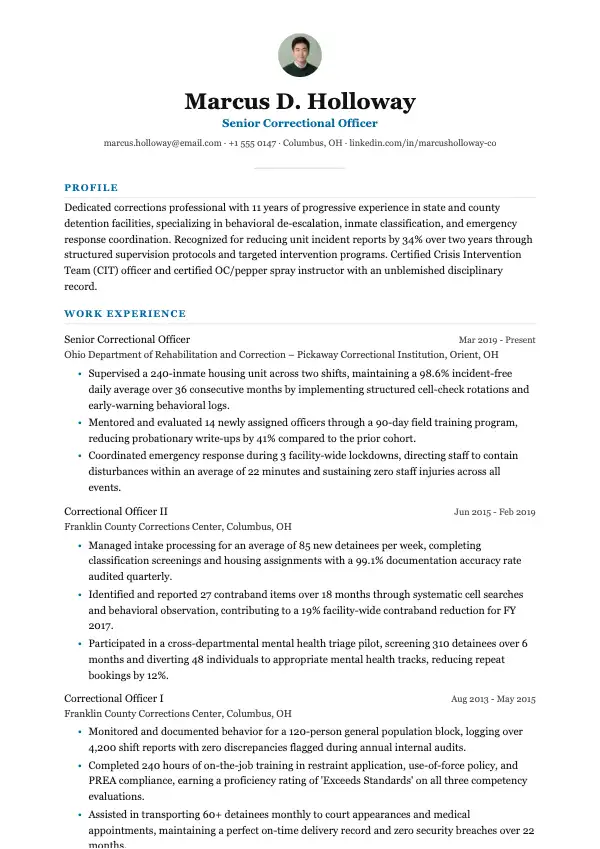
Marcus D. Holloway
Senior Correctional Officer
marcus.holloway@email.com · +1 555 0147 · Columbus, OH · linkedin.com/in/marcusholloway-co
- Profile
- Dedicated corrections professional with 11 years of progressive experience in state and county detention facilities, specializing in behavioral de-escalation, inmate classification, and emergency response coordination. Recognized for reducing unit incident reports by 34% over two years through structured supervision protocols and targeted intervention programs. Certified Crisis Intervention Team (CIT) officer and certified OC/pepper spray instructor with an unblemished disciplinary record.
- Work Experience
Senior Correctional Officer
Ohio Department of Rehabilitation and Correction – Pickaway Correctional Institution, Orient, OH · Mar 2019 - Present
- Supervised a 240-inmate housing unit across two shifts, maintaining a 98.6% incident-free daily average over 36 consecutive months by implementing structured cell-check rotations and early-warning behavioral logs.
- Mentored and evaluated 14 newly assigned officers through a 90-day field training program, reducing probationary write-ups by 41% compared to the prior cohort.
- Coordinated emergency response during 3 facility-wide lockdowns, directing staff to contain disturbances within an average of 22 minutes and sustaining zero staff injuries across all events.
Correctional Officer II
Franklin County Corrections Center, Columbus, OH · Jun 2015 - Feb 2019
- Managed intake processing for an average of 85 new detainees per week, completing classification screenings and housing assignments with a 99.1% documentation accuracy rate audited quarterly.
- Identified and reported 27 contraband items over 18 months through systematic cell searches and behavioral observation, contributing to a 19% facility-wide contraband reduction for FY 2017.
- Participated in a cross-departmental mental health triage pilot, screening 310 detainees over 6 months and diverting 48 individuals to appropriate mental health tracks, reducing repeat bookings by 12%.
Correctional Officer I
Franklin County Corrections Center, Columbus, OH · Aug 2013 - May 2015
- Monitored and documented behavior for a 120-person general population block, logging over 4,200 shift reports with zero discrepancies flagged during annual internal audits.
- Completed 240 hours of on-the-job training in restraint application, use-of-force policy, and PREA compliance, earning a proficiency rating of 'Exceeds Standards' on all three competency evaluations.
- Assisted in transporting 60+ detainees monthly to court appearances and medical appointments, maintaining a perfect on-time delivery record and zero security breaches over 22 months.
- Education
Associate of Applied Science – Criminal Justice
Columbus State Community College, Columbus, OH · 2011 - 2013
Graduated with Honors; coursework in corrections law, behavioral psychology, and institutional security management
- Skills
- Crisis Intervention Team (CIT) Certification · OC/Pepper Spray Instructor Certification · PREA Compliance & Investigations · Inmate Classification & Risk Assessment · Use-of-Force Policy & Restraint Techniques · Incident Report Writing & Documentation · Emergency Response Coordination · Ohio Peace Officer Training Academy (OPOTA) – Corrections Module · Behavioral De-escalation & Conflict Resolution
- Links
- LinkedIn: linkedin.com/in/marcusholloway-co · Certification: OPOTA corrections training #MH-44821 (record on request)
What makes this resume work
- The summary names the CIT and OC instructor certifications in the first paragraph, ensuring those high-value credentials surface before a recruiter reads a single bullet point.
- Every experience bullet pairs an action verb with a specific number — percentages, headcounts, or time spans — replacing vague duty statements with evidence a hiring manager can evaluate at a glance.
- The skills section mirrors the exact terminology used in Ohio DOC and county jail job postings, including 'PREA Compliance,' 'OPOTA,' and 'Inmate Classification,' which are the terms ATS platforms are trained to match.
- The three-role progression from Officer I to Senior Officer tells a clear advancement story without requiring a separate cover letter to explain it, signaling retention and upward trajectory to any screening committee.
Keywords that help you pass the ATS
Work the ones that fit your experience into your resume, naturally, not stuffed.
How to write a Correctional Officer resume
Choose the right format for a Correctional Officer resume
Use a reverse-chronological format. Correctional facilities — county jails, state prisons, federal Bureau of Prisons (BOP) facilities, and private operators like CoreCivic and GEO Group — want to see a clear employment timeline because background investigators will verify every gap. A functional or hybrid format raises red flags with hiring sergeants and HR screeners alike.
Keep the resume to one page if you have fewer than ten years of experience; two pages are acceptable for senior officers or those moving into supervisory roles. Use standard section headers (Work Experience, Skills, Education, Certifications) so applicant tracking systems used by state DOC portals and USAJOBS parse the document correctly. Avoid tables, text boxes, and graphics — many government ATS tools strip them out.
- Margins: 0.75–1 inch; font: Arial or Calibri 10–12pt
- File format: PDF unless the job posting specifically requires .docx
- Contact header can include your state correctional officer certification or license number (POST or your state's equivalent) if you already hold one
Write a professional summary that clears the first cut
Your summary sits at the top and gives the hiring lieutenant a quick reason to keep reading. Skip the objective statement — those are outdated. Write three to four sentences that name your years of experience, the custody level or facility type you've worked in, a standout credential, and one quantifiable achievement.
Example: "State-certified Correctional Officer with 6 years of experience in a Level IV maximum-security facility housing 1,200 inmates. Trained in crisis intervention (CIT), restraint application, and PREA compliance auditing. Maintained a zero use-of-force grievance record over the past three annual reviews. Seeking a senior officer position where experience in gang intelligence documentation and cell extraction team leadership can reduce facility incident rates."
Write work-experience bullets that show measurable impact
Each bullet should follow an action-verb → task → result structure. Vague phrases like 'responsible for inmate supervision' tell the reader nothing. Quantify headcount, incident rates, shift size, or training hours wherever you can. Pull numbers from your annual performance evaluations, shift logs, or facility statistics reports.
Focus on security outcomes, compliance, and leadership — those are the three dimensions supervisors evaluate during promotion boards and lateral hiring panels.
- Supervised daily movement and welfare checks for 180 general-population inmates across two housing units, contributing to a 22% reduction in inmate-on-inmate assaults during FY 2023 compared to the prior year.
- Led a 6-officer cell extraction team through 14 use-of-force incidents over 18 months with zero officer injuries and full OC/force documentation compliance on every report, resulting in no sustained grievances.
Skills and certifications recruiters and ATS systems look for
State DOC postings and federal vacancy announcements on USAJOBS use keyword filtering. Mirror the language in the job posting and include the specific certifications the facility requires. Hard skills and credentials carry far more weight than soft-skill buzzwords.
Separate your skills into a short list rather than burying them in paragraph form. Recruiters scan for licensure and training first, then look at experience.
- State correctional officer certification or license (from your state's POST or equivalent board) — include your state and, if it has one, the expiration date
- CPR/AED and First Aid (AHA or Red Cross, with renewal date)
- Crisis Intervention Team (CIT) or Mental Health First Aid training
- PREA (Prison Rape Elimination Act) compliance and audit procedures
- Tools and systems: Offender Management Network Information (OMNI), VINE, SHU log software, body-worn camera systems, OC/pepper spray and restraint equipment qualification
Education, licenses, and additional credentials
Most entry-level positions require a high school diploma or GED plus completion of a state correctional officer academy (its length varies by agency). List your academy graduation, the certifying body, and the year. If you hold an associate's or bachelor's degree in Criminal Justice, Criminology, or a related field, place it above the academy since it often qualifies you for higher starting pay steps or accelerated promotion timelines.
Military service translates well in this field — list your MOS if it involved law enforcement, corrections, or security duties (e.g., 31B Military Police, MA Navy Master-at-Arms). Veterans applying to federal BOP positions should note their veterans' preference points on USAJOBS applications and attach the DD-214. Include any in-service training relevant to corrections: brig duty, detainee operations, or confinement facility assignments.
Mistakes to avoid
- Listing 'inmate supervision' as a standalone bullet without specifying custody level, headcount, or security outcome makes your experience impossible to evaluate against other candidates.
- Omitting your correctional certification's state and status forces recruiters to follow up, and many won't bother when they have a stack of complete applications.
- Using law enforcement jargon from a different field — such as 'patrol' or 'citation' — signals to corrections hiring panels that you don't understand the distinct operational environment of a correctional facility.
- Leaving unexplained employment gaps on a corrections resume is a serious problem because every gap triggers scrutiny during the mandatory background investigation; add a brief note (e.g., 'Career break — family caregiving') rather than leaving the timeline silent.
Frequently asked questions
- Do I need a cover letter when applying for a correctional officer job?
- For county and municipal jail positions, a cover letter is rarely required but can help if you're making a lateral move from a different security field. For state DOC and federal BOP applications, the cover letter matters less than your completed application packet, background questionnaire, and medical/physical fitness documentation. When in doubt, include a one-page letter — it never hurts and occasionally makes a difference with a civilian HR screener.
- How do I address a termination or disciplinary action on a correctional officer resume?
- Do not address it on the resume itself — the resume is not the place for explanations. Background investigators will surface it regardless, so prepare a clear, factual verbal explanation for the interview and the background questionnaire. Attempting to obscure or omit a termination on a government application is grounds for automatic disqualification and potential fraud charges.
- Can I use my military corrections or security experience on a civilian correctional officer resume?
- Yes, and it is a strong asset — translate your MOS duties into civilian corrections language. For example, 'supervised 40 pretrial detainees in a Level II confinement facility' is more useful than citing your MOS code alone. Many state DOC systems and the federal BOP have formal military crosswalk policies that give veterans credit toward experience requirements, so confirm with the specific agency's HR office.
Make it yours in minutes
Open this example in the builder, swap in your details, and export a clean, ATS-ready resume.
Once your resume is ready
More for this application
- Template style
- Professional resume templates