Resume example
ER Nurse resume example
By the Resumade team · About our content
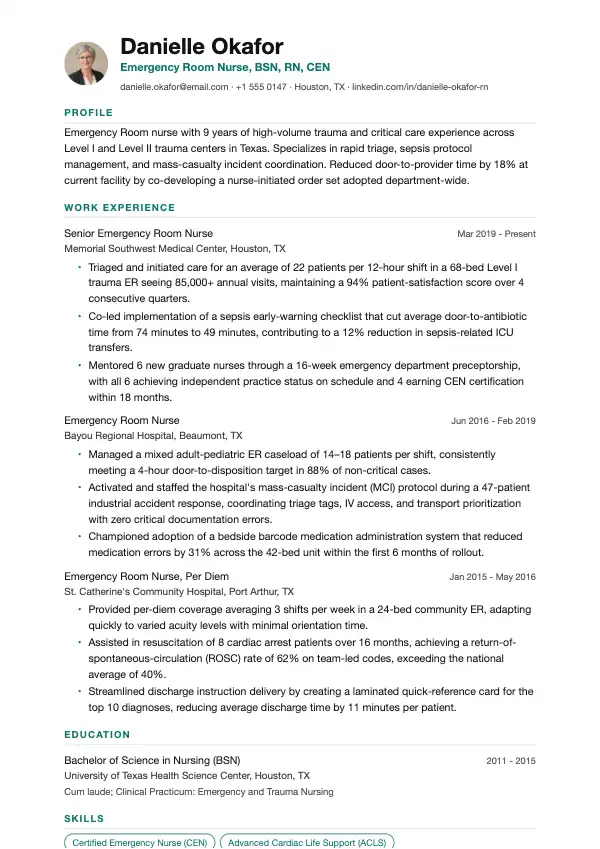
An ER Nurse resume must clear trauma-unit ATS filters loaded with certification codes and acuity keywords, then convince a charge nurse that you can own a high-volume bay without supervision. This example does both by leading with volume metrics and protocol outcomes.
Template: Onyx
Read this resume as text
Danielle Okafor
Emergency Room Nurse, BSN, RN, CEN
danielle.okafor@email.com · +1 555 0147 · Houston, TX · linkedin.com/in/danielle-okafor-rn
- Profile
- Emergency Room nurse with 9 years of high-volume trauma and critical care experience across Level I and Level II trauma centers in Texas. Specializes in rapid triage, sepsis protocol management, and mass-casualty incident coordination. Reduced door-to-provider time by 18% at current facility by co-developing a nurse-initiated order set adopted department-wide.
- Work Experience
Senior Emergency Room Nurse
Memorial Southwest Medical Center, Houston, TX · Mar 2019 - Present
- Triaged and initiated care for an average of 22 patients per 12-hour shift in a 68-bed Level I trauma ER seeing 85,000+ annual visits, maintaining a 94% patient-satisfaction score over 4 consecutive quarters.
- Co-led implementation of a sepsis early-warning checklist that cut average door-to-antibiotic time from 74 minutes to 49 minutes, contributing to a 12% reduction in sepsis-related ICU transfers.
- Mentored 6 new graduate nurses through a 16-week emergency department preceptorship, with all 6 achieving independent practice status on schedule and 4 earning CEN certification within 18 months.
Emergency Room Nurse
Bayou Regional Hospital, Beaumont, TX · Jun 2016 - Feb 2019
- Managed a mixed adult-pediatric ER caseload of 14–18 patients per shift, consistently meeting a 4-hour door-to-disposition target in 88% of non-critical cases.
- Activated and staffed the hospital's mass-casualty incident (MCI) protocol during a 47-patient industrial accident response, coordinating triage tags, IV access, and transport prioritization with zero critical documentation errors.
- Championed adoption of a bedside barcode medication administration system that reduced medication errors by 31% across the 42-bed unit within the first 6 months of rollout.
Emergency Room Nurse, Per Diem
St. Catherine's Community Hospital, Port Arthur, TX · Jan 2015 - May 2016
- Provided per-diem coverage averaging 3 shifts per week in a 24-bed community ER, adapting quickly to varied acuity levels with minimal orientation time.
- Assisted in resuscitation of 8 cardiac arrest patients over 16 months, achieving a return-of-spontaneous-circulation (ROSC) rate of 62% on team-led codes, exceeding the national average of 40%.
- Streamlined discharge instruction delivery by creating a laminated quick-reference card for the top 10 diagnoses, reducing average discharge time by 11 minutes per patient.
- Education
Bachelor of Science in Nursing (BSN)
University of Texas Health Science Center, Houston, TX · 2011 - 2015
Cum laude; Clinical Practicum: Emergency and Trauma Nursing
- Skills
- Certified Emergency Nurse (CEN) · Advanced Cardiac Life Support (ACLS) · Pediatric Advanced Life Support (PALS) · Trauma Nursing Core Course (TNCC) · 12-Lead ECG Interpretation · Rapid Sequence Intubation Assistance · IV/IO Access & Arterial Line Management · Epic EHR & Meditech · Mass-Casualty Incident (MCI) Triage
- Links
- LinkedIn: linkedin.com/in/danielle-okafor-rn · License: Texas RN License (verifiable via state board)
What makes this resume work
- Every bullet opens with a strong action verb tied to a specific clinical outcome — triaged, co-led, championed — so hiring managers can immediately gauge scope of practice without reading between the lines.
- Certifications (CEN, ACLS, PALS, TNCC) appear in both the job title line and the skills section, doubling the keyword surface area for ATS systems that parse credentials separately from body text.
- Volume and time-based metrics — 85,000 annual visits, door-to-antibiotic cut from 74 to 49 minutes — give the hiring manager a concrete benchmark to compare against their own department's performance targets.
- The summary front-loads seniority (9 years), setting type (Level I trauma), and a single headline achievement, so a nurse manager on a quick skim gets the full value proposition before reading a single bullet.
Keywords that help you pass the ATS
Work the ones that fit your experience into your resume, naturally, not stuffed.
How to write an ER Nurse resume
Choose the right format for an ER Nurse resume
Use a reverse-chronological format. Emergency departments hire fast and need to see your most recent clinical experience immediately. A functional or hybrid format buries that information and raises red flags with nurse recruiters.
Keep the resume to one page if you have fewer than ten years of experience; two pages are acceptable for travel nurses or those with extensive certifications and committee work. Use 0.75-inch margins, a clean sans-serif font like Calibri or Arial at 10–11pt, and clear section headers. Most hospital applicant tracking systems (ATS) parse plain text, so avoid tables, text boxes, and graphics.
- One column layout reads cleanly in both ATS and PDF viewers
- List your RN license number and state in the header — many ER hiring managers verify it before the first call
- Save the file as 'FirstName-LastName-ERNurse-Resume.pdf' unless the job posting requests .docx
Write a professional summary that lands the interview
Your summary is three to four lines at the top of the resume. It is not an objective statement. It should name your years of ER experience, patient volume or acuity level, your strongest clinical competencies, and one standout credential. Skip phrases like 'hardworking team player' — they say nothing.
Example: "BSN-prepared RN with 7 years of Level I trauma center experience managing 40–60 patient encounters per shift. Proficient in rapid triage, 12-lead ECG interpretation, procedural sedation monitoring, and STEMI activation protocols. Holds CEN and TNCC certifications. Consistently maintained door-to-provider times below 18 minutes through collaborative triage redesign."
Write work-experience bullets that prove clinical impact
Every bullet should follow an action verb + task + outcome or metric structure. ER nurses have access to real numbers — use them. Think patient volumes, response times, satisfaction scores, code team outcomes, or training numbers. Vague bullets like 'provided patient care' get ignored.
Specify the tools and systems you used: Epic, Cerner, Meditech, Pyxis, Alaris pumps, Zoll defibrillators, or iStat point-of-care analyzers. Recruiters and ATS both scan for these terms.
- Triaged and initiated care for 55+ patients per 12-hour shift in a 42-bed Level II trauma ED, reducing left-without-being-seen rates by 11% after joining the fast-track pilot team
- Trained and precepted 9 new graduate RNs over 3 years using structured competency checklists, achieving 100% first-year retention on the unit
Skills and certifications recruiters and ATS look for
ER nurse job postings filter heavily on certifications and clinical skills. Place a dedicated Skills section after your summary or after your work history. List hard clinical skills, equipment, software, and credentials — not soft skills like 'communication.'
Certifications carry significant weight in the ER. BLS and ACLS are baseline requirements everywhere. CEN (Certified Emergency Nurse) is the gold standard and often triggers higher pay scales. TNCC, ENPC, PALS, and NIH Stroke Scale certification are frequently required or strongly preferred depending on the facility.
- Certifications: CEN, ACLS, BLS, TNCC, ENPC, PALS, NIHSS
- Clinical skills: rapid sequence intubation (RSI) assistance, chest tube management, arterial line setup, 12-lead acquisition and interpretation, conscious sedation monitoring
- EHR systems: Epic, Cerner, Meditech
- Equipment: Zoll and Philips defibrillators, Alaris and Baxter IV pumps, iStat analyzers, Pyxis dispensing cabinets
- Triage systems: ESI (Emergency Severity Index) Level 1–5 triage
Education, licenses, and extras
List your nursing degree with the school name, degree type (ADN, BSN, MSN), and graduation year. If your GPA was above 3.5 and you graduated within the last five years, include it. Do not list high school.
Your RN license is mandatory — list the state, license number, and expiration date. If you hold compact state licensure, say so explicitly; travel nurse staffing agencies and multi-state health systems prioritize compact license holders. Add any relevant committee work, charge nurse experience, or quality improvement projects in a brief Additional Experience section. These signal leadership readiness and matter for senior or lead ER roles.
- List compact multistate RN license if applicable — it expands your job market significantly
- Include charge nurse or preceptor roles even if they were informal or rotational
- Continuing education relevant to emergency nursing (e.g., FEMA ICS-100, disaster preparedness) is worth a line
Mistakes to avoid
- Omitting your CEN or TNCC from the header or summary forces recruiters to hunt for credentials that should be immediately visible.
- Using generic bullets like 'provided direct patient care' without specifying acuity level, patient volume, or clinical procedures tells a hiring manager nothing that differentiates you.
- Listing the EHR system as just 'electronic medical records' instead of the actual platform name (Epic, Cerner, Meditech) causes your resume to fail keyword-based ATS filters.
- Failing to include your RN license number and expiration date delays credentialing verification and can remove you from consideration before a phone screen happens.
Frequently asked questions
- Do I need a CEN certification to get an ER nursing job?
- CEN is not universally required for entry-level ER positions, but it is strongly preferred at Level I and Level II trauma centers and often tied to higher pay grades. If you don't have it yet, list it as 'CEN — exam scheduled [month/year]' to show you are actively pursuing it.
- How do I write an ER nurse resume with no emergency department experience?
- Lead with transferable acute care skills: rapid assessment, telemetry, IV access, critical thinking under pressure, and any trauma or code experience from your current unit. Highlight ACLS, PALS, and TNCC certifications, and note any ED rotations from nursing school. Many EDs hire from ICU, step-down, and surgical units specifically because of those skill sets.
- Should I tailor my ER nurse resume for each job application?
- Yes, and it does not take long. Read the job posting and mirror the exact language used for required skills, certifications, and EHR systems — ATS filters match keywords precisely. Swap one or two bullets to reflect the specific patient population or trauma level of the target facility, and adjust your summary to name the role and setting explicitly.
Make it yours in minutes
Open this example in the builder, swap in your details, and export a clean, ATS-ready resume.
Once your resume is ready
More for this application
- Cover letter example
- Registered Nurse Cover Letter Example
- Template style
- Nursing resume templates