Resume example
Front-End Developer resume example
By the Resumade team · About our content
A strong Front-End Developer resume must clear ATS keyword filters on frameworks and tooling, then immediately show a hiring manager that you move metrics, not just markup. This example leads with a quantified summary, stacks impact-first bullets, and surfaces every major recruiter search term organically.
Template: Cadence
Read this resume as text
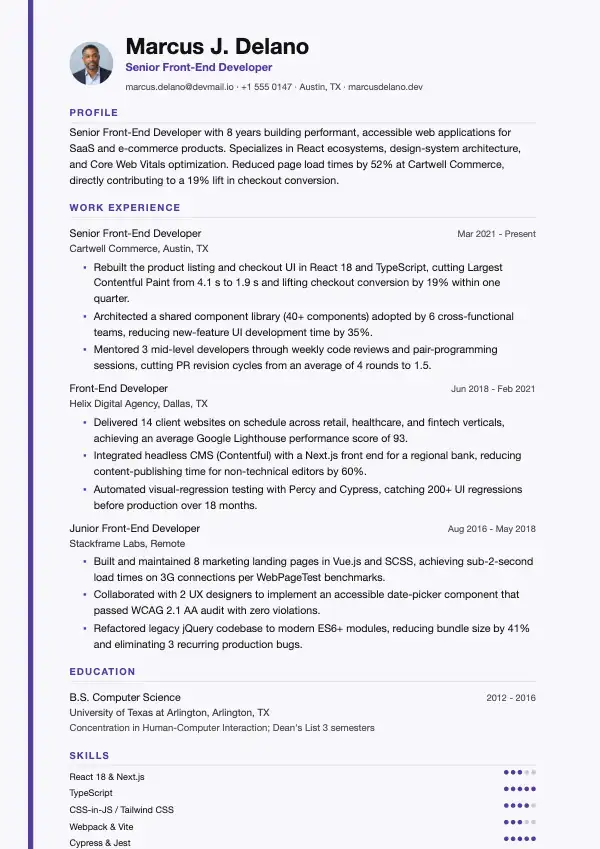
Marcus J. Delano
Senior Front-End Developer
marcus.delano@devmail.io · +1 555 0147 · Austin, TX · marcusdelano.dev
- Profile
- Senior Front-End Developer with 8 years building performant, accessible web applications for SaaS and e-commerce products. Specializes in React ecosystems, design-system architecture, and Core Web Vitals optimization. Reduced page load times by 52% at Cartwell Commerce, directly contributing to a 19% lift in checkout conversion.
- Work Experience
Senior Front-End Developer
Cartwell Commerce, Austin, TX · Mar 2021 - Present
- Rebuilt the product listing and checkout UI in React 18 and TypeScript, cutting Largest Contentful Paint from 4.1 s to 1.9 s and lifting checkout conversion by 19% within one quarter.
- Architected a shared component library (40+ components) adopted by 6 cross-functional teams, reducing new-feature UI development time by 35%.
- Mentored 3 mid-level developers through weekly code reviews and pair-programming sessions, cutting PR revision cycles from an average of 4 rounds to 1.5.
Front-End Developer
Helix Digital Agency, Dallas, TX · Jun 2018 - Feb 2021
- Delivered 14 client websites on schedule across retail, healthcare, and fintech verticals, achieving an average Google Lighthouse performance score of 93.
- Integrated headless CMS (Contentful) with a Next.js front end for a regional bank, reducing content-publishing time for non-technical editors by 60%.
- Automated visual-regression testing with Percy and Cypress, catching 200+ UI regressions before production over 18 months.
Junior Front-End Developer
Stackframe Labs, Remote · Aug 2016 - May 2018
- Built and maintained 8 marketing landing pages in Vue.js and SCSS, achieving sub-2-second load times on 3G connections per WebPageTest benchmarks.
- Collaborated with 2 UX designers to implement an accessible date-picker component that passed WCAG 2.1 AA audit with zero violations.
- Refactored legacy jQuery codebase to modern ES6+ modules, reducing bundle size by 41% and eliminating 3 recurring production bugs.
- Education
B.S. Computer Science
University of Texas at Arlington, Arlington, TX · 2012 - 2016
Concentration in Human-Computer Interaction; Dean's List 3 semesters
- Skills
- React 18 & Next.js · TypeScript · CSS-in-JS / Tailwind CSS · Webpack & Vite · Cypress & Jest · Web Accessibility (WCAG 2.1 AA) · Core Web Vitals Optimization · GraphQL & REST API Integration · Figma-to-Code Handoff
- Links
- Portfolio: marcusdelano.dev · GitHub: github.com/marcusdelano · LinkedIn: linkedin.com/in/marcusdelano
What makes this resume work
- The summary opens with seniority and years of experience in the first five words, then closes with a specific conversion-rate result — giving both ATS and humans an instant signal of value.
- Every bullet follows an action-verb → task → measurable-outcome structure (e.g., percentages, counts, time savings), making impact scannable at a glance for each role.
- The skills section lists exact tool names recruiters filter by — 'React 18 & Next.js,' 'WCAG 2.1 AA,' 'Core Web Vitals Optimization' — rather than vague categories like 'JavaScript frameworks.'
- Three portfolio/GitHub/LinkedIn links appear in the header so a recruiter or ATS parser captures them immediately, without hunting through the document.
Keywords that help you pass the ATS
Work the ones that fit your experience into your resume, naturally, not stuffed.
How to write a Front-End Developer resume
Choose the right format for a Front-End Developer resume
Use a reverse-chronological format unless you are switching careers or have fewer than two years of experience, in which case a hybrid format works better. Keep your resume to one page if you have under eight years of experience; two pages are acceptable beyond that, but every line must earn its place.
Lead with a header that includes your name, city and state (no full street address), phone, professional email, GitHub profile URL, and a portfolio or personal site link. Recruiters at companies like Google, Meta, and mid-size product startups will click your GitHub before they finish reading your summary, so make sure pinned repos are current and READMEs are clean.
- Use clean, single-column or two-column layouts that parse correctly through ATS tools like Greenhouse, Lever, and Workday
- Set margins between 0.5 and 1 inch; use 10–12pt font in a sans-serif face such as Calibri or Inter
- Save and submit as a PDF unless the job posting explicitly requests a .docx file
- Place your portfolio link in the header, not buried in a skills section
Write a professional summary that positions you clearly
Your summary is three to four sentences that answer: what you build, how long you have been doing it, what stack you live in, and what kind of impact you have had. Skip objectives like 'seeking a challenging role.' Hiring managers read dozens of resumes; tell them immediately why you are worth the next five minutes.
Here is a strong example for a mid-level candidate: "Front-End Developer with six years of experience building performant, accessible web applications in React and TypeScript. Reduced Lighthouse performance scores from 54 to 91 on a high-traffic e-commerce platform serving 2M monthly users. Comfortable owning the full UI layer from design-system tokens to CI/CD pipeline integration. Seeking a product-focused team where component architecture and Core Web Vitals actually matter."
Write work-experience bullets that show impact, not just activity
Each bullet should follow an action verb → task → measurable result structure. Avoid vague phrases like 'worked on' or 'helped with.' Name the actual framework, library, or tool you used, and quantify the outcome whenever possible — load times, bundle sizes, sprint velocity, user engagement, error rates, or revenue impact all count.
If you cannot find an exact number, use a reasonable range or a percentage derived from analytics tools like Google Lighthouse, Datadog, or New Relic. Two strong examples are shown below.
- Rebuilt the product listing page in Next.js 14 with React Server Components, cutting Time to First Byte from 1.8s to 340ms and increasing organic conversion rate by 12% over 90 days
- Architected a shared component library in Storybook using Radix UI primitives and Tailwind CSS, reducing cross-team UI inconsistencies by 40% and cutting new-feature build time by an estimated 30%
Skills and certifications recruiters and ATS systems look for
Front-end job descriptions are highly keyword-driven. Pull exact terms from the postings you are targeting and mirror them in your skills section and bullet points. Group skills by category — core languages, frameworks, tooling, and testing — so a recruiter can scan it at a glance.
Certifications carry real weight when they come from recognized sources. The Meta Front-End Developer Professional Certificate (Coursera), AWS Certified Developer – Associate, and Google's Web Performance certification are commonly listed on job postings. Accessibility credentials such as the IAAP Web Accessibility Specialist (WAS) are increasingly valued, especially at enterprise employers subject to WCAG 2.1 AA compliance requirements.
- Core languages: HTML5, CSS3, JavaScript (ES2022+), TypeScript
- Frameworks and libraries: React, Next.js, Vue 3, Angular, Svelte
- Tooling: Webpack, Vite, ESLint, Prettier, Nx, Docker
- Testing: Jest, React Testing Library, Cypress, Playwright
- Other in-demand terms: Core Web Vitals, WCAG 2.1, REST APIs, GraphQL, Git, CI/CD, Figma handoff
Education, licenses, and extras that round out your resume
List your highest degree first: degree name, institution, and graduation year. GPA is optional and only worth including if it is 3.5 or above and you graduated within the last three years. A CS or Software Engineering degree is common but not required — many hired front-end developers hold degrees in design, communications, or unrelated fields, so do not apologize for your path.
Below education, add a short section for open-source contributions, technical blog posts, conference talks (even local meetups), or notable side projects with live URLs. These extras differentiate you from candidates with identical stacks. If you have contributed meaningfully to a well-known open-source project — even a merged pull request to a popular npm package — name it explicitly.
- Include bootcamp credentials (e.g., App Academy, Flatiron School) if they are your primary training; list them as you would a degree
- Link to any published npm packages, Chrome extensions, or public repos with real usage stats
- List spoken languages if you are applying to companies with global or multilingual user bases
Mistakes to avoid
- Listing every technology you have ever touched rather than the stack you can defend in a technical interview creates credibility problems when interviewers probe your depth.
- Omitting portfolio and GitHub links — or linking to repos with no commits in the past year and no READMEs — is one of the fastest ways to lose a front-end reviewer's interest.
- Writing bullets that describe responsibilities ('responsible for maintaining the React codebase') instead of outcomes makes your resume indistinguishable from every other candidate at your level.
- Using a heavily styled, multi-column resume template with icons, progress bars, and custom fonts often breaks ATS parsing and causes your skills and job titles to be read out of order or dropped entirely.
Frequently asked questions
- Should I include a portfolio link on my Front-End Developer resume?
- Yes, and it should be in your header, not an afterthought. Front-end roles are one of the few where a portfolio is considered near-mandatory — it lets hiring managers verify your visual and technical standards before a phone screen. Make sure the site loads fast, is mobile-responsive, and showcases two to four projects with brief case-study notes explaining the problem, your approach, and the result.
- How do I list React or other frameworks on my resume without looking like I'm just name-dropping?
- Anchor every framework mention to a specific project or outcome in your work-experience bullets — for example, 'Built a real-time dashboard in React Query and Recharts that replaced a legacy jQuery table, reducing data-refresh latency from 8s to under 1s.' This proves you used the tool in production rather than in a tutorial. In your skills section, a simple list is fine, but the bullets are where credibility is established.
- Is a two-page Front-End Developer resume ever acceptable?
- Two pages are reasonable if you have eight or more years of experience with multiple roles, a meaningful open-source history, or conference and publication credits that are genuinely relevant. If you are stretching a five-year career onto two pages by padding bullet points or listing every course you have ever taken, cut it back to one. Recruiters spend about seven seconds on an initial pass (Ladders eye-tracking study, 2018), so density and relevance matter more than length.
Make it yours in minutes
Open this example in the builder, swap in your details, and export a clean, ATS-ready resume.
Once your resume is ready
More for this application
- Cover letter example
- Web Developer Cover Letter Example
- Template style
- Software Engineer resume templates