Resume example
Mechanical Engineer resume example
By the Resumade team · About our content
A mechanical engineer resume is searched for tools and methodologies, then read for engineering impact, so it has to work for the ATS and the manager. This example pairs domain-specific hard skills with quantified impact to do both jobs at once.
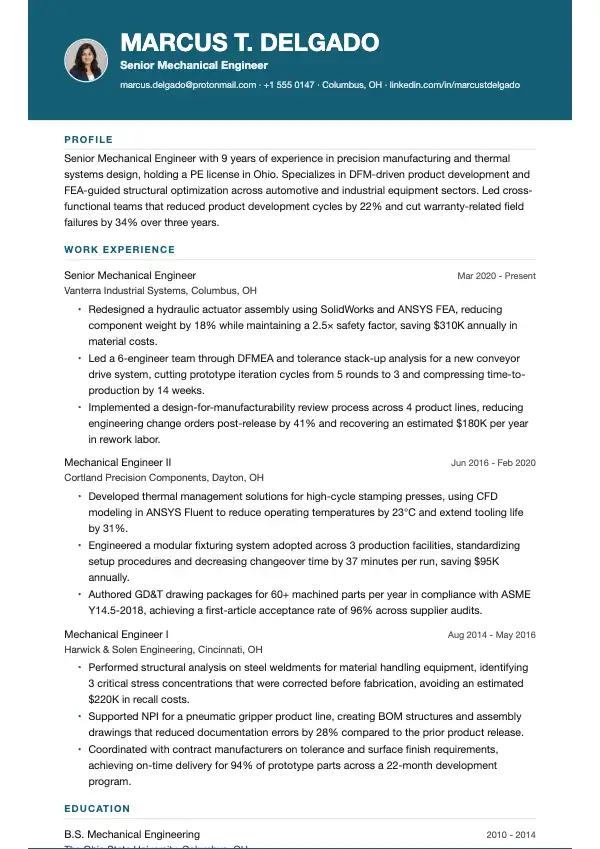
Template: Vermilion
Read this resume as text
Marcus T. Delgado
Senior Mechanical Engineer
marcus.delgado@protonmail.com · +1 555 0147 · Columbus, OH · linkedin.com/in/marcustdelgado
- Profile
- Senior Mechanical Engineer with 9 years of experience in precision manufacturing and thermal systems design, holding a PE license in Ohio. Specializes in DFM-driven product development and FEA-guided structural optimization across automotive and industrial equipment sectors. Led cross-functional teams that reduced product development cycles by 22% and cut warranty-related field failures by 34% over three years.
- Work Experience
Senior Mechanical Engineer
Vanterra Industrial Systems, Columbus, OH · Mar 2020 - Present
- Redesigned a hydraulic actuator assembly using SolidWorks and ANSYS FEA, reducing component weight by 18% while maintaining a 2.5× safety factor, saving $310K annually in material costs.
- Led a 6-engineer team through DFMEA and tolerance stack-up analysis for a new conveyor drive system, cutting prototype iteration cycles from 5 rounds to 3 and compressing time-to-production by 14 weeks.
- Implemented a design-for-manufacturability review process across 4 product lines, reducing engineering change orders post-release by 41% and recovering an estimated $180K per year in rework labor.
Mechanical Engineer II
Cortland Precision Components, Dayton, OH · Jun 2016 - Feb 2020
- Developed thermal management solutions for high-cycle stamping presses, using CFD modeling in ANSYS Fluent to reduce operating temperatures by 23°C and extend tooling life by 31%.
- Engineered a modular fixturing system adopted across 3 production facilities, standardizing setup procedures and decreasing changeover time by 37 minutes per run, saving $95K annually.
- Authored GD&T drawing packages for 60+ machined parts per year in compliance with ASME Y14.5-2018, achieving a first-article acceptance rate of 96% across supplier audits.
Mechanical Engineer I
Harwick & Solen Engineering, Cincinnati, OH · Aug 2014 - May 2016
- Performed structural analysis on steel weldments for material handling equipment, identifying 3 critical stress concentrations that were corrected before fabrication, avoiding an estimated $220K in recall costs.
- Supported NPI for a pneumatic gripper product line, creating BOM structures and assembly drawings that reduced documentation errors by 28% compared to the prior product release.
- Coordinated with contract manufacturers on tolerance and surface finish requirements, achieving on-time delivery for 94% of prototype parts across a 22-month development program.
- Education
B.S. Mechanical Engineering
The Ohio State University, Columbus, OH · 2010 - 2014
Minor in Materials Science; GPA 3.7; ASME Student Chapter President 2013–2014
- Skills
- SolidWorks (CSWA Certified) · ANSYS FEA & Fluent CFD · GD&T / ASME Y14.5-2018 · DFMEA & PFMEA · Design for Manufacturability (DFM) · Hydraulic & Pneumatic Systems · Thermal Systems Design · PE License – Ohio (#ME-48821) · MathWorks MATLAB
- Links
- LinkedIn: linkedin.com/in/marcustdelgado · PE License: Ohio Professional Engineer License #ME-48821 (verifiable via state board)
What makes this resume work
- Every bullet opens with a strong action verb tied to a specific engineering discipline—redesigned, developed, engineered—so a hiring manager immediately understands scope without reading the full line.
- The skills section names exact tools and certifications (SolidWorks CSWA, ANSYS Fluent, PE License with a real-format number) rather than broad categories, matching the literal strings recruiters type into ATS search fields.
- Metrics are engineering-credible: weight reduction percentages, temperature deltas in °C, and dollar savings derived from labor or material costs—not vague 'improved efficiency' claims that any candidate could copy.
- The summary front-loads seniority, years of experience, PE licensure, and two headline results in three sentences, giving a recruiter on a quick skim every reason to keep reading before reaching the experience section.
Keywords that help you pass the ATS
Work the ones that fit your experience into your resume, naturally, not stuffed.
How to write a Mechanical Engineer resume
Choose the right format for a Mechanical Engineer resume
Use a reverse-chronological format for almost every mechanical engineering role. Hiring managers at manufacturers, defense contractors, and aerospace firms want to see your most recent project work first, because your current tools, software versions, and industry exposure matter more than your earliest jobs.
Keep your resume to one page if you have fewer than ten years of experience; two pages are acceptable for senior engineers or those with extensive project portfolios, publications, or patents. Use clean section headers, consistent font sizing (10–12 pt body text), and enough white space so an ATS can parse it without errors. Avoid tables, text boxes, and graphics — they break parsing in most applicant tracking systems used by companies like Siemens, Caterpillar, and Lockheed Martin.
- Reverse-chronological order, most recent role at the top
- One page for 0–9 years of experience; two pages maximum for senior engineers
- Standard section order: Summary, Skills, Experience, Education, Certifications
- Save and submit as a PDF unless the job posting explicitly requests a Word file
Write a professional summary that targets the specific role
Your summary sits directly below your name and contact information. It should be three to four sentences that name your engineering discipline, years of experience, the industries you know, and one or two measurable achievements. Skip objective statements — they tell the employer what you want, not what you deliver.
Tailor the summary to each job posting by mirroring its language. If the posting says 'thermal management' or 'GD&T,' use those exact phrases. Here is an example of a strong summary for a mid-level mechanical engineer: "Mechanical engineer with seven years of experience in product development for the automotive and consumer electronics industries. Proficient in SolidWorks, ANSYS Mechanical, and DFMEA methodology. Led cross-functional teams to reduce component weight by 18% on a high-volume injection-molded assembly, cutting unit cost by $1.40. Seeking a senior design role where structural simulation and DFM expertise drive product performance."
Write work-experience bullets that show impact, not just duties
Each bullet should follow an action verb + task + measurable result structure. Recruiters spend about seven seconds on an initial scan (Ladders eye-tracking study, 2018), so front-load the achievement. Quantify everything you can: cycle time, cost savings, weight reduction, tolerance improvements, prototype iterations, or on-time delivery rates. Generic phrases like 'responsible for mechanical design' waste space and get ignored.
Pull metrics directly from project closeout reports, engineering change orders, or your performance reviews. If an exact number is confidential, use a range or a percentage. Two example bullets that demonstrate the right approach:
- Redesigned a hydraulic manifold assembly in CATIA V5, reducing machining operations by 30% and cutting per-unit cost from $340 to $218 across a 12,000-unit annual production run.
- Led FEA stress analysis in ANSYS Workbench for a structural bracket subjected to 15g shock loads, identifying a wall-thickness change that eliminated three field failures per quarter and avoided a $220K recall.
Skills and certifications recruiters and ATS systems look for
Build a dedicated skills section and load it with the specific tools and methodologies listed in job postings. Generic terms like 'CAD' or 'engineering software' will not match ATS keyword filters. Name the actual software version or platform when relevant. Certifications should appear in this section or in a dedicated certifications block with the issuing body and year.
Prioritize hard technical skills over soft skills in this section. Communication and teamwork belong in your bullet points as demonstrated behaviors, not as listed competencies.
- CAD/CAE tools: SolidWorks, CATIA V5/V6, Creo Parametric, AutoCAD, NX, ANSYS Mechanical, ANSYS Fluent, Abaqus
- Methodologies: GD&T (ASME Y14.5), DFMEA, PFMEA, DFM, DFA, Six Sigma, Design of Experiments (DOE), tolerance stack-up analysis
- Certifications: PE (Professional Engineer) license, Certified SolidWorks Professional (CSWP), Six Sigma Green or Black Belt, PMP, AWS Certified Welder (if applicable)
- Standards: ASME, ISO 9001, MIL-SPEC, ASTM material standards
- Programming and simulation: MATLAB, Python (for data analysis or automation scripts), LabVIEW
Education, licenses, and extras that close the deal
List your highest degree first: degree name, major, university, and graduation year. For mechanical engineering, a BS in Mechanical Engineering (or closely related field) from an ABET-accredited program is the baseline expectation at most employers. Include your GPA only if it is 3.5 or above and you graduated within the last three years. List your PE license in both the skills section and the education section with your state and license number — many government and infrastructure roles require it, and it is a significant differentiator in private industry too.
Add an extras section if you have patents (list patent number and title), relevant publications, conference presentations (ASME, SAE, AIAA), or professional memberships such as ASME, SAE International, or NSPE. If you hold a security clearance, state the level and status — this is critical for defense and aerospace roles at companies like Raytheon, Boeing, or General Dynamics. Do not include a photo, age, or marital status on a US resume.
- ABET-accredited BS or MS in Mechanical Engineering is the standard baseline
- PE license: include state, license number, and year obtained
- Patents: list number, title, and filing or grant year
- Security clearance level and current status if applicable
Mistakes to avoid
- Listing CAD or simulation software without naming the specific tool — write 'ANSYS Mechanical R2023' not 'FEA software,' because ATS filters match exact product names.
- Omitting units and scale from project descriptions, which makes achievements unverifiable and forces a recruiter to guess whether your 'large assembly' had ten parts or ten thousand.
- Burying the PE license at the bottom of the resume when it is a legal requirement or strong differentiator for the target role — it should appear in your summary and skills section, not only in education.
- Using a resume template with multi-column layouts or embedded graphics that cause ANSYS, SolidWorks, or other technical keywords to be dropped or scrambled when parsed by an ATS.
Frequently asked questions
- Should a mechanical engineer include a portfolio or project attachments with their resume?
- Include a link to an online portfolio — a personal site, GitHub repository, or Google Drive folder — directly in your contact header if you have CAD models, simulation results, or prototypes worth showing. Do not attach files unless the job posting asks for them, because many ATS platforms strip attachments. Mention the most impressive project briefly in your summary so a recruiter knows the portfolio exists.
- How important is a PE license for a mechanical engineering resume?
- It depends on the sector. Civil and structural engineering roles often require it, especially at senior levels, and government, municipal, and infrastructure clients often mandate a licensed engineer of record. In product development, aerospace, or consumer electronics, a PE is less commonly required but still signals credibility and professional commitment. If you are EIT-certified and working toward your PE, list 'Engineer in Training (EIT), [State], [Year]' so hiring managers know you are on the path.
- What is the best way to handle a mechanical engineering resume when switching industries, for example from automotive to aerospace?
- Lead with transferable technical skills — FEA, tolerance analysis, GD&T, materials selection — that apply across both industries, and reframe your bullet points around outcomes rather than industry-specific jargon. In your summary, explicitly state the target industry and connect your background to it: note that automotive lightweight structures and aerospace structural optimization share the same fundamental physics and toolsets. Obtaining an aerospace-adjacent certification such as AS9100 awareness training or a relevant AIAA membership can also signal genuine intent to make the move.
Make it yours in minutes
Open this example in the builder, swap in your details, and export a clean, ATS-ready resume.
Once your resume is ready
More for this application
- Cover letter example
- Mechanical Engineer Cover Letter Example
- Template style
- Simple resume templates