Resume example
Nutritionist resume example
By the Resumade team · About our content
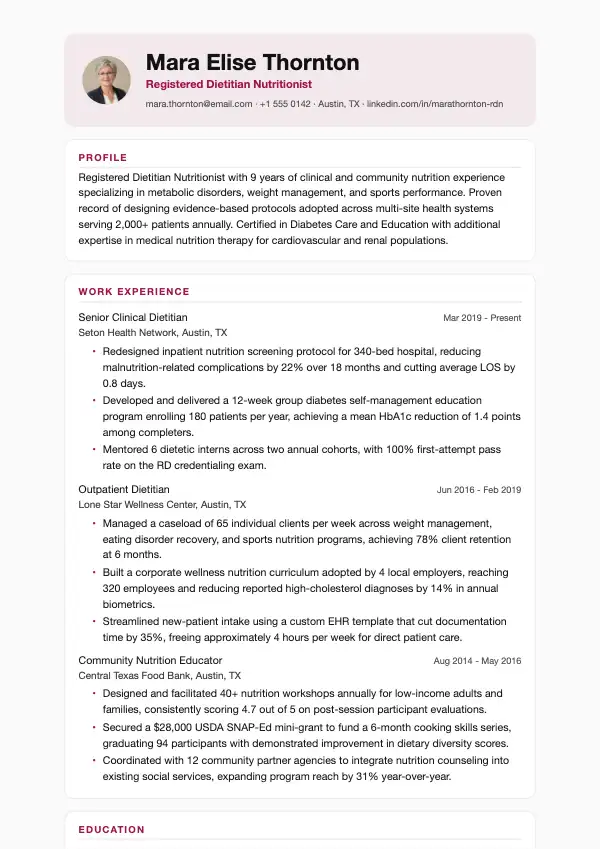
A Nutritionist resume needs credentials like RDN and CDCES where a recruiter's search will find them, and numbers that prove clinical impact. This example does both by surfacing certifications in the title line and loading every bullet with a measurable outcome.
Template: Portrait
Read this resume as text
Mara Elise Thornton
Registered Dietitian Nutritionist
mara.thornton@email.com · +1 555 0142 · Austin, TX · linkedin.com/in/marathornton-rdn
- Profile
- Registered Dietitian Nutritionist with 9 years of clinical and community nutrition experience specializing in metabolic disorders, weight management, and sports performance. Proven record of designing evidence-based protocols adopted across multi-site health systems serving 2,000+ patients annually. Certified in Diabetes Care and Education with additional expertise in medical nutrition therapy for cardiovascular and renal populations.
- Work Experience
Senior Clinical Dietitian
Seton Health Network, Austin, TX · Mar 2019 - Present
- Redesigned inpatient nutrition screening protocol for 340-bed hospital, reducing malnutrition-related complications by 22% over 18 months and cutting average LOS by 0.8 days.
- Developed and delivered a 12-week group diabetes self-management education program enrolling 180 patients per year, achieving a mean HbA1c reduction of 1.4 points among completers.
- Mentored 6 dietetic interns across two annual cohorts, with 100% first-attempt pass rate on the RD credentialing exam.
Outpatient Dietitian
Lone Star Wellness Center, Austin, TX · Jun 2016 - Feb 2019
- Managed a caseload of 65 individual clients per week across weight management, eating disorder recovery, and sports nutrition programs, achieving 78% client retention at 6 months.
- Built a corporate wellness nutrition curriculum adopted by 4 local employers, reaching 320 employees and reducing reported high-cholesterol diagnoses by 14% in annual biometrics.
- Streamlined new-patient intake using a custom EHR template that cut documentation time by 35%, freeing approximately 4 hours per week for direct patient care.
Community Nutrition Educator
Central Texas Food Bank, Austin, TX · Aug 2014 - May 2016
- Designed and facilitated 40+ nutrition workshops annually for low-income adults and families, consistently scoring 4.7 out of 5 on post-session participant evaluations.
- Secured a $28,000 USDA SNAP-Ed mini-grant to fund a 6-month cooking skills series, graduating 94 participants with demonstrated improvement in dietary diversity scores.
- Coordinated with 12 community partner agencies to integrate nutrition counseling into existing social services, expanding program reach by 31% year-over-year.
- Education
M.S. Nutrition Science
Texas State University, San Marcos, TX · 2012 - 2014
Thesis: Dietary Fiber Intake and Glycemic Variability in Pre-Diabetic Adults
B.S. Dietetics
University of Texas at Austin, Austin, TX · 2008 - 2012
Cum Laude; Dietetic Internship completed at St. David's Medical Center
- Skills
- Registered Dietitian Nutritionist (RDN, CDR) · Certified Diabetes Care and Education Specialist (CDCES) · Medical Nutrition Therapy (MNT) · Motivational Interviewing · Epic EHR & Nutrition Care Manager · Macronutrient & Micronutrient Analysis (ESHA Genesis R&D) · SNAP-Ed Program Development · Sports Nutrition & Body Composition Assessment · Enteral & Parenteral Nutrition Support
- Links
- LinkedIn: linkedin.com/in/marathornton-rdn · License: Texas Licensed Dietitian #MT-4821 (verifiable via state licensing agency)
What makes this resume work
- The job title line reads 'Registered Dietitian Nutritionist' — the exact credential string ATS systems and recruiters search for — rather than the vague label 'Nutritionist' alone.
- Every experience bullet opens with a strong action verb and closes with a quantified result (%, days, dollar amounts, headcount), making it easy for a hiring manager to gauge real-world impact at a glance.
- Hard skills are listed as full credential names (RDN, CDCES) and software tools (ESHA Genesis R&D, Epic EHR) rather than soft descriptors, directly matching the terminology in job postings and ATS filters.
- The summary front-loads seniority (9 years), two clinical specialisms, and one headline metric (2,000+ patients annually), giving a recruiter on a quick first scan an immediate reason to keep reading.
Keywords that help you pass the ATS
Work the ones that fit your experience into your resume, naturally, not stuffed.
How to write a Nutritionist resume
Choose the right format for a Nutritionist resume
Use a reverse-chronological format unless you are making a significant specialty switch (e.g., clinical to sports nutrition), in which case a hybrid format lets you lead with a skills section before listing jobs. Either way, keep the resume to one page if you have fewer than eight years of experience; two pages are acceptable for senior clinical dietitians or those with published research.
Set margins to 0.75–1 inch, use a clean sans-serif font at 10–12 pt, and place your RD or RDN credential directly after your name in the header so hiring managers see it before reading a single bullet. Applicant tracking systems used by hospital networks and large outpatient groups scan for credential abbreviations, so spell them out once and abbreviate consistently throughout.
- Header: Name + RD/RDN/CDN credential, city and state, phone, professional email, LinkedIn
- Sections in order: Summary, Licensure/Certifications, Work Experience, Education, Skills
- Save and submit as a PDF unless the job posting explicitly requests a Word file
- Keep file name professional: FirstLast_Nutritionist_Resume.pdf
Write a professional summary that positions your specialty
Recruiters spend about seven seconds on an initial scan (Ladders eye-tracking study, 2018). Your summary must name your specialty, years of experience, and one measurable outcome in three to four sentences. Avoid vague openers like 'dedicated professional' — name the population you serve, the setting you work in, and what you actually deliver.
Example: "Registered Dietitian Nutritionist with 6 years of experience in acute-care and outpatient oncology settings. Specialize in medical nutrition therapy for patients undergoing chemotherapy, with a track record of reducing unplanned weight loss by 18% across a 200-patient caseload through individualized enteral and oral supplementation protocols. Proficient in Epic, Meditech, and NutriBase; board-certified in oncology nutrition (CSO) since 2021."
Write work-experience bullets that show measurable impact
Each bullet should follow an action verb + task + result structure. Quantify wherever possible: caseload size, percentage improvements in patient outcomes, number of staff trained, revenue generated through billable counseling sessions, or reduction in readmission rates tied to your nutrition interventions. Vague bullets like 'provided nutrition counseling' tell a recruiter nothing about scope or effectiveness.
Pull language directly from the job posting to pass ATS filters — if the posting says 'medical nutrition therapy,' use that exact phrase rather than a synonym.
- Managed a caseload of 85 outpatients per week in a community health center, achieving a 22% improvement in HbA1c levels among Type 2 diabetes patients over 12 months through individualized meal planning and motivational interviewing.
- Developed and delivered a 6-week weight-management group program for 40 participants per cohort, generating $48,000 in annual program revenue and earning a 94% participant satisfaction rating on post-program surveys.
Skills and certifications recruiters and ATS look for
List hard skills, software, and credentials in a dedicated skills section so ATS can parse them cleanly. Clinical settings prioritize Epic and Meditech EHR proficiency; private practice and telehealth roles look for practice management tools like Simple Practice or Healthie. Sports nutrition roles want familiarity with body composition analysis tools such as InBody or DEXA interpretation.
Certifications signal specialty depth and often determine interview eligibility for senior roles. The Commission on Dietetic Registration offers several board certifications that carry real weight with hiring committees.
- Core credential: RD or RDN (Commission on Dietetic Registration); state CDN or LD license as required
- Specialty board certifications: CSO (Oncology), CSSD (Sports Dietetics), CSOWM (Obesity and Weight Management), CDCES (Diabetes Care, from CBDCE)
- Software: Epic, Meditech, Cerner, NutriBase, Nutritionist Pro, Healthie, Simple Practice
- Clinical skills: enteral and parenteral nutrition support, FODMAP protocol, motivational interviewing, indirect calorimetry
- Soft skills worth naming: patient education, interdisciplinary team collaboration, group facilitation
Education, licenses, and extras that complete your resume
List your highest degree first: degree name, institution, and graduation year. You do not need to include GPA unless you are a new graduate with a 3.5 or above. If your dietetic internship was at a notable program or included a specialty rotation relevant to the job, name it explicitly — it functions as experience for new RDs with limited work history.
If your state licenses or certifies dietitians or nutritionists, add a separate 'Licenses' line with your license number and expiration date; many hospital credentialing departments require this before they extend an offer. If you have continuing education hours in a trending area (eating disorders, gut health, plant-based clinical nutrition), note relevant CEU courses or workshops under a brief 'Professional Development' line at the bottom.
- Include dietetic internship program name and completion year if within the last five years
- List your state license number and expiration date, if your state issues one, to speed up credentialing
- Add relevant publications, presentations, or media appearances if applying to academic medical centers
Mistakes to avoid
- Listing 'RD eligible' or 'dietetic intern' without clarifying your current licensure status creates confusion and can count against you for roles that require an active credential.
- Writing a generic objective statement instead of a specialty-specific summary wastes the most-read section of your resume and signals a lack of focus to hiring committees.
- Omitting your state license or letting it appear expired on your resume can disqualify you from hospital and healthcare system roles before the phone screen.
- Using only task-based bullets without patient load numbers, outcome percentages, or program scale makes your experience indistinguishable from every other applicant at your career level.
Frequently asked questions
- Do I need to list my RD exam date or just the credential on my Nutritionist resume?
- List the credential abbreviation (RD or RDN) after your name and in the certifications section with the year you obtained it. You do not need the exam date, but if your state licenses dietitians, include your license number and expiration date separately, since many healthcare employers verify this before scheduling interviews.
- How should a new Registered Dietitian write a resume with little work experience?
- Lead with your dietetic internship rotations and any supervised practice hours in specialty areas, treating them as experience entries with bullet points describing patient population, caseload, and outcomes. Include any relevant research projects, community nutrition programs you contributed to, or graduate coursework in clinical nutrition to fill the experience section substantively.
- Should a Nutritionist in private practice format their resume differently than one applying to a hospital?
- Yes — for private practice or telehealth roles, emphasize business outcomes such as client retention rates, program revenue, and telehealth platform proficiency alongside clinical skills. Hospital and health system resumes should front-load clinical credentials, EHR software experience, and interdisciplinary team contributions, since credentialing committees prioritize those factors during the hiring review.
Make it yours in minutes
Open this example in the builder, swap in your details, and export a clean, ATS-ready resume.
Once your resume is ready
More for this application
- Template style
- ATS-Friendly resume templates