Resume example
Paramedic resume example
By the Resumade team · About our content
EMS employers sort paramedic applicants by certification and clinical protocol, so those terms belong near the top, spelled as the posting spells them. This example leads with licensure, quantifies outcomes, and structures experience to mirror how EMS medical directors evaluate competency.
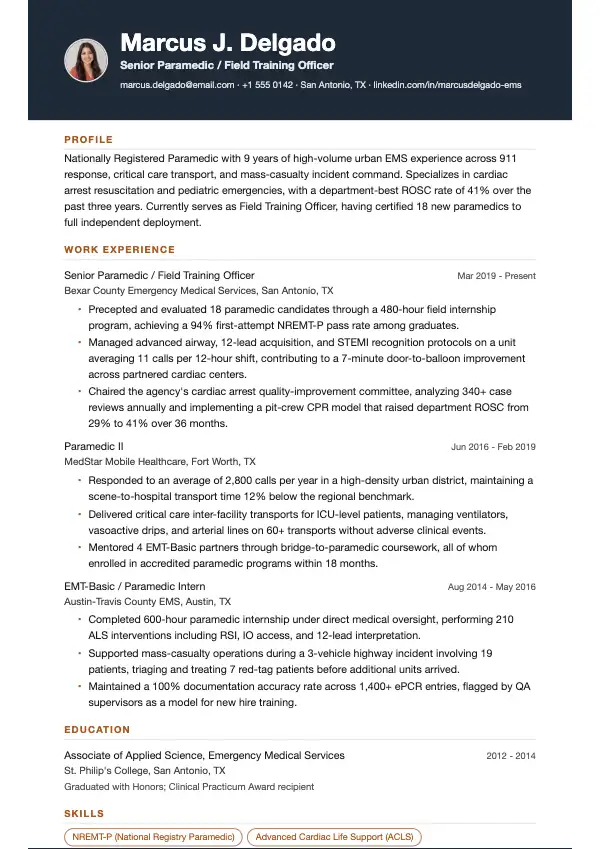
Template: Graphite
Read this resume as text
Marcus J. Delgado
Senior Paramedic / Field Training Officer
marcus.delgado@email.com · +1 555 0142 · San Antonio, TX · linkedin.com/in/marcusdelgado-ems
- Profile
- Nationally Registered Paramedic with 9 years of high-volume urban EMS experience across 911 response, critical care transport, and mass-casualty incident command. Specializes in cardiac arrest resuscitation and pediatric emergencies, with a department-best ROSC rate of 41% over the past three years. Currently serves as Field Training Officer, having certified 18 new paramedics to full independent deployment.
- Work Experience
Senior Paramedic / Field Training Officer
Bexar County Emergency Medical Services, San Antonio, TX · Mar 2019 - Present
- Precepted and evaluated 18 paramedic candidates through a 480-hour field internship program, achieving a 94% first-attempt NREMT-P pass rate among graduates.
- Managed advanced airway, 12-lead acquisition, and STEMI recognition protocols on a unit averaging 11 calls per 12-hour shift, contributing to a 7-minute door-to-balloon improvement across partnered cardiac centers.
- Chaired the agency's cardiac arrest quality-improvement committee, analyzing 340+ case reviews annually and implementing a pit-crew CPR model that raised department ROSC from 29% to 41% over 36 months.
Paramedic II
MedStar Mobile Healthcare, Fort Worth, TX · Jun 2016 - Feb 2019
- Responded to an average of 2,800 calls per year in a high-density urban district, maintaining a scene-to-hospital transport time 12% below the regional benchmark.
- Delivered critical care inter-facility transports for ICU-level patients, managing ventilators, vasoactive drips, and arterial lines on 60+ transports without adverse clinical events.
- Mentored 4 EMT-Basic partners through bridge-to-paramedic coursework, all of whom enrolled in accredited paramedic programs within 18 months.
EMT-Basic / Paramedic Intern
Austin-Travis County EMS, Austin, TX · Aug 2014 - May 2016
- Completed 600-hour paramedic internship under direct medical oversight, performing 210 ALS interventions including RSI, IO access, and 12-lead interpretation.
- Supported mass-casualty operations during a 3-vehicle highway incident involving 19 patients, triaging and treating 7 red-tag patients before additional units arrived.
- Maintained a 100% documentation accuracy rate across 1,400+ ePCR entries, flagged by QA supervisors as a model for new hire training.
- Education
Associate of Applied Science, Emergency Medical Services
St. Philip's College, San Antonio, TX · 2012 - 2014
Graduated with Honors; Clinical Practicum Award recipient
- Skills
- NREMT-P (National Registry Paramedic) · Advanced Cardiac Life Support (ACLS) · Pediatric Advanced Life Support (PALS) · Pre-Hospital Trauma Life Support (PHTLS) · Rapid Sequence Intubation (RSI) · 12-Lead ECG Acquisition & Interpretation · ePCR Documentation (ImageTrend Elite) · Mass-Casualty Incident (MCI) Triage · Critical Care Transport (CCT)
- Links
- LinkedIn: linkedin.com/in/marcusdelgado-ems · Certification: National Registry Paramedic (NRP) #NRP-TX-4482910 (verifiable via NREMT)
What makes this resume work
- The summary names the NREMT-P credential in the first clause so ATS systems score it immediately, then anchors credibility with a specific 41% ROSC stat rather than a vague claim of excellence.
- Every bullet opens with a strong action verb tied to a clinical or operational outcome — precepted, managed, chaired — and closes with a number (time saved, pass rate, call volume) that gives reviewers an evidence-based picture of performance.
- The skills section front-loads the full spelled-out certification names alongside their acronyms (e.g., 'Advanced Cardiac Life Support (ACLS)') so the resume matches both how recruiters type searches and how abbreviations appear in job postings.
- The Field Training Officer title is paired in the same role header as Senior Paramedic, signaling leadership growth without requiring a separate entry, which keeps the resume to one page while still showing career progression.
Keywords that help you pass the ATS
Work the ones that fit your experience into your resume, naturally, not stuffed.
How to write a Paramedic resume
Choose the right format for a Paramedic resume
Use a reverse-chronological format. EMS hiring managers scan quickly and want to see your most recent field experience first. A functional or hybrid format raises red flags because it can obscure employment gaps or limited hands-on time.
Keep the resume to one page if you have fewer than ten years of experience; two pages are acceptable for flight paramedics, supervisors, or those with extensive continuing education. Use clean section headers, consistent font sizing (10–12 pt body, 14–16 pt name), and enough white space so the document is readable under fluorescent break-room lighting.
- Margins: 0.75–1 inch on all sides
- Font: Calibri, Arial, or Georgia — avoid decorative typefaces
- File format: PDF unless the job posting specifically requests .docx
- Section order: Contact info → Summary → Certifications → Experience → Education → Skills
Write a professional summary that earns a second look
Your summary sits directly below your name and contact information. Write three to four sentences that answer: How many years of experience do you have? What setting (911, interfacility, flight, event medicine)? What do you do better than the average candidate? Skip objectives; hiring managers already know you want the job.
Example: "State-licensed Paramedic with 7 years of high-volume 911 experience in a urban 911 system averaging 14 calls per shift. ACLS-, PALS-, and ITLS-certified with demonstrated proficiency in 12-lead interpretation, RSI-assisted intubation, and CPAP management. Maintained a 96% on-scene time compliance rate over the last two performance review cycles. Seeking a field supervisor role where clinical mentorship and protocol development are priorities."
Write work-experience bullets that show impact, not just duties
Every bullet should follow an action verb → task → measurable result structure. Recruiters at busy EMS agencies discard resumes that say 'Responded to emergency calls' — that is assumed. Instead, quantify call volume, patient outcomes, skills performed, training delivered, or process improvements you contributed to.
Pull numbers from your agency's CAD reports, PCR audits, or performance reviews. If you precepted students, state how many. If you reduced medication error rates, say by how much.
- Managed advanced airway interventions — including RSI and surgical cricothyrotomy — on 40+ critical patients annually, achieving a 94% first-attempt intubation success rate verified through quarterly PCR audits.
- Precepted 12 EMT-to-Paramedic students over three years, designing skills competency checklists later adopted as the county training division's standard evaluation tool.
Skills and certifications recruiters and ATS systems look for
Applicant tracking systems at larger fire-based and third-service EMS agencies parse for exact credential abbreviations. Spell them out once and abbreviate in parentheses, or list both forms. Hard skills and certifications carry far more weight than soft skills in EMS hiring; trim generic phrases like 'team player' and replace them with clinical competencies.
Prioritize the certifications that appear in the job posting. A critical care transport role will weight FP-C or CCP-C heavily; a municipal 911 post will focus on NRP and state licensure.
- Certifications: NRP (Nationally Registered Paramedic), state paramedic license, ACLS, BLS, PALS, PHTLS or ITLS, AMLS, EPC, GEMS
- Advanced credentials: FP-C (Flight Paramedic-Certified), CCP-C (Critical Care Paramedic), NRP (Neonatal Resuscitation Program)
- Clinical skills: 12-lead acquisition and interpretation, RSI, IO access, needle thoracostomy, CPAP/BiPAP, point-of-care ultrasound (if trained)
- Software and systems: ImageTrend, ESO, Zoll RescueNet, Trauma Register, CAD platforms (Tritech, Tyler New World)
- Soft skills worth listing: Spanish-language patient communication, field training officer (FTO) experience, QA/QI committee participation
Education, licenses, and extras that round out your resume
List your paramedic program first — include the institution, degree or certificate title, and graduation year. If you hold an associate or bachelor's degree in paramedicine or emergency health sciences, list it above your certificate. Do not list your high school diploma once you have post-secondary credentials.
Place your active state license number and expiration date in a dedicated Licenses section or alongside the credential name — many HR departments verify this before scheduling interviews. Add any relevant extras: FEMA ICS 100/200/700/800 completions, tactical EMS (TEMS) training, hazmat operations certification, or EMS instructor licensure. These differentiate you in competitive applicant pools without padding your resume.
Mistakes to avoid
- Listing certifications without expiration dates forces recruiters to call and verify, which often moves your application to the bottom of the pile.
- Using vague duty statements like 'Provided patient care' instead of specifying the acuity level, call volume, or clinical interventions makes your experience indistinguishable from an EMT-Basic's.
- Omitting your NREMT registry number or state license number when the posting requests it signals carelessness and slows the credentialing check.
- Including a photo, date of birth, or marital status — common on international resumes — is unnecessary on US EMS applications and can create unconscious bias issues for the hiring agency.
Frequently asked questions
- Should I list every certification on my Paramedic resume even if it's expired?
- Only list certifications that are currently active or will renew before your start date. Expired credentials without a renewal date in progress suggest a lapse in professional development and can disqualify you at the screening stage. If you are actively recertifying, note the expected renewal date in parentheses next to the credential.
- How do I write a Paramedic resume if I'm transitioning from fire-based EMS to a private critical care transport company?
- Lead with any critical care exposure you already have — interfacility transports, STEMI or stroke activations, extended scene times — and highlight advanced certifications like CCEMTP or CCP-C if you hold them. Reframe your fire department experience around patient contact hours and clinical outcomes rather than suppression duties, and address the transition directly in your summary so the hiring manager does not wonder why you are leaving.
- Is a one-page resume required for Paramedic positions, or can I use two pages?
- One page is the standard for entry-level and mid-career field paramedics with under ten years of experience. Two pages are appropriate if you have flight or critical care experience, supervisory or FTO roles, published protocols, or significant continuing education that directly supports the position you are applying for. Never pad to fill a second page — a half-empty second page is worse than a tight one-pager.
Make it yours in minutes
Open this example in the builder, swap in your details, and export a clean, ATS-ready resume.
Once your resume is ready
More for this application
- Template style
- Nursing resume templates