Resume example
Lab Technician resume example
By the Resumade team · About our content
A Lab Technician resume must clear keyword filters for certifications and analyzer names, then prove to the hiring manager that you protect patient safety and keep throughput high. This example does both with specific QC metrics and equipment callouts in every role.
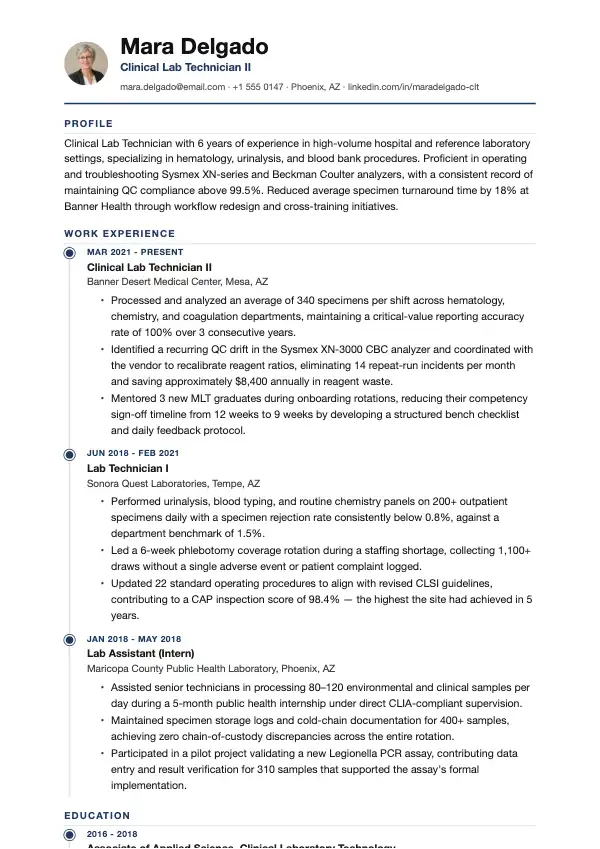
Template: Chronicle
Read this resume as text
Mara Delgado
Clinical Lab Technician II
mara.delgado@email.com · +1 555 0147 · Phoenix, AZ · linkedin.com/in/maradelgado-clt
- Profile
- Clinical Lab Technician with 6 years of experience in high-volume hospital and reference laboratory settings, specializing in hematology, urinalysis, and blood bank procedures. Proficient in operating and troubleshooting Sysmex XN-series and Beckman Coulter analyzers, with a consistent record of maintaining QC compliance above 99.5%. Reduced average specimen turnaround time by 18% at Banner Health through workflow redesign and cross-training initiatives.
- Work Experience
Clinical Lab Technician II
Banner Desert Medical Center, Mesa, AZ · Mar 2021 - Present
- Processed and analyzed an average of 340 specimens per shift across hematology, chemistry, and coagulation departments, maintaining a critical-value reporting accuracy rate of 100% over 3 consecutive years.
- Identified a recurring QC drift in the Sysmex XN-3000 CBC analyzer and coordinated with the vendor to recalibrate reagent ratios, eliminating 14 repeat-run incidents per month and saving approximately $8,400 annually in reagent waste.
- Mentored 3 new MLT graduates during onboarding rotations, reducing their competency sign-off timeline from 12 weeks to 9 weeks by developing a structured bench checklist and daily feedback protocol.
Lab Technician I
Sonora Quest Laboratories, Tempe, AZ · Jun 2018 - Feb 2021
- Performed urinalysis, blood typing, and routine chemistry panels on 200+ outpatient specimens daily with a specimen rejection rate consistently below 0.8%, against a department benchmark of 1.5%.
- Led a 6-week phlebotomy coverage rotation during a staffing shortage, collecting 1,100+ draws without a single adverse event or patient complaint logged.
- Updated 22 standard operating procedures to align with revised CLSI guidelines, contributing to a CAP inspection score of 98.4% — the highest the site had achieved in 5 years.
Lab Assistant (Intern)
Maricopa County Public Health Laboratory, Phoenix, AZ · Jan 2018 - May 2018
- Assisted senior technicians in processing 80–120 environmental and clinical samples per day during a 5-month public health internship under direct CLIA-compliant supervision.
- Maintained specimen storage logs and cold-chain documentation for 400+ samples, achieving zero chain-of-custody discrepancies across the entire rotation.
- Participated in a pilot project validating a new Legionella PCR assay, contributing data entry and result verification for 310 samples that supported the assay's formal implementation.
- Education
Associate of Applied Science, Clinical Laboratory Technology
Mesa Community College, Mesa, AZ · 2016 - 2018
Graduated with Distinction; Clinical Practicum completed at HonorHealth Scottsdale
- Skills
- ASCP MLT Certification (MLT(ASCP), 2018, current) · Sysmex XN-Series & Beckman Coulter AU analyzers · Hematology, Urinalysis & Blood Bank procedures · QC/QA and CAP/CLIA compliance · Epic Beaker LIS & Cerner PathNet · Phlebotomy (certified, AZ) · CLSI guideline interpretation · Electrolyte & coagulation panel analysis · Microscopy and manual differential cell counts
- Links
- LinkedIn: linkedin.com/in/maradelgado-clt · Certification: MLT(ASCP) #MLT-0147382 (verifiable via ASCP)
What makes this resume work
- The summary names the exact analyzer platforms (Sysmex XN-series, Beckman Coulter) so the resume matches recruiter keyword searches before the hiring manager reads a single bullet.
- Every bullet closes with a hard number — rejection rates, cost savings, inspection scores — giving lab directors concrete evidence of performance rather than vague claims of accuracy or attention to detail.
- The ASCP MLT certification appears in both the skills section and the links section with its certification number, making credential confirmation effortless for credentialing coordinators who often screen before the manager does.
- The internship role is included and quantified (310 samples, zero discrepancies) rather than omitted, which fills the timeline gap and demonstrates that even early-career work was approached with professional rigor.
Keywords that help you pass the ATS
Work the ones that fit your experience into your resume, naturally, not stuffed.
How to write a Lab Technician resume
Choose the right format for a Lab Technician resume
Use a reverse-chronological format for almost every lab technician position. Hiring managers in clinical, research, and industrial labs want to see your most recent bench experience first, not a functional layout that buries your timeline.
Keep the resume to one page if you have fewer than eight years of experience; two pages are acceptable for senior techs or those with extensive publication or validation histories. Use clean section headers, 10–12 pt font, and 0.75-inch margins. Avoid tables and text boxes — many lab employers use applicant tracking systems (ATS) that misread them.
- Standard sections: Contact Info, Summary, Work Experience, Skills, Education, Certifications
- File format: PDF unless the posting asks for a Word (.docx) file
- Tailor the header keywords to the job title (e.g., 'Clinical Lab Technician' vs. 'Quality Control Lab Technician')
Write a professional summary that passes the first scan
Your summary sits at the top and should be three to four sentences that tell a recruiter your specialty, years of experience, key techniques, and one concrete result. Skip objectives like 'seeking a challenging role.' Name your actual domain — microbiology, hematology, histology, environmental testing — and anchor it with a number.
Example: "MLT (ASCP)-certified clinical lab technician with 5 years of high-volume experience in hematology and urinalysis at a 400-bed hospital. Proficient in Sysmex XN-1000 and Beckman Coulter DxH 900 analyzers. Reduced reagent waste by 18% by redesigning daily QC workflows. Comfortable rotating across chemistry, blood bank, and microbiology benches during overnight shifts."
Write work-experience bullets that show impact, not just duties
Each bullet should follow an action verb + task + result or scale formula. Recruiters know what a lab tech does day to day; your job is to show how well you did it and at what volume. Avoid vague phrases like 'responsible for testing samples' — replace them with throughput numbers, error rates, turnaround times, or process improvements.
Pull metrics from your own records: how many samples per shift, what your QC pass rate was, how many instruments you maintained, or how much a process change saved.
- Processed and resulted an average of 320 specimens per 10-hour shift on a Roche cobas 6000 chemistry analyzer, maintaining a <0.5% repeat rate over 18 months.
- Led validation of a new BD MAX molecular platform, cutting MRSA turnaround time from 48 hours to 6 hours and reducing manual plating labor by 30%.
Skills and certifications recruiters and ATS look for
Lab job postings are keyword-dense. Your skills section needs to match the specific instruments, methodologies, and credentials named in each posting. Split the section into technical skills and soft skills, but keep soft skills brief — ATS filters are built around hard competencies.
Certifications carry serious weight in clinical and regulated environments. If you hold an ASCP or AMT credential, list it in both your header and a dedicated certifications section with the issuing body and expiration year.
- Certifications: MLT(ASCP), MLS(ASCP), MT(AMT), California CLS or MLT license, CLIA-compliant QC training
- Analyzers & instruments: Sysmex XN series, Beckman Coulter DxH/AU, Roche cobas, bioMérieux VITEK 2, Hologic Panther
- Techniques: PCR/qPCR, ELISA, flow cytometry, gram staining, blood banking (ABO/Rh typing, crossmatch), urinalysis, cell culture
- Software: LIS platforms (Cerner PathNet, Epic Beaker, Meditech), Microsoft Excel for QC charting, LabWare LIMS
- Regulatory knowledge: CAP, CLIA, OSHA bloodborne pathogen standards, GLP, GMP
Education, licenses, and extras that complete the picture
List your degree, the institution, and graduation year. For lab techs, an Associate of Applied Science in Clinical Laboratory Technology or a Bachelor of Science in Medical Laboratory Science, Biology, or Chemistry are the standard credentials. If you completed a clinical practicum or externship at a named facility, include it under education — it signals hands-on hours to employers who care about bench readiness.
Below education, add a short Certifications block with credential name, issuing body, and renewal date. If you have state licensure (required in states like California, New York, and Florida), list the license number and expiration. Extras worth including: poster presentations, proficiency testing scores above lab average, language skills relevant to patient-facing roles, or OSHA 30 training.
- State licenses: include license number and expiration date if your state licenses laboratory personnel
- Continuing education: ASCP requires 36 CE credits per three-year cycle — note completion if you are current
- Relevant coursework is worth listing only if you graduated within the last two years
Mistakes to avoid
- Listing instruments you have only observed but never independently operated — interviewers will probe your hands-on proficiency and inconsistencies damage your credibility.
- Using a generic skills list without matching it to the specific analyzer platforms or methodologies named in the job posting, which causes ATS filters to rank your resume lower.
- Omitting your ASCP or AMT credential from the resume header, forcing recruiters to hunt for it when many screen by certification before reading further.
- Writing duty-based bullets like 'performed phlebotomy and processed samples' with no volume, accuracy rate, or turnaround context, making your experience indistinguishable from every other applicant.
Frequently asked questions
- Do I need a certification to get a lab technician job in the US?
- Most hospital and reference lab positions strongly prefer or require ASCP or AMT certification, and several states mandate a state license on top of that. Non-certified candidates may find entry-level roles at smaller private labs or research settings, but earning your MLT(ASCP) significantly expands your options.
- How do I write a lab technician resume with no experience?
- Lead with your clinical practicum or externship hours, naming the facility, the benches you rotated through, and the volume of specimens you handled. Highlight academic lab projects, specific instruments you trained on, and any QC or proficiency testing you participated in. Certifications and a strong education section carry more weight at this stage than work history.
- Should I list every instrument I have ever used on my resume?
- List instruments you can operate independently and troubleshoot at a basic level — not every analyzer you walked past during training. Prioritize the platforms mentioned in the job posting and group older or less relevant equipment under a general line like 'additional experience with legacy Beckman and Abbott platforms.' Quality over quantity prevents you from being caught out in a technical interview.
Make it yours in minutes
Open this example in the builder, swap in your details, and export a clean, ATS-ready resume.
Once your resume is ready
More for this application
- Template style
- Nursing resume templates