Resume example
Pharmacist resume example
By the Resumade team · About our content
A pharmacist resume must clear ATS keyword filters for clinical certifications and EHR systems, then show hiring managers concrete evidence of patient-outcome improvements. This example does both with BCPS credentials up front and metric-anchored bullets throughout.
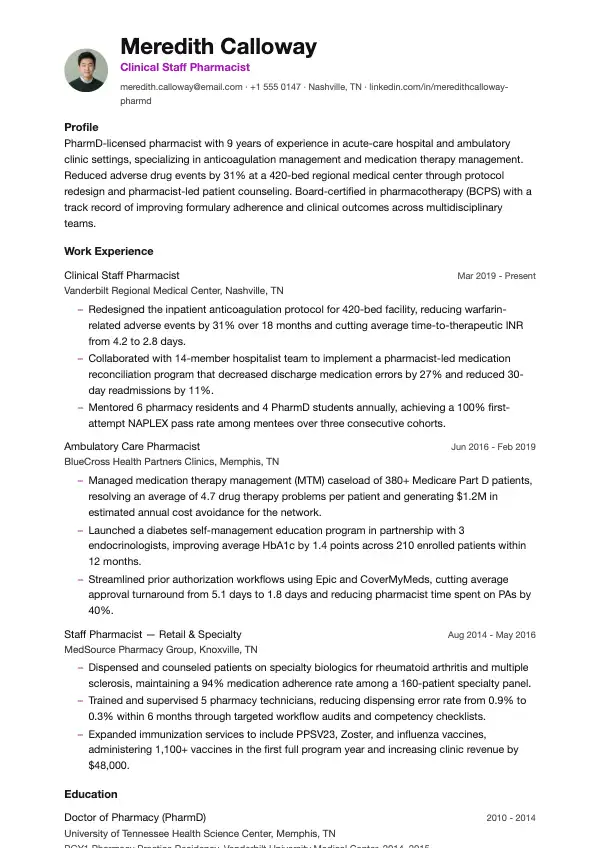
Template: Minimal
Read this resume as text
Meredith Calloway
Clinical Staff Pharmacist
meredith.calloway@email.com · +1 555 0147 · Nashville, TN · linkedin.com/in/meredithcalloway-pharmd
- Profile
- PharmD-licensed pharmacist with 9 years of experience in acute-care hospital and ambulatory clinic settings, specializing in anticoagulation management and medication therapy management. Reduced adverse drug events by 31% at a 420-bed regional medical center through protocol redesign and pharmacist-led patient counseling. Board-certified in pharmacotherapy (BCPS) with a track record of improving formulary adherence and clinical outcomes across multidisciplinary teams.
- Work Experience
Clinical Staff Pharmacist
Vanderbilt Regional Medical Center, Nashville, TN · Mar 2019 - Present
- Redesigned the inpatient anticoagulation protocol for 420-bed facility, reducing warfarin-related adverse events by 31% over 18 months and cutting average time-to-therapeutic INR from 4.2 to 2.8 days.
- Collaborated with 14-member hospitalist team to implement a pharmacist-led medication reconciliation program that decreased discharge medication errors by 27% and reduced 30-day readmissions by 11%.
- Mentored 6 pharmacy residents and 4 PharmD students annually, achieving a 100% first-attempt NAPLEX pass rate among mentees over three consecutive cohorts.
Ambulatory Care Pharmacist
BlueCross Health Partners Clinics, Memphis, TN · Jun 2016 - Feb 2019
- Managed medication therapy management (MTM) caseload of 380+ Medicare Part D patients, resolving an average of 4.7 drug therapy problems per patient and generating $1.2M in estimated annual cost avoidance for the network.
- Launched a diabetes self-management education program in partnership with 3 endocrinologists, improving average HbA1c by 1.4 points across 210 enrolled patients within 12 months.
- Streamlined prior authorization workflows using Epic and CoverMyMeds, cutting average approval turnaround from 5.1 days to 1.8 days and reducing pharmacist time spent on PAs by 40%.
Staff Pharmacist — Retail & Specialty
MedSource Pharmacy Group, Knoxville, TN · Aug 2014 - May 2016
- Dispensed and counseled patients on specialty biologics for rheumatoid arthritis and multiple sclerosis, maintaining a 94% medication adherence rate among a 160-patient specialty panel.
- Trained and supervised 5 pharmacy technicians, reducing dispensing error rate from 0.9% to 0.3% within 6 months through targeted workflow audits and competency checklists.
- Expanded immunization services to include PPSV23, Zoster, and influenza vaccines, administering 1,100+ vaccines in the first full program year and increasing clinic revenue by $48,000.
- Education
Doctor of Pharmacy (PharmD)
University of Tennessee Health Science Center, Memphis, TN · 2010 - 2014
PGY1 Pharmacy Practice Residency, Vanderbilt University Medical Center, 2014–2015
- Skills
- Board-Certified Pharmacist in Pharmacotherapy (BCPS) · Medication Therapy Management (MTM) · Anticoagulation Management · Epic & Cerner EHR · Drug Utilization Review (DUR) · Pharmacokinetics & Dosing Optimization · Immunization Administration (CPE-certified) · Prior Authorization & Formulary Management · HIPAA Compliance & Patient Counseling
- Links
- LinkedIn: linkedin.com/in/meredithcalloway-pharmd · License: Tennessee Pharmacist License #MC-2014-0883 (verifiable via state board)
What makes this resume work
- The summary leads with seniority, a board certification, and a single headline result — giving a hiring manager a reason to keep reading before they reach the first job entry.
- Every bullet follows an action-verb → intervention → quantified outcome structure, making it easy to scan for impact without reading full sentences.
- Hard skills are listed as discrete, searchable phrases (e.g., 'Drug Utilization Review (DUR)', 'Anticoagulation Management') that mirror the exact terms pharmacy directors and ATS platforms filter for.
- The education section doubles as a residency disclosure by placing the PGY1 note inline, avoiding a separate section that could push skills below the fold on a one-page view.
Keywords that help you pass the ATS
Work the ones that fit your experience into your resume, naturally, not stuffed.
How to write a Pharmacist resume
Choose the right format for a Pharmacist resume
Use a reverse-chronological format. Pharmacy hiring managers and hospital credentialing teams want to see your most recent role first, and applicant tracking systems (ATS) used by pharmacy chains and large hospital networks handle this layout well. A functional format, which hides dates and employers, raises flags with credentialing teams and parses less reliably than a chronological one.
Keep the resume to one page if you have fewer than ten years of experience; two pages are acceptable for clinical pharmacists with extensive rotation, residency, or specialty experience. Use clean section headers, a readable font like Calibri or Georgia at 10–12 pt, and consistent margin widths. Avoid tables and text boxes — ATS software frequently misreads them.
- Standard sections in order: Contact Info, Licensure/Credentials, Summary, Work Experience, Skills, Education, Certifications
- Place your active state pharmacy license prominently near your name
- Save and submit as a text-based PDF; send a .docx only if the job posting asks for Word
Write a professional summary that earns a second look
Your summary is three to four lines at the top of the resume — not an objective statement. It should name your practice setting (retail, hospital, long-term care, specialty, compounding), your years of experience, one or two clinical strengths, and a measurable result. Skip phrases like 'hardworking team player.'
Example: "Licensed PharmD with 7 years of experience in acute care and ambulatory clinical pharmacy. Board-certified in pharmacotherapy (BCPS) with demonstrated expertise in antimicrobial stewardship, medication reconciliation, and MTM services. Reduced 30-day readmission rates by 11% through a pharmacist-led discharge counseling program at a 400-bed regional medical center."
Write work-experience bullets that show impact
Every bullet should follow an action-verb + task + outcome structure. Quantify wherever you can: prescription volume, error rates, cost savings, patient satisfaction scores, or program outcomes. Generic duties like 'filled prescriptions and counseled patients' tell a hiring manager nothing they don't already assume.
Pull metrics from your performance reviews, departmental dashboards, or pharmacy management systems like QS/1, PioneerRx, Epic Willow, or Omnicell reporting tools.
- Managed a high-volume retail pharmacy processing 450+ prescriptions daily, maintaining a dispensing accuracy rate of 99.97% over a 3-year period with zero sentinel events
- Led a pharmacist-driven warfarin management clinic serving 120 patients monthly, achieving 78% of patients within therapeutic INR range versus a 61% baseline at program launch
Skills and certifications recruiters and ATS systems look for
Include a dedicated skills section with both clinical competencies and the software platforms you actually use. ATS systems at major health systems and pharmacy chains keyword-match against the job description, so mirror the language used in the posting. Certifications from BPS (Board of Pharmacy Specialties) carry significant weight for clinical roles and should be listed with the credential abbreviation and expiration or renewal date.
Do not pad this section with vague soft skills. Every item should be something a hiring manager can verify or test.
- BPS certifications: BCPS, BCACP, BCOP, BCCCP, BCGP, BCIDP — list whichever apply
- Immunization certification (APhA), MTM certification (Outcomes MTM or Mirixa platform experience)
- Pharmacy software: Epic Willow, Cerner Pharmacy, Pyxis, Omnicell, QS/1, PioneerRx, ScriptPro
- Clinical skills: anticoagulation management, pharmacokinetics dosing, medication therapy management, CPOE review, formulary management
- Regulatory knowledge: DEA controlled substance compliance, USP <797>/<800> compounding standards, HIPAA
Education, licenses, and extras that complete the picture
List your PharmD (or BS Pharmacy for older graduates) with institution, city, and graduation year. If you completed a PGY-1 or PGY-2 residency through ASHP-accredited programs, list those immediately after your degree — they function like graduate training and matter enormously for hospital and clinical roles. Fellowship training belongs here too.
Create a separate Licensure section rather than burying your license in Education. Include your state license number, issuing state, and expiration date. If you hold licenses in multiple states, list each one. Your NPI number and CPR/BLS certification round out this section. Publications, poster presentations at APhA or ASHP meetings, or preceptor appointments are worth adding as a brief Additional section if you have them.
Mistakes to avoid
- Omitting your state pharmacy license number and expiration date forces credentialing staff to chase you down and signals carelessness with compliance details.
- Listing pharmacy school rotations as work experience after you have two or more years of post-graduate employment clutters the resume and makes it harder to find your actual professional record.
- Using vague volume language like 'high-volume pharmacy' without a number when you can easily state the daily prescription count or patient panel size.
- Failing to tailor the skills section to the specific practice setting — a retail pharmacy resume and a clinical hospital pharmacy resume should not have identical skills lists.
Frequently asked questions
- Do I need to put my pharmacy license number on my resume?
- Yes. Most pharmacy employers verify licensure through NABP or state boards before extending an offer, and including your license number upfront speeds up that process. List the state, license number, and expiration date clearly in a Licensure section near the top of the resume.
- How important is a BPS board certification for getting a hospital pharmacy job?
- For clinical specialist and Pharm D roles in acute care, BCPS or a relevant specialty certification like BCCCP or BCIDP is increasingly treated as a baseline expectation rather than a differentiator at competitive health systems. Some health systems ask about board certification on the application itself, and a 'no' to a required credential can end an application automatically. If you are in progress, note the expected exam date.
- Should a pharmacist include a residency on a resume the same way as a job?
- List your PGY-1 and PGY-2 residencies in a dedicated Residency Training section directly below your Education, not under Work Experience. Include the program name, sponsoring institution, and dates. This keeps your clinical training visible and follows the convention pharmacy hiring committees and credentialing departments expect to see.
Make it yours in minutes
Open this example in the builder, swap in your details, and export a clean, ATS-ready resume.
Once your resume is ready
More for this application
- Cover letter example
- Pharmacist Cover Letter Example
- Template style
- Minimalist resume templates