Resume example
Electrical Engineer resume example
By the Resumade team · About our content
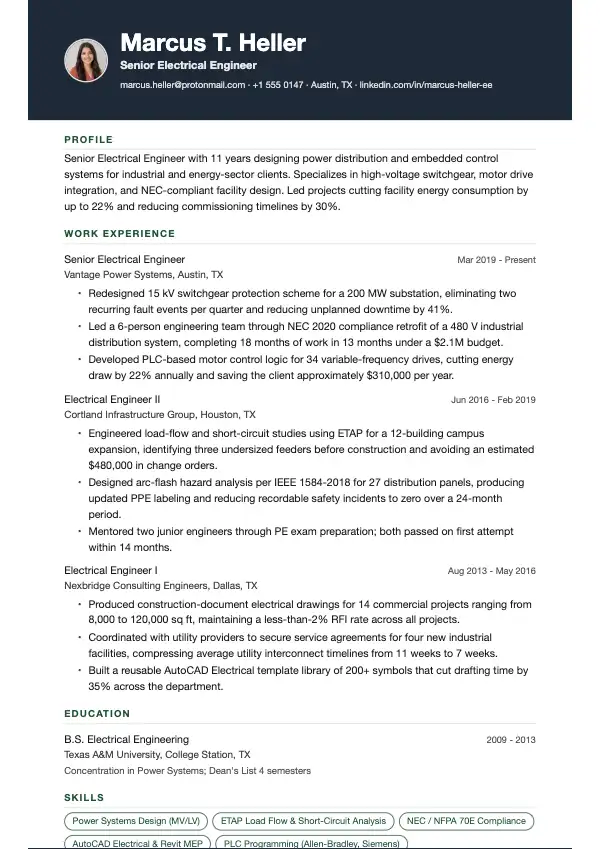
An Electrical Engineer resume must clear ATS filters on domain-specific terms while proving quantified impact to the hiring manager. This example does both: every bullet ties an action to a measurable outcome, and the skills section mirrors the language recruiters actually search.
Template: Graphite
Read this resume as text
Marcus T. Heller
Senior Electrical Engineer
marcus.heller@protonmail.com · +1 555 0147 · Austin, TX · linkedin.com/in/marcus-heller-ee
- Profile
- Senior Electrical Engineer with 11 years designing power distribution and embedded control systems for industrial and energy-sector clients. Specializes in high-voltage switchgear, motor drive integration, and NEC-compliant facility design. Led projects cutting facility energy consumption by up to 22% and reducing commissioning timelines by 30%.
- Work Experience
Senior Electrical Engineer
Vantage Power Systems, Austin, TX · Mar 2019 - Present
- Redesigned 15 kV switchgear protection scheme for a 200 MW substation, eliminating two recurring fault events per quarter and reducing unplanned downtime by 41%.
- Led a 6-person engineering team through NEC 2020 compliance retrofit of a 480 V industrial distribution system, completing 18 months of work in 13 months under a $2.1M budget.
- Developed PLC-based motor control logic for 34 variable-frequency drives, cutting energy draw by 22% annually and saving the client approximately $310,000 per year.
Electrical Engineer II
Cortland Infrastructure Group, Houston, TX · Jun 2016 - Feb 2019
- Engineered load-flow and short-circuit studies using ETAP for a 12-building campus expansion, identifying three undersized feeders before construction and avoiding an estimated $480,000 in change orders.
- Designed arc-flash hazard analysis per IEEE 1584-2018 for 27 distribution panels, producing updated PPE labeling and reducing recordable safety incidents to zero over a 24-month period.
- Mentored two junior engineers through PE exam preparation; both passed on first attempt within 14 months.
Electrical Engineer I
Nexbridge Consulting Engineers, Dallas, TX · Aug 2013 - May 2016
- Produced construction-document electrical drawings for 14 commercial projects ranging from 8,000 to 120,000 sq ft, maintaining a less-than-2% RFI rate across all projects.
- Coordinated with utility providers to secure service agreements for four new industrial facilities, compressing average utility interconnect timelines from 11 weeks to 7 weeks.
- Built a reusable AutoCAD Electrical template library of 200+ symbols that cut drafting time by 35% across the department.
- Education
B.S. Electrical Engineering
Texas A&M University, College Station, TX · 2009 - 2013
Concentration in Power Systems; Dean's List 4 semesters
- Skills
- Power Systems Design (MV/LV) · ETAP Load Flow & Short-Circuit Analysis · NEC / NFPA 70E Compliance · AutoCAD Electrical & Revit MEP · PLC Programming (Allen-Bradley, Siemens) · Variable Frequency Drives (VFD) Integration · Arc-Flash Analysis (IEEE 1584-2018) · Professional Engineer (PE) — Texas License #98234 · Project Budgeting & Schedule Management
- Links
- LinkedIn: linkedin.com/in/marcus-heller-ee · PE License: Texas Professional Engineer License #98234 (verifiable via state board) · Portfolio: marcusheller.engineering/projects
What makes this resume work
- Every experience bullet opens with a strong action verb and closes with a dollar figure, percentage, or time saving — giving hiring managers an instant ROI picture rather than a list of duties.
- The skills section is structured as discrete, searchable hard skills and certifications rather than vague categories, ensuring ATS parsers match the resume to power-systems and controls job postings.
- The summary front-loads seniority (11 years), domain (power distribution, embedded controls), and two headline metrics in three sentences — surviving a recruiter’s first quick scan before a single bullet is read.
- Including the PE license number directly on the resume, with the issuing board named, removes friction for employers who screen for licensure, signaling professionalism and saving a follow-up email.
Keywords that help you pass the ATS
Work the ones that fit your experience into your resume, naturally, not stuffed.
How to write an Electrical Engineer resume
Choose the right format for an Electrical Engineer resume
Use a reverse-chronological format unless you are making a significant industry shift (for example, moving from power utilities to semiconductor design). Recruiters in electrical engineering scan for progression — they want to see your most recent role first, the scope of your projects, and whether your technical depth has grown over time.
Keep the resume to one page if you have fewer than ten years of experience; two pages are acceptable beyond that. Use clean section headers, consistent font sizing (10–12 pt body text), and avoid multi-column layouts that break applicant tracking systems. Save and submit as a PDF unless the job posting explicitly requests a Word file.
- Margins: 0.5–1 inch on all sides to maximize readable space
- Font: Arial, Calibri, or Georgia — nothing decorative
- File name: LastName_FirstName_EE_Resume.pdf
- Section order: Summary → Skills → Experience → Education → Certifications → Licenses
Write a professional summary that positions your engineering specialty
Your summary is three to four sentences that tell a hiring manager your discipline (power systems, embedded systems, RF, controls, PCB design, etc.), your years of experience, your most impressive quantifiable achievement, and what you are targeting next. Generic phrases like 'results-driven engineer' waste every word. Be specific about your domain and the types of systems or products you have worked on.
Example: "Licensed PE with 9 years of experience designing medium-voltage distribution systems (4 kV–34.5 kV) for industrial and utility clients. Led protection coordination studies and arc-flash analyses for 14 substations across three states, reducing equipment failure incidents by 31%. Proficient in ETAP, AutoCAD Electrical, and NERC reliability standards. Seeking a senior power systems role with a regional utility or large EPC firm."
Write work-experience bullets that show scope and impact
Each bullet should follow an action verb → technical task → measurable result structure. Avoid vague statements like 'responsible for circuit design.' Instead, describe the type of circuit, the constraints you worked within, and what the outcome was. Hiring managers look for specifics: voltage levels, current ratings, board layer counts, simulation tools used, and schedule or cost outcomes.
Quantify wherever you can — power savings in kW or percentage, PCB cost reduction in dollars, project delivery timelines, test coverage percentages, or number of units shipped. If a number is confidential, use a range or a relative metric.
- Designed a 6-layer, mixed-signal PCB for a motor drive controller using Altium Designer, reducing BOM cost by $18 per unit and cutting EMI failures in pre-compliance testing from 7 to 1 across a 500-unit pilot run.
- Performed load flow, short-circuit, and harmonic analysis in ETAP for a 12 MW industrial facility, identifying a 15% capacity overload on two feeders and redesigning the distribution layout to eliminate the risk before construction began.
Skills and certifications recruiters and ATS systems look for
Electrical engineering job postings are highly keyword-driven. Your skills section should list tools, standards, and methodologies by name — not categories. Separate hard technical skills from software tools and standards. Certifications and licenses belong in their own section but can be mirrored in the skills block for ATS purposes.
Prioritize skills that appear verbatim in the job description. A power engineer applying to a utility role should surface NERC, NESC, and NEC compliance; an embedded engineer should surface RTOS, C/C++, JTAG debugging, and MISRA C.
- Design tools: Altium Designer, Cadence OrCAD, KiCad, AutoCAD Electrical, SOLIDWORKS Electrical
- Simulation and analysis: ETAP, MATLAB/Simulink, LTspice, PSCAD, ANSYS Maxwell
- Standards: NEC, NESC, IEC 61850, IEEE 1584, NERC CIP, MIL-STD-461
- Certifications: PE (Professional Engineer), FE/EIT, NABCEP PV Installation Professional, RCDD, Six Sigma Green Belt
- Programming: C, C++, Python, VHDL, Verilog, LabVIEW
Education, licenses, and extras that close the deal
List your degree, institution, and graduation year. Include your GPA only if it is 3.5 or higher and you graduated within the last five years. For electrical engineers, your PE license is often a hard requirement for senior roles at utilities and EPC firms — list the license number, issuing state, and expiration date. If you hold a PE in multiple states, list all of them.
Relevant extras that strengthen your resume include IEEE membership, publications in IEEE Transactions journals, patents, capstone or thesis project titles (especially for new graduates), and security clearances (Secret or TS/SCI) if you are targeting defense contractors. Volunteer work on FIRST Robotics or IEEE student chapters signals leadership and is worth a line if you are early-career.
Mistakes to avoid
- Listing tools like AutoCAD or MATLAB without specifying the application — state whether you used MATLAB for control system modeling, signal processing, or power flow analysis so recruiters understand your actual depth.
- Omitting voltage levels, power ratings, or system scale from project descriptions, which makes it impossible for a hiring manager to judge whether your experience matches the role's technical requirements.
- Failing to list your PE license state and number for roles where licensure is a legal or contractual requirement, which leaves the reviewer unable to confirm the one qualification they cannot waive.
- Using a heavily formatted or table-based resume template that corrupts when parsed by ATS platforms like Workday or Taleo, causing your technical skills and job titles to be misread or dropped entirely.
Frequently asked questions
- Should an electrical engineer include a PE license on their resume if it's in progress?
- Yes — list it as 'PE License, [State] — Exam passed, pending issuance' or 'EIT/FE certified, PE application in progress.' Many employers, especially utilities and EPC firms, plan hiring around licensure timelines and will factor this into an offer. Never omit it just because the license has not been issued yet.
- How do I write an electrical engineer resume with no full-time experience?
- Lead with a strong skills section and place your education block higher on the page. Include your senior capstone project with specific technical details — the system you designed, the tools you used, and any measured performance outcomes. Internship experience, co-op rotations, lab assistant roles, and relevant IEEE project work all belong in the experience section and should be written with the same action-verb and metric structure as full-time roles.
- What is the right length for an experienced electrical engineer's resume?
- Two pages is the standard for engineers with ten or more years of experience, particularly if you have worked across multiple disciplines or hold a PE license with a project portfolio. Beyond two pages, you risk burying your most relevant work — cut older roles down to two or three bullets each and remove positions older than 15 years unless they are directly relevant to the target role.
Make it yours in minutes
Open this example in the builder, swap in your details, and export a clean, ATS-ready resume.
Once your resume is ready
More for this application
- Template style
- Modern resume templates