Resume example
Physical Therapist resume example
By the Resumade team · About our content
A Physical Therapist resume must clear ATS keyword filters for certifications and specialties, then immediately show hiring managers patient outcomes and caseload scale. This example does both by leading with specialty credentials and quantified recovery results.
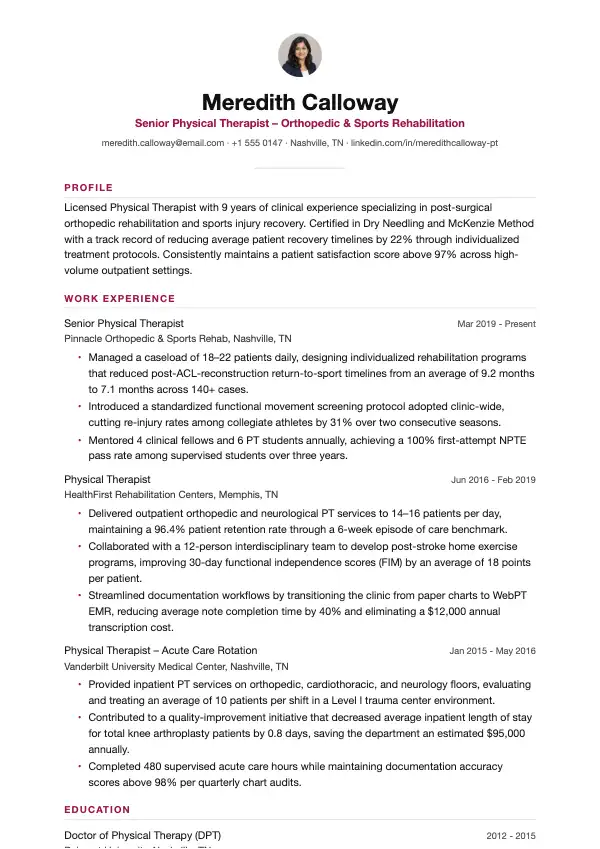
Template: Windsor
Read this resume as text
Meredith Calloway
Senior Physical Therapist – Orthopedic & Sports Rehabilitation
meredith.calloway@email.com · +1 555 0147 · Nashville, TN · linkedin.com/in/meredithcalloway-pt
- Profile
- Licensed Physical Therapist with 9 years of clinical experience specializing in post-surgical orthopedic rehabilitation and sports injury recovery. Certified in Dry Needling and McKenzie Method with a track record of reducing average patient recovery timelines by 22% through individualized treatment protocols. Consistently maintains a patient satisfaction score above 97% across high-volume outpatient settings.
- Work Experience
Senior Physical Therapist
Pinnacle Orthopedic & Sports Rehab, Nashville, TN · Mar 2019 - Present
- Managed a caseload of 18–22 patients daily, designing individualized rehabilitation programs that reduced post-ACL-reconstruction return-to-sport timelines from an average of 9.2 months to 7.1 months across 140+ cases.
- Introduced a standardized functional movement screening protocol adopted clinic-wide, cutting re-injury rates among collegiate athletes by 31% over two consecutive seasons.
- Mentored 4 clinical fellows and 6 PT students annually, achieving a 100% first-attempt NPTE pass rate among supervised students over three years.
Physical Therapist
HealthFirst Rehabilitation Centers, Memphis, TN · Jun 2016 - Feb 2019
- Delivered outpatient orthopedic and neurological PT services to 14–16 patients per day, maintaining a 96.4% patient retention rate through a 6-week episode of care benchmark.
- Collaborated with a 12-person interdisciplinary team to develop post-stroke home exercise programs, improving 30-day functional independence scores (FIM) by an average of 18 points per patient.
- Streamlined documentation workflows by transitioning the clinic from paper charts to WebPT EMR, reducing average note completion time by 40% and eliminating a $12,000 annual transcription cost.
Physical Therapist – Acute Care Rotation
Vanderbilt University Medical Center, Nashville, TN · Jan 2015 - May 2016
- Provided inpatient PT services on orthopedic, cardiothoracic, and neurology floors, evaluating and treating an average of 10 patients per shift in a Level I trauma center environment.
- Contributed to a quality-improvement initiative that decreased average inpatient length of stay for total knee arthroplasty patients by 0.8 days, saving the department an estimated $95,000 annually.
- Completed 480 supervised acute care hours while maintaining documentation accuracy scores above 98% per quarterly chart audits.
- Education
Doctor of Physical Therapy (DPT)
Belmont University, Nashville, TN · 2012 - 2015
Graduated with Distinction; Clinical Research Award – Outcomes in Post-Surgical Knee Rehabilitation
- Skills
- Orthopedic Manual Therapy (OMPT) · Dry Needling – Certified (DN-C) · McKenzie Method – Credentialed Practitioner · Functional Movement Screen (FMS) Certified · WebPT & Clinicient EMR · Therapeutic Exercise Prescription · Neuromuscular Re-education · Blood Flow Restriction (BFR) Training · ASTYM Soft Tissue Mobilization
- Links
- LinkedIn: linkedin.com/in/meredithcalloway-pt · License: Tennessee Physical Therapist License #PT-0048821 (verifiable via state board)
What makes this resume work
- The summary names the exact specializations — orthopedic and sports rehab — plus two headline numbers (22% faster recovery, 97% satisfaction), giving a hiring manager an instant reason to keep reading rather than a vague mission statement.
- Every bullet opens with a strong action verb and closes with a specific metric — patient volumes, percentage improvements, or dollar figures — so the candidate's impact is concrete and comparable across settings.
- Hard skills are listed as formal credential names (DN-C, McKenzie Credentialed Practitioner, FMS Certified) rather than generic terms, which directly mirrors how recruiters and ATS systems search for qualified candidates.
- Including the acute care rotation at Vanderbilt as a distinct role demonstrates breadth across inpatient and outpatient settings, signaling versatility to employers hiring for varied clinical environments.
Keywords that help you pass the ATS
Work the ones that fit your experience into your resume, naturally, not stuffed.
How to write a Physical Therapist resume
Choose the right format for a Physical Therapist resume
Use a reverse-chronological format for almost every PT job application. Hiring managers at hospitals, outpatient clinics, and SNFs want to see your most recent clinical setting first, because patient population and caseload type matter far more in PT hiring than in most other fields.
Keep the resume to one page if you have fewer than eight years of experience; two pages are acceptable for PTs with multiple specialties, travel assignments, or research publications. Use clean section headers, consistent font sizing (10–12 pt body, 14–16 pt name), and at least 0.5-inch margins. Avoid tables and text boxes — many hospital ATS platforms parse them poorly.
- Reverse-chronological order for all clinical positions
- One page for early-career, two pages for experienced PTs with diverse settings
- Standard fonts: Calibri, Georgia, or Arial — nothing decorative
- No photos, no graphics, no color-coded skill bars
Write a Physical Therapist professional summary that gets read
Your summary sits directly under your name and contact info. It should be three to four sentences that tell a recruiter your specialty, years of experience, and one or two outcomes. Skip phrases like 'passionate about helping people' — every PT resume says that.
"Licensed Physical Therapist (DPT, 6 years) specializing in orthopedic and post-surgical rehabilitation in outpatient settings. Consistently maintains a caseload of 14–16 patients per day while achieving a 92% patient satisfaction score across 2023–2024. Certified in Dry Needling and LSVT BIG for Parkinson's patients. Seeking a senior PT role at a Level I trauma center or sports medicine clinic."
Write Physical Therapist work-experience bullets that show impact
Each bullet should follow an action verb → task → measurable result structure. Quantify caseload size, patient outcomes, wait-time reductions, or productivity percentages. Vague bullets like 'provided patient care' tell a hiring manager nothing useful. Pull numbers from your annual reviews, EMR reports, or departmental dashboards.
Reference the specific EMR or scheduling system you used (WebPT, Raintree, Epic, Casamba, Clinicient) and any specialty equipment or modalities (Biodex dynamometer, NMES, ASTYM, blood flow restriction training). These details pass ATS keyword filters and confirm clinical depth to the hiring manager.
- Reduced average patient discharge time by 11% by implementing standardized HEP compliance tracking in WebPT for a 220-patient orthopedic caseload.
- Achieved 97% functional goal attainment rate for post-TKR patients over 18 months by integrating blood flow restriction training into early-phase protocols.
Skills and certifications recruiters and ATS systems look for
Build a dedicated skills section that lists clinical specialties, modalities, certifications, and software. Many hospital systems run resumes through ATS before a human sees them, so match your language to the job posting. If the posting says 'neurological rehabilitation,' use that exact phrase, not 'neuro PT.'
List certifications with the full name and issuing body, not just acronyms. OCS (ABPTS), SCS (ABPTS), NCS (ABPTS), COMT (NAIOMT), FAAOMPT, LSVT BIG, McKenzie Method (MDT), and Dry Needling credentials are all strong differentiators. Also note BLS/CPR (AHA) and any state-specific licensure requirements you already meet.
- Clinical specialties: orthopedics, sports medicine, neurological rehab, pediatrics, vestibular, pelvic floor
- Modalities: ultrasound, TENS/NMES, ASTYM, cupping, manual therapy, kinesiotaping, BFR
- EMR/software: WebPT, Epic, Raintree, Casamba, Clinicient, Optima
- Certifications: OCS, SCS, NCS, COMT, FAAOMPT, LSVT BIG, MDT, Dry Needling
- Outcome tools: LEFS, DASH, Oswestry, PSFS, Berg Balance Scale, FIM
Education, licenses, and extras that complete the picture
List your DPT (or MPT/MSPT for older graduates) with institution, city, state, and graduation year. You do not need GPA unless you graduated within two years and it is above 3.5. Below your degree, add your state PT license number and expiration date — many online applications require it anyway, and putting it on the resume saves the recruiter a step.
Add a separate line for your NPTE passage (listing it is optional, but it signals credibility for new grads). If you completed a residency or fellowship (ABPTRFE-accredited programs), list it as its own entry between education and work experience — it carries significant weight. Clinical rotations are relevant for new grads only; drop them once you have two or more years of paid experience.
- Format: Doctor of Physical Therapy (DPT), University Name, City, ST — May 2019
- License: State PT License #PT123456, State Board of PT, Expires 12/2027
- APTA membership and any APTA section memberships (Orthopaedic, Neurology, Sports)
- Relevant continuing education: list only if 20+ hours or directly tied to the target role
Mistakes to avoid
- Listing job duties instead of outcomes — writing 'evaluated and treated patients' tells a recruiter nothing about your caseload size, patient population, or results.
- Omitting your state license number and expiration date, which forces recruiters to follow up before they can even submit your application to a hiring manager.
- Using a generic skills list that ignores the specific EMR, outcome measures, and modalities named in the job posting, causing ATS filters to rank your resume lower.
- Including clinical rotation sites after you have two or more years of paid PT experience, which pushes more relevant work history down the page and signals a lack of professional content.
Frequently asked questions
- Should a new grad Physical Therapist include clinical rotations on their resume?
- Yes, for new grads with no paid PT experience, clinical rotations belong on the resume under a 'Clinical Experience' section. List the setting, supervising CI's title, patient population, and any specialty skills you practiced. Remove this section once you have two years of paid experience, since it will crowd out more relevant content.
- How do I show productivity metrics on a Physical Therapist resume if my employer tracks units, not outcomes?
- Convert units data into context a non-clinical recruiter can understand: for example, 'Averaged 52 billable units per day across a 14-patient caseload, consistently meeting the clinic's 90% productivity benchmark.' You can also cite patient satisfaction scores, discharge rates, or re-admission rates if your facility tracks them in the EMR.
- Do Physical Therapist resumes need to be tailored for each job, or is one version enough?
- Tailor at minimum the summary and skills section for each application, especially when switching between settings such as outpatient ortho, inpatient acute care, or home health. Each setting has distinct ATS keywords, required certifications, and caseload expectations that a single generic resume will not address well enough to pass initial screening.
Make it yours in minutes
Open this example in the builder, swap in your details, and export a clean, ATS-ready resume.
Once your resume is ready
More for this application
- Template style
- Nursing resume templates