Resume example
Police Officer resume example
By the Resumade team · About our content
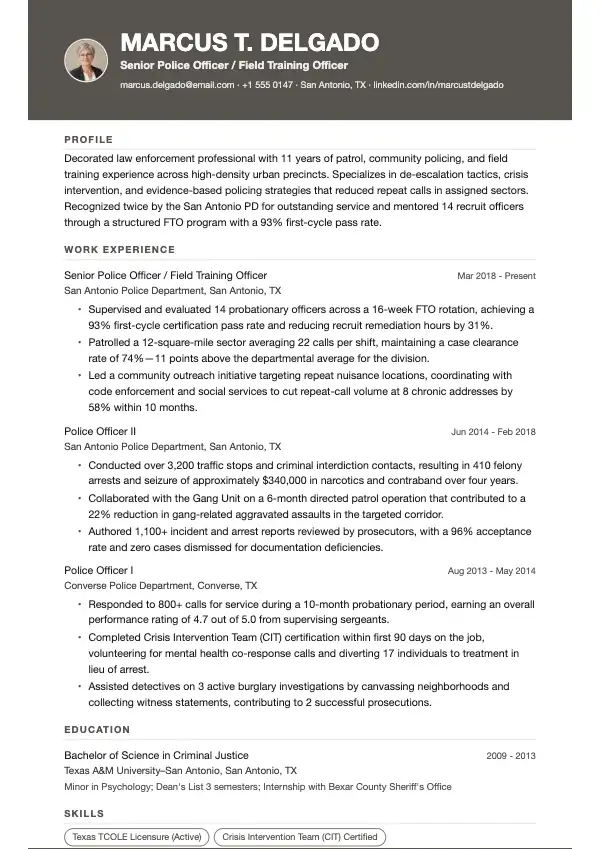
A police officer resume must clear automated keyword filters built around certifications and penal codes, then persuade a lieutenant or HR director that the candidate reduces risk and improves outcomes. This example does both by leading with licensure, quantified clearance rates, and a field-training record.
Template: Bold
Read this resume as text
Marcus T. Delgado
Senior Police Officer / Field Training Officer
marcus.delgado@email.com · +1 555 0147 · San Antonio, TX · linkedin.com/in/marcustdelgado
- Profile
- Decorated law enforcement professional with 11 years of patrol, community policing, and field training experience across high-density urban precincts. Specializes in de-escalation tactics, crisis intervention, and evidence-based policing strategies that reduced repeat calls in assigned sectors. Recognized twice by the San Antonio PD for outstanding service and mentored 14 recruit officers through a structured FTO program with a 93% first-cycle pass rate.
- Work Experience
Senior Police Officer / Field Training Officer
San Antonio Police Department, San Antonio, TX · Mar 2018 - Present
- Supervised and evaluated 14 probationary officers across a 16-week FTO rotation, achieving a 93% first-cycle certification pass rate and reducing recruit remediation hours by 31%.
- Patrolled a 12-square-mile sector averaging 22 calls per shift, maintaining a case clearance rate of 74%—11 points above the departmental average for the division.
- Led a community outreach initiative targeting repeat nuisance locations, coordinating with code enforcement and social services to cut repeat-call volume at 8 chronic addresses by 58% within 10 months.
Police Officer II
San Antonio Police Department, San Antonio, TX · Jun 2014 - Feb 2018
- Conducted over 3,200 traffic stops and criminal interdiction contacts, resulting in 410 felony arrests and seizure of approximately $340,000 in narcotics and contraband over four years.
- Collaborated with the Gang Unit on a 6-month directed patrol operation that contributed to a 22% reduction in gang-related aggravated assaults in the targeted corridor.
- Authored 1,100+ incident and arrest reports reviewed by prosecutors, with a 96% acceptance rate and zero cases dismissed for documentation deficiencies.
Police Officer I
Converse Police Department, Converse, TX · Aug 2013 - May 2014
- Responded to 800+ calls for service during a 10-month probationary period, earning an overall performance rating of 4.7 out of 5.0 from supervising sergeants.
- Completed Crisis Intervention Team (CIT) certification within first 90 days on the job, volunteering for mental health co-response calls and diverting 17 individuals to treatment in lieu of arrest.
- Assisted detectives on 3 active burglary investigations by canvassing neighborhoods and collecting witness statements, contributing to 2 successful prosecutions.
- Education
Bachelor of Science in Criminal Justice
Texas A&M University–San Antonio, San Antonio, TX · 2009 - 2013
Minor in Psychology; Dean's List 3 semesters; Internship with Bexar County Sheriff's Office
- Skills
- Texas TCOLE Licensure (Active) · Crisis Intervention Team (CIT) Certified · Field Training Officer (FTO) Certified · Use-of-Force & De-escalation Tactics · Evidence Collection & Chain of Custody · Incident Command System (ICS 100/200) · PoliceTech RMS & CAD Systems · Criminal Law & Texas Penal Code · Community-Oriented Policing (COP) Strategies
- Links
- LinkedIn: linkedin.com/in/marcustdelgado
What makes this resume work
- The summary names a specific, verifiable result—93% FTO pass rate—in the opening paragraph, giving reviewers an immediate performance anchor before they read a single bullet.
- Every bullet follows an action-verb → activity → measurable outcome structure, with real units (%, $, case counts) that distinguish this candidate from applicants who list duties instead of impact.
- Hard skills are written as recruiters and ATS engines actually search them—'Texas TCOLE Licensure,' 'CIT Certified,' 'ICS 100/200'—rather than vague phrases like 'strong legal knowledge.'
- Progression from Officer I at a smaller agency to Senior Officer and FTO at a major department tells a clear career story that signals reliability and upward trajectory without needing a separate cover letter to explain it.
Keywords that help you pass the ATS
Work the ones that fit your experience into your resume, naturally, not stuffed.
How to write a Police Officer resume
Choose the right format for a Police Officer resume
Use a reverse-chronological format. Hiring sergeants and HR staff at police departments scan dozens of applications and expect a predictable structure: contact info, summary, experience, skills, education, and certifications — in that order. Functional or hybrid formats raise red flags in law enforcement hiring because they appear to hide gaps or thin experience.
Keep your resume to one page if you have fewer than ten years on the job; two pages are acceptable for detectives, supervisors, or officers with military service, specialized units, or extensive training records. Use a clean 11–12 pt serif or sans-serif font, half-inch margins, and no graphics or headshot — most departments run applications through civil-service software that strips formatting.
- Standard section order: Contact → Summary → Experience → Skills → Education & Licenses
- File format: PDF unless the department's online portal specifies .docx
- Avoid tables and text boxes — applicant tracking systems used by large municipal agencies often misread them
- Name your file: LastName_FirstName_PoliceOfficer.pdf
Write a professional summary that clears the first cut
Your summary is three to four lines at the top of the page. It should state your years of experience, your primary specialty (patrol, investigations, community policing, SWAT support), a key credential, and one concrete result. Skip objective statements — they tell the department what you want, not what you deliver.
Example: "Patrol Officer with 7 years of experience in a 400-officer municipal department, POST-certified in Crisis Intervention (CIT) and Defensive Tactics Instructor. Maintained a 94% case-closure rate on assigned incident reports and received two departmental commendations for de-escalation outcomes. Seeking a Field Training Officer role with Riverside PD to develop patrol-ready recruits."
Write work-experience bullets that show impact, not just duties
Every bullet should follow an action-verb → task → result structure. Patrol duties are assumed; what sets you apart is volume, outcomes, and specialized assignments. Quantify wherever records allow — arrest counts, caseloads, response times, training hours delivered, or grant amounts managed.
Avoid phrases like 'responsible for patrolling' or 'assisted with investigations.' Those are job descriptions, not accomplishments. Pull numbers from your annual evaluations, department stats, or CAD system reports.
- Responded to an average of 12 calls per shift across a 22-square-mile patrol zone; maintained a 97% on-time response rate for Priority-1 calls over three consecutive years.
- Conducted 340+ field interviews annually as part of a directed-patrol narcotics initiative, contributing to a 18% reduction in drug-related incidents in the assigned sector within 14 months.
Skills and certifications recruiters and ATS systems look for
Law enforcement applicant tracking systems — including NeoGov, which is used by hundreds of municipal and county agencies — scan for specific credential keywords. List certifications with their full official name and issuing body. A skills section of eight to twelve tightly relevant terms outperforms a bloated list of twenty generic ones.
Separate hard skills (tools, systems, certifications) from soft skills, or skip the soft-skills list entirely — traits like 'communication' and 'integrity' carry no weight without evidence in your bullets.
- POST (Peace Officer Standards and Training) Certification — state-specific, always list your state
- Crisis Intervention Team (CIT) Certification
- NCIC / state terminal operator certification (e.g., CLETS, LEADS)
- CAD systems: Tyler New World, Motorola PremierOne, Spillman
- Use of Force / Defensive Tactics Instructor (if applicable)
- CPR/AED, Emergency Vehicle Operations Course (EVOC)
- Report writing systems: RMS platforms such as Axon Records or Brazos
Education, licenses, and additional credentials
List your highest degree first. A criminal justice degree is common but not required at most agencies — if your degree is unrelated, list it without commentary. Academy graduation belongs here or in a separate 'Training' section if you have significant coursework to show. Always include your POST certificate number or academy graduation date; some civil-service applications require it and reviewers will look for it.
Add military service, honorable discharge status, and any MOS (Military Occupational Specialty) relevant to law enforcement — many departments award civil-service preference points and hiring managers view prior service favorably. Include language fluency if you speak Spanish, Mandarin, or another language common in your target jurisdiction; bilingual officers are actively recruited.
- Associate of Science or Bachelor of Science in Criminal Justice — list institution, graduation year
- Police Academy: name of academy, graduation date, class rank if top 10%
- POST Certificate: number and issuing state
- Veteran status and DD-214 availability (note 'DD-214 available upon request' if applicable)
Mistakes to avoid
- Listing academy training under 'Work Experience' instead of 'Education' or 'Training' confuses hiring reviewers who expect a clear separation between formal instruction and sworn service.
- Omitting your POST certification state or number forces HR to follow up and can disqualify your application in civil-service systems that require it as a screening field.
- Using vague duty language like 'patrolled assigned area' with no volume, outcome, or context makes your experience indistinguishable from every other applicant in the stack.
- Including a photo, badge graphic, or department seal on your resume — many HR teams set photos aside to limit bias, and an agency seal on a personal document can look like misuse of official insignia.
Frequently asked questions
- Should a police officer resume include an objective statement?
- No — replace it with a professional summary that leads with your certification, years of experience, and a quantified result. Objective statements focus on what you want from the job; summaries show what you bring to the department, which is what hiring panels care about.
- How do I list police academy training on my resume?
- Place it under 'Education' or a dedicated 'Training & Certifications' section, not under work experience. Include the academy's full name, your graduation date, and your POST certificate number. If you graduated in the top of your class or received a leadership award, note it briefly.
- Can I use my police resume to apply for federal law enforcement jobs like CBP or FBI?
- Your resume structure will transfer, but federal applications through USAJOBS follow their own rules — each position needs start and end dates (month and year) and hours worked per week, and since September 27, 2025, USAJOBS resumes are limited to two pages. Tailor each application to the specific vacancy announcement and mirror the language used in the job duties section, as federal HR specialists check your resume against the qualifications in the announcement.
Make it yours in minutes
Open this example in the builder, swap in your details, and export a clean, ATS-ready resume.
Once your resume is ready
More for this application
- Template style
- Creative resume templates