Resume example
Process Engineer resume example
By the Resumade team · About our content
A Process Engineer resume must clear keyword filters for tools like Aspen and PI System while proving quantified impact to a hiring manager at first glance. This example does both: every bullet leads with a verb and closes with a dollar or percentage result, and the skills block mirrors the exact terms recruiters search.
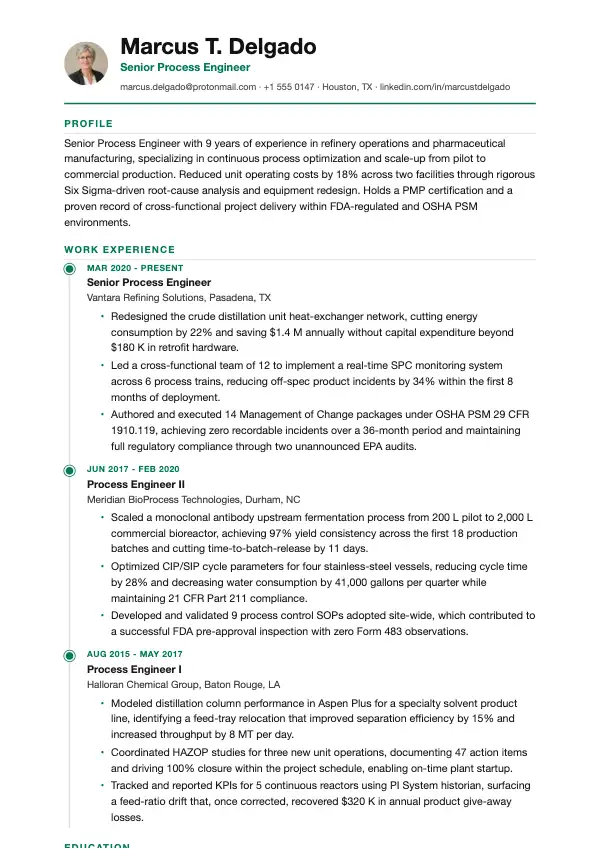
Template: Chronicle
Read this resume as text
Marcus T. Delgado
Senior Process Engineer
marcus.delgado@protonmail.com · +1 555 0147 · Houston, TX · linkedin.com/in/marcustdelgado
- Profile
- Senior Process Engineer with 9 years of experience in refinery operations and pharmaceutical manufacturing, specializing in continuous process optimization and scale-up from pilot to commercial production. Reduced unit operating costs by 18% across two facilities through rigorous Six Sigma-driven root-cause analysis and equipment redesign. Holds a PMP certification and a proven record of cross-functional project delivery within FDA-regulated and OSHA PSM environments.
- Work Experience
Senior Process Engineer
Vantara Refining Solutions, Pasadena, TX · Mar 2020 - Present
- Redesigned the crude distillation unit heat-exchanger network, cutting energy consumption by 22% and saving $1.4 M annually without capital expenditure beyond $180 K in retrofit hardware.
- Led a cross-functional team of 12 to implement a real-time SPC monitoring system across 6 process trains, reducing off-spec product incidents by 34% within the first 8 months of deployment.
- Authored and executed 14 Management of Change packages under OSHA PSM 29 CFR 1910.119, achieving zero recordable incidents over a 36-month period and maintaining full regulatory compliance through two unannounced EPA audits.
Process Engineer II
Meridian BioProcess Technologies, Durham, NC · Jun 2017 - Feb 2020
- Scaled a monoclonal antibody upstream fermentation process from 200 L pilot to 2,000 L commercial bioreactor, achieving 97% yield consistency across the first 18 production batches and cutting time-to-batch-release by 11 days.
- Optimized CIP/SIP cycle parameters for four stainless-steel vessels, reducing cycle time by 28% and decreasing water consumption by 41,000 gallons per quarter while maintaining 21 CFR Part 211 compliance.
- Developed and validated 9 process control SOPs adopted site-wide, which contributed to a successful FDA pre-approval inspection with zero Form 483 observations.
Process Engineer I
Halloran Chemical Group, Baton Rouge, LA · Aug 2015 - May 2017
- Modeled distillation column performance in Aspen Plus for a specialty solvent product line, identifying a feed-tray relocation that improved separation efficiency by 15% and increased throughput by 8 MT per day.
- Coordinated HAZOP studies for three new unit operations, documenting 47 action items and driving 100% closure within the project schedule, enabling on-time plant startup.
- Tracked and reported KPIs for 5 continuous reactors using PI System historian, surfacing a feed-ratio drift that, once corrected, recovered $320 K in annual product give-away losses.
- Education
B.S. Chemical Engineering
Louisiana State University, Baton Rouge, LA · 2011 - 2015
Graduated cum laude; Senior Capstone: Pinch Analysis for Ethylene Plant Heat Integration
- Skills
- Aspen Plus / Aspen HYSYS · Six Sigma Green Belt (ASQ) · PMP Certified · OSHA PSM / 29 CFR 1910.119 · 21 CFR Part 211 (Pharma GMP) · OSIsoft PI System · Statistical Process Control (SPC) · HAZOP Facilitation · MATLAB / Python (data analysis)
- Links
- LinkedIn: linkedin.com/in/marcustdelgado · PE License: Texas Professional Engineer License #112847 (verifiable via state board)
What makes this resume work
- Each bullet follows a strict action → method → measurable outcome structure, so a hiring manager can immediately calculate the candidate's dollar value without reading between the lines.
- The skills section lists certification bodies and regulation numbers (ASQ, OSHA 29 CFR 1910.119, 21 CFR Part 211) rather than vague labels, which matches the Boolean strings technical recruiters actually run in ATS platforms like Workday and Taleo.
- Two distinct industry domains — refinery and pharmaceutical bioprocessing — are represented in separate roles, signaling versatility without diluting the core identity of 'process optimization specialist.'
- The education note on the capstone project replaces a generic GPA line with domain-relevant technical content, giving early-career readers a model for surfacing academic work that reads like real engineering experience.
Keywords that help you pass the ATS
Work the ones that fit your experience into your resume, naturally, not stuffed.
How to write a Process Engineer resume
Choose the right format for a Process Engineer resume
Use a reverse-chronological format. Hiring managers in manufacturing, chemical, semiconductor, and oil-and-gas sectors want to trace your progression through increasingly complex process challenges — a functional or hybrid format obscures that story and raises red flags.
Keep the resume to one page if you have under ten years of experience, two pages if you have more. Use 0.75-inch margins, a clean sans-serif font (Calibri 10–11 pt works well), and clear section headers. ATS systems used by large manufacturers like BASF, Dow, and Intel parse single-column layouts most reliably, so avoid tables and text boxes.
- Sections in order: Contact Info → Summary → Skills → Work Experience → Education → Certifications
- Include a LinkedIn URL and, if relevant, a link to a published process improvement case study or patent
- Use standard section labels — 'Work Experience' not 'Where I've Made an Impact' — for ATS compatibility
Write a professional summary that frames your process engineering value
Your summary is three to four sentences that answer: what process domain do you specialize in, what scale of operations have you worked on, and what is your measurable track record. Skip objectives and personal adjectives. Lead with your discipline and years of experience, then anchor it with a concrete result.
Example: "Process Engineer with 7 years in continuous pharmaceutical manufacturing, specializing in API synthesis scale-up and process validation per FDA 21 CFR Part 211. Reduced batch cycle time by 18% at a 500-L reactor scale through DOE-driven parameter optimization. Experienced with PHA facilitation, P&ID review, and cross-functional NPI teams. Six Sigma Green Belt."
Write work-experience bullets that prove impact with numbers
Each bullet should follow an action-verb → process or tool → quantified outcome structure. Vague bullets like 'Improved efficiency' get ignored. Recruiters in this field are looking for yield improvements, cost reductions, cycle time changes, uptime percentages, scrap rates, and throughput gains. If you led a capital project, state the budget.
Pull metrics from MES reports, SPC charts, OEE dashboards, or project close-out documents. Even rough figures — 'approximately $400K annual savings' — are more credible than no figure at all.
- Redesigned distillation column feed preheat circuit using Aspen Plus simulation, reducing steam consumption by 23% and saving $310K annually across two production trains
- Led DMAIC project to eliminate root cause of HDPE extruder surging; implemented closed-loop melt pressure control via Siemens S7 PLC, cutting off-spec product from 4.1% to 0.6% and recovering 190 production hours per year
Skills and certifications recruiters and ATS systems look for
Process engineering spans many sub-disciplines, so tailor your skills section to the job posting. A semiconductor fab role wants CVD, CMP, and statistical process control; a refinery role wants HAZOP, PHAs, and process simulation in HYSYS. List the actual tool names — not categories — because ATS keyword matching is literal.
Certifications carry real weight in this field. Six Sigma credentials signal structured problem-solving. PMP signals project delivery capability. Industry-specific credentials like API 510 (pressure vessel inspection) or OSHA PSM knowledge signal safety competence. List certification body, credential name, and year obtained.
- Simulation: Aspen Plus, Aspen HYSYS, COMSOL, ProMax
- Statistical tools: Minitab, JMP, SPC, DOE (Design of Experiments)
- Process safety: HAZOP, FMEA, PHA, Layer of Protection Analysis (LOPA)
- Automation & controls: DeltaV, Siemens S7, Allen-Bradley, PI System (OSIsoft)
- Certifications: Six Sigma Green or Black Belt (ASQ), PMP (PMI), Lean Manufacturing, API 510/570, OSHA 30-Hour Process Safety
Education, licenses, and extras that close the deal
List your degree, institution, and graduation year. For process engineers, a B.S. or M.S. in Chemical Engineering, Mechanical Engineering, or Materials Science is the standard baseline. If your GPA was 3.5 or above and you graduated within the last five years, include it. Relevant coursework (thermodynamics, reaction kinetics, fluid mechanics) is worth listing only for new graduates.
If you hold a Professional Engineer (PE) license, put it prominently — either in the header next to your name or as the first item in your certifications section. Patents, published process improvement papers, or presentations at AIChE or TAPPI conferences belong in an 'Additional' section at the bottom and can differentiate you meaningfully from candidates with similar titles.
Mistakes to avoid
- Listing process responsibilities instead of outcomes — writing 'Responsible for SPC monitoring' tells a hiring manager nothing about whether your monitoring actually improved yield or reduced defects.
- Using generic tool names like 'process simulation software' instead of specifying Aspen HYSYS or ProMax, which causes ATS keyword matching to fail and signals a lack of hands-on depth.
- Omitting the scale and context of your work — a reactor optimization project at a 10-gallon pilot plant and one at a 50,000-gallon commercial unit require very different skills, and recruiters need that distinction.
- Burying a PE license or Six Sigma Black Belt credential in the education section instead of surfacing it in the header or summary, where screeners see it on the first scan.
Frequently asked questions
- Do process engineers need a PE license to get hired?
- Not universally, but it depends heavily on the sector. Roles in oil and gas, civil infrastructure, and consulting often require or strongly prefer a PE. Semiconductor, pharmaceutical, and consumer goods manufacturers rarely list it as mandatory. If you have it, always display it — it removes a hiring objection even when the job posting doesn't mention it.
- How do I write a process engineer resume with no industry experience?
- Lead with your simulation skills, lab or co-op projects, and any coursework in reaction engineering, thermodynamics, or controls. Quantify what you can from academic projects — reactor conversion rates, yield from a pilot-scale experiment, or cost estimates from a senior design project. Internship experience at any manufacturing site is worth detailing even if the process domain differs from your target role.
- Should I tailor my process engineer resume for every application?
- Yes, at minimum adjust the skills section and the first two bullets of each job entry to mirror the language in the posting. If a job description says 'HAZOP facilitation' and your resume says 'hazard review,' a keyword search may miss you despite identical experience. Fifteen minutes of targeted editing per application makes the match easier for a recruiter to see.
Make it yours in minutes
Open this example in the builder, swap in your details, and export a clean, ATS-ready resume.
Once your resume is ready
More for this application
- Template style
- ATS-Friendly resume templates