Resume example
Research Assistant resume example
By the Resumade team · About our content
A Research Assistant resume must clear keyword filters for domain-specific tools and methods while showing hiring managers you can own protocols end-to-end. This example does both by leading with quantified lab contributions and naming exact software, techniques, and compliance frameworks recruiters search for.
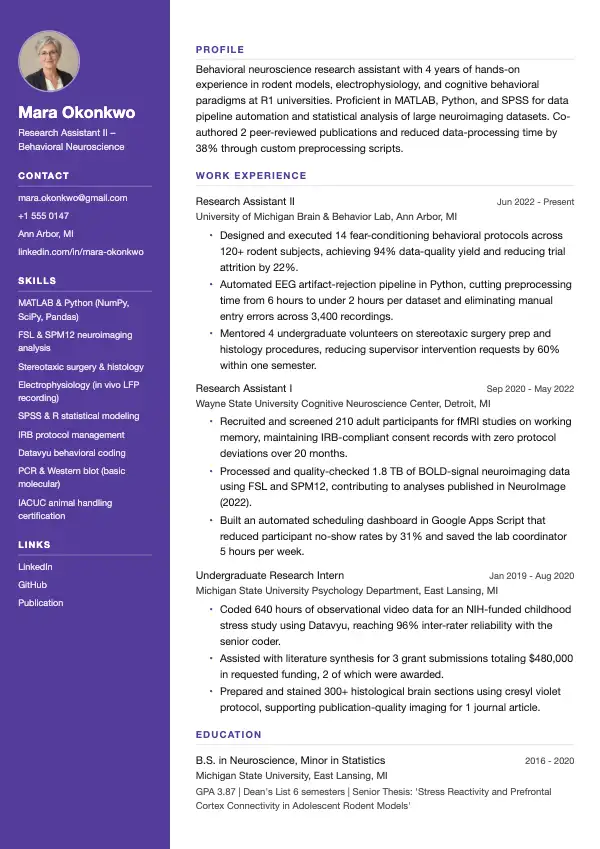
Template: Harbor
Read this resume as text
Mara Okonkwo
Research Assistant II – Behavioral Neuroscience
mara.okonkwo@gmail.com · +1 555 0147 · Ann Arbor, MI · linkedin.com/in/mara-okonkwo
- Profile
- Behavioral neuroscience research assistant with 4 years of hands-on experience in rodent models, electrophysiology, and cognitive behavioral paradigms at R1 universities. Proficient in MATLAB, Python, and SPSS for data pipeline automation and statistical analysis of large neuroimaging datasets. Co-authored 2 peer-reviewed publications and reduced data-processing time by 38% through custom preprocessing scripts.
- Work Experience
Research Assistant II
University of Michigan Brain & Behavior Lab, Ann Arbor, MI · Jun 2022 - Present
- Designed and executed 14 fear-conditioning behavioral protocols across 120+ rodent subjects, achieving 94% data-quality yield and reducing trial attrition by 22%.
- Automated EEG artifact-rejection pipeline in Python, cutting preprocessing time from 6 hours to under 2 hours per dataset and eliminating manual entry errors across 3,400 recordings.
- Mentored 4 undergraduate volunteers on stereotaxic surgery prep and histology procedures, reducing supervisor intervention requests by 60% within one semester.
Research Assistant I
Wayne State University Cognitive Neuroscience Center, Detroit, MI · Sep 2020 - May 2022
- Recruited and screened 210 adult participants for fMRI studies on working memory, maintaining IRB-compliant consent records with zero protocol deviations over 20 months.
- Processed and quality-checked 1.8 TB of BOLD-signal neuroimaging data using FSL and SPM12, contributing to analyses published in NeuroImage (2022).
- Built an automated scheduling dashboard in Google Apps Script that reduced participant no-show rates by 31% and saved the lab coordinator 5 hours per week.
Undergraduate Research Intern
Michigan State University Psychology Department, East Lansing, MI · Jan 2019 - Aug 2020
- Coded 640 hours of observational video data for an NIH-funded childhood stress study using Datavyu, reaching 96% inter-rater reliability with the senior coder.
- Assisted with literature synthesis for 3 grant submissions totaling $480,000 in requested funding, 2 of which were awarded.
- Prepared and stained 300+ histological brain sections using cresyl violet protocol, supporting publication-quality imaging for 1 journal article.
- Education
B.S. in Neuroscience, Minor in Statistics
Michigan State University, East Lansing, MI · 2016 - 2020
GPA 3.87 | Dean's List 6 semesters | Senior Thesis: 'Stress Reactivity and Prefrontal Cortex Connectivity in Adolescent Rodent Models'
- Skills
- MATLAB & Python (NumPy, SciPy, Pandas) · FSL & SPM12 neuroimaging analysis · Stereotaxic surgery & histology · Electrophysiology (in vivo LFP recording) · SPSS & R statistical modeling · IRB protocol management · Datavyu behavioral coding · PCR & Western blot (basic molecular) · IACUC animal handling certification
- Links
- LinkedIn · GitHub · Publication
What makes this resume work
- The job title includes the seniority tier ('Research Assistant II') and the specialty ('Behavioral Neuroscience'), so it matches both broad and narrow recruiter searches without keyword stuffing.
- Every bullet opens with a precise action verb tied to a lab task — 'Automated,' 'Recruited,' 'Coded' — and closes with a number, making the scope of work immediately scannable and credible.
- The skills section lists tools and certifications exactly as they appear in job postings (FSL, SPM12, IACUC, Datavyu) rather than paraphrasing them, which protects ATS match rates across applicant tracking systems.
- The education note surfaces the thesis title, GPA, and Dean's List status in one compact line, giving academic hiring committees the scholarly signal they weight heavily without consuming extra resume real estate.
Keywords that help you pass the ATS
Work the ones that fit your experience into your resume, naturally, not stuffed.
How to write a Research Assistant resume
Choose the right format for a Research Assistant resume
Use a reverse-chronological format unless you are a student with minimal lab experience, in which case a hybrid format that leads with a skills or coursework section works better. Keep the resume to one page if you have fewer than five years of experience; two pages are acceptable for postdoctoral-level candidates or those with extensive publication lists.
Set margins to 0.75–1 inch, use a clean sans-serif font at 10–12 pt, and include clearly labeled sections. Applicant tracking systems used by universities and research hospitals parse plain text poorly, so avoid tables, text boxes, and graphics.
- Lead with your name and a professional email — university addresses are fine and signal academic affiliation
- List your ORCID iD if you have publications; it saves recruiters a search step
- Place a publications or presentations section after education if you have three or more entries
- Use consistent date formatting (Month YYYY) throughout
Write a professional summary that positions your research focus
Your summary should name your research area, your methodological strengths, and one concrete outcome in three to four sentences. Generic phrases like 'hard-working team player' waste the only section a hiring manager reads before deciding to continue. Tailor the summary to the specific lab or institution — a cognitive neuroscience lab cares about fMRI preprocessing pipelines, not your general 'attention to detail.'
Example: "Detail-oriented Research Assistant with three years of experience in behavioral neuroscience at a Tier-1 R1 university. Proficient in rodent surgical procedures, stereotaxic injections, and histological analysis using ImageJ and MATLAB. Contributed to two NIH-funded projects, co-authored one peer-reviewed publication in Journal of Neuroscience, and maintained IRB and IACUC compliance across all active protocols."
Write work-experience bullets that show measurable impact
Every bullet should follow an action verb → task → result structure. Quantify wherever possible: sample sizes, throughput, error-rate reductions, grant amounts, or time savings. Hiring committees and PIs want to see that you understand the scientific stakes of accuracy and efficiency, not just that you 'assisted with experiments.'
- Processed and quality-checked fMRI datasets for 120 participants using FSL and SPM12, reducing preprocessing errors by 30% through a standardized QC checklist adopted lab-wide
- Managed a 400-sample biobank inventory in REDCap, cutting specimen retrieval time from 25 minutes to under 8 minutes by redesigning the labeling and storage schema
Skills and certifications recruiters and ATS systems look for
Research Assistant job postings are keyword-dense. Pull exact tool names from the job description and mirror them in your skills section. Separate hard skills (software, instruments, assays) from research competencies (study design, IRB submission, data management) and any formal certifications.
Certifications matter more than many candidates realize. CITI Program training in Human Subjects Research or Animal Research is expected at most academic medical centers. GCP certification is required for clinical trial positions. Statistical software proficiency should be listed with version numbers or context where relevant.
- Statistical software: R (tidyverse, ggplot2), SPSS, SAS, Python (pandas, scipy)
- Lab techniques: PCR, ELISA, Western blot, cell culture, flow cytometry, CRISPR
- Imaging and analysis: ImageJ/FIJI, FSL, SPM, MATLAB, NIS-Elements
- Data platforms: REDCap, Qualtrics, Covidence, EPIC (read access)
- Certifications: CITI Human Subjects, CITI GCP, HIPAA compliance training, IACUC animal handling
Education, licenses, and extras that strengthen your candidacy
List your degree, institution, graduation year, and GPA if it is 3.5 or above. Include your thesis or capstone title if it is directly relevant to the target role — PIs read these. If you are ABD or currently enrolled, write 'Expected May 2027' rather than leaving the date blank.
Below education, add separate sections for Publications (use APA or AMA format consistently), Conference Presentations, Grants and Fellowships, and Relevant Coursework if you are early-career. Volunteer research experience at a campus lab counts as real experience — list it under work history, not as an afterthought. Mention any language skills if the lab works with non-English-speaking participant populations.
- List poster presentations at regional or national conferences (e.g., SfN, APA, APHA) — they demonstrate professional engagement
- Include any grant writing contributions, even if you were a named contributor rather than PI
- Note first-author vs. co-author status clearly for every publication
Mistakes to avoid
- Listing lab techniques without context — 'performed PCR' tells a PI nothing about your throughput, accuracy, or independence level.
- Omitting CITI or GCP certification when it is listed as required in the job posting, even if you completed the training years ago.
- Using a single generic resume for every application instead of swapping in the specific assays, software, or disease areas named in each job description.
- Burying publications or conference presentations at the bottom of a two-page resume instead of giving them a dedicated, prominently placed section.
Frequently asked questions
- Should a Research Assistant resume include a publications section even if I only have one paper?
- Yes, include it. One peer-reviewed publication, even as a middle author, is meaningful in academic hiring and should appear in its own section with a full citation. If you have a preprint or a manuscript under review, list it with the status noted — it still signals productivity.
- How do I write a Research Assistant resume with no paid lab experience?
- Treat volunteer lab rotations, course-based research projects, and independent study credits exactly like paid positions — list the PI's name, the institution, your dates, and specific techniques you used. Hiring managers at the entry level expect this and evaluate candidates on skills and initiative, not payroll status.
- What is the right length for a Research Assistant resume?
- One page is standard for candidates with fewer than five years of experience, including most undergraduate and master's-level applicants. PhD candidates and postdocs with publications, grants, and conference presentations can justify two pages, but a curriculum vitae is often the preferred document for academic research positions — check the posting carefully.
Make it yours in minutes
Open this example in the builder, swap in your details, and export a clean, ATS-ready resume.
Once your resume is ready
More for this application
- Template style
- Academic resume templates