Resume example
Research Scientist resume example
By the Resumade team · About our content
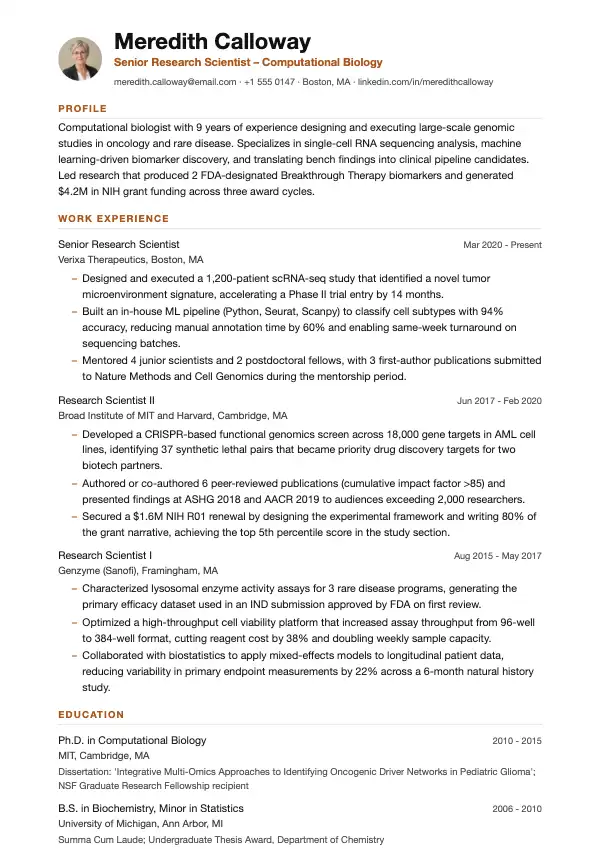
A Research Scientist resume must clear automated keyword filters tuned for domain tools and methodologies, then convince a hiring manager that the candidate moves science forward measurably. This example does both by leading with grant dollars, publication impact, and trial timelines.
Template: Wren
Read this resume as text
Meredith Calloway
Senior Research Scientist – Computational Biology
meredith.calloway@email.com · +1 555 0147 · Boston, MA · linkedin.com/in/meredithcalloway
- Profile
- Computational biologist with 9 years of experience designing and executing large-scale genomic studies in oncology and rare disease. Specializes in single-cell RNA sequencing analysis, machine learning-driven biomarker discovery, and translating bench findings into clinical pipeline candidates. Led research that produced 2 FDA-designated Breakthrough Therapy biomarkers and generated $4.2M in NIH grant funding across three award cycles.
- Work Experience
Senior Research Scientist
Verixa Therapeutics, Boston, MA · Mar 2020 - Present
- Designed and executed a 1,200-patient scRNA-seq study that identified a novel tumor microenvironment signature, accelerating a Phase II trial entry by 14 months.
- Built an in-house ML pipeline (Python, Seurat, Scanpy) to classify cell subtypes with 94% accuracy, reducing manual annotation time by 60% and enabling same-week turnaround on sequencing batches.
- Mentored 4 junior scientists and 2 postdoctoral fellows, with 3 first-author publications submitted to Nature Methods and Cell Genomics during the mentorship period.
Research Scientist II
Broad Institute of MIT and Harvard, Cambridge, MA · Jun 2017 - Feb 2020
- Developed a CRISPR-based functional genomics screen across 18,000 gene targets in AML cell lines, identifying 37 synthetic lethal pairs that became priority drug discovery targets for two biotech partners.
- Authored or co-authored 6 peer-reviewed publications (cumulative impact factor >85) and presented findings at ASHG 2018 and AACR 2019 to audiences exceeding 2,000 researchers.
- Secured a $1.6M NIH R01 renewal by designing the experimental framework and writing 80% of the grant narrative, achieving the top 5th percentile score in the study section.
Research Scientist I
Genzyme (Sanofi), Framingham, MA · Aug 2015 - May 2017
- Characterized lysosomal enzyme activity assays for 3 rare disease programs, generating the primary efficacy dataset used in an IND submission approved by FDA on first review.
- Optimized a high-throughput cell viability platform that increased assay throughput from 96-well to 384-well format, cutting reagent cost by 38% and doubling weekly sample capacity.
- Collaborated with biostatistics to apply mixed-effects models to longitudinal patient data, reducing variability in primary endpoint measurements by 22% across a 6-month natural history study.
- Education
Ph.D. in Computational Biology
MIT, Cambridge, MA · 2010 - 2015
Dissertation: 'Integrative Multi-Omics Approaches to Identifying Oncogenic Driver Networks in Pediatric Glioma'; NSF Graduate Research Fellowship recipient
B.S. in Biochemistry, Minor in Statistics
University of Michigan, Ann Arbor, MI · 2006 - 2010
Summa Cum Laude; Undergraduate Thesis Award, Department of Chemistry
- Skills
- Single-cell RNA sequencing (scRNA-seq) · CRISPR functional genomics · Python (Scanpy, Seurat, scikit-learn) · R (DESeq2, edgeR, ggplot2) · NIH grant writing (R01, R21) · Biomarker discovery & validation · Flow cytometry & FACS · Regulatory documentation (IND, BLA support) · Statistical modeling (mixed-effects, survival analysis)
- Links
- LinkedIn: linkedin.com/in/meredithcalloway · Google Scholar: scholar.google.com/citations?user=mcalloway · GitHub: github.com/mcalloway-bio
What makes this resume work
- The summary names seniority, years of experience, exact domain (computational oncology), and two headline outcomes in three sentences — giving a hiring manager a reason to keep reading before reaching the first job entry.
- Every bullet opens with a strong action verb and closes with a number: percentages, dollar amounts, patient counts, or time saved — making the scientific contribution legible to both bench scientists and R&D leadership evaluating the resume.
- Hard skills are listed as the exact tool names and methodologies (Scanpy, DESeq2, scRNA-seq, CRISPR screens) that ATS systems and scientific recruiters search for, rather than vague category labels like 'bioinformatics software.'
- The education section includes dissertation title and fellowship, signaling research depth and independent funding ability — two signals that differentiate senior research candidates from those with only industry experience.
Keywords that help you pass the ATS
Work the ones that fit your experience into your resume, naturally, not stuffed.
How to write a Research Scientist resume
Choose the right format for a Research Scientist resume
Use a reverse-chronological format unless you are pivoting from academia to industry, in which case a hybrid format lets you lead with a skills section before your experience. Either way, keep the document to two pages maximum — one page if you have fewer than five years of experience. Recruiters at biotech, pharma, and tech companies spend seconds scanning before deciding whether to read further, so use clean section headers, consistent fonts (Arial or Calibri at 10–11pt), and no tables or text boxes that break applicant tracking systems.
Place your contact information, a professional summary, core skills, work experience, and education in that order. If you have published papers or patents, add a brief Publications section at the bottom — do not bury them in the body text.
- Reverse-chronological: best for industry-to-industry moves
- Hybrid: useful when transitioning from postdoc or academia to industry
- Two-page limit; one page for early-career scientists
- Avoid tables, columns, and graphics — they confuse most ATS parsers
Write a professional summary that lands interviews
Your summary is three to four lines at the top of the resume. It should name your scientific discipline, your years of experience, two or three technical strengths, and the kind of role you are targeting. Avoid vague phrases like 'passionate scientist' or 'team player.' Instead, anchor every claim to something measurable or specific.
Example: "Molecular biologist with 7 years of industry experience in CRISPR-based gene editing and high-throughput screening. Led a 4-person team that advanced two oncology candidates from hit identification to lead optimization within 18 months. Seeking a Senior Research Scientist role in therapeutic genome editing at a clinical-stage biotech."
Write work-experience bullets that show impact, not just tasks
Each bullet should follow an action verb → method or tool → quantified outcome structure. Hiring managers want to see what you did, how you did it, and what changed because of it. Avoid listing responsibilities; describe results. If your work is confidential, use percentages, relative comparisons, or stage-gate milestones instead of absolute figures.
- Developed and validated a multiplexed qPCR assay using QuantStudio 12K Flex, reducing target confirmation time by 40% and enabling the team to screen 300+ compounds per quarter.
- Optimized a CHO cell fed-batch process through DoE (JMP 16), increasing monoclonal antibody titer from 2.1 g/L to 4.8 g/L and saving an estimated $1.2M in upstream manufacturing costs annually.
Skills and certifications recruiters and ATS systems look for
List hard skills in a dedicated section using the exact terminology found in job postings — ATS systems match keywords literally. Group them by category: techniques, instrumentation, software, and data analysis. Soft skills belong in your bullets, not in a skills list. For certifications, include the issuing body and year.
Relevant certifications include Good Laboratory Practice (GLP) and Good Manufacturing Practice (GMP) training, IACUC animal research certification, Biosafety Level 2 or 3 certification, and Six Sigma Green Belt if you work in process development. Data-focused roles increasingly require proficiency in Python, R, or MATLAB, and listing these explicitly matters.
- Techniques: CRISPR-Cas9, flow cytometry, Western blot, IHC, SPR, ELISA, NGS library prep
- Instrumentation: BD FACSAria, Biacore T200, QuantStudio, Operetta CLS, BioAnalyzer
- Software & data: GraphPad Prism, JMP, Spotfire, Benchling, Python (pandas, scipy), R
- Certifications: GLP/GMP training, IACUC, BSL-2/BSL-3, RAC (Regulatory Affairs Certification)
Education, publications, patents, and other extras
For most Research Scientist roles, a Ph.D. in a relevant field is the baseline expectation, though some companies hire M.S. candidates with five or more years of experience. List your degree, institution, graduation year, and dissertation title in one line — do not include GPA unless it is above 3.8 and you graduated within the last three years.
Below education, add a Publications section formatted in ACS or APA style, limited to your five most relevant peer-reviewed papers. List patents separately with the patent number and filing date. If you have presented at major conferences — AACR, ASHG, SfN, ACS — include a brief Presentations section. Fellowships such as NIH F32 or NSF GRFP are worth listing because they signal competitive peer review, which industry hiring managers respect.
- Include dissertation title — it signals your exact specialty to non-expert recruiters
- Cap publications at five; link to your Google Scholar profile for the full list
- List patents with number, title, and status (pending vs. granted)
- Name major fellowships and grants — NIH, NSF, DOE, HHMI carry real weight
Mistakes to avoid
- Using academic CV formatting — a ten-page CV with exhaustive publication lists overwhelms industry recruiters who expect a focused two-page resume.
- Writing task-based bullets like 'Responsible for running Western blots' instead of outcome-based bullets that show what the data produced or what decision it enabled.
- Omitting proprietary tool names and platform versions, which causes ATS systems to miss keyword matches even when you have the required skills.
- Listing a Ph.D. thesis defense date without clarifying whether the degree is conferred, which creates ambiguity that recruiters often resolve by skipping the application.
Frequently asked questions
- Should a Research Scientist resume include a publications list?
- Yes, but keep it concise — list your five most relevant peer-reviewed publications and add a link to your Google Scholar or ORCID profile for the complete record. Industry recruiters rarely read every paper, but the presence of publications confirms you can execute and communicate research. Format them consistently using ACS or APA style.
- Do Research Scientist roles require a Ph.D., and how should I handle an M.S. on my resume?
- Most industry Research Scientist titles at biotech and pharma companies expect a Ph.D. plus zero to three years of postdoctoral or industry experience, but some companies hire M.S. candidates with five or more years of hands-on research experience. If you hold an M.S., compensate by emphasizing depth of technical skills, leadership of projects, and any first-author publications or patents. Frame your summary around outcomes rather than credentials.
- How do I quantify research accomplishments when my work is confidential or preclinical?
- Use relative metrics, stage-gate language, and process improvements instead of compound names or absolute efficacy data. Phrases like 'advanced two programs from hit-to-lead within 12 months,' 'reduced assay variability by 35%,' or 'cut reagent costs by $80K annually through vendor renegotiation' convey impact without disclosing proprietary information. Check your employment agreement and use percentages or process benchmarks when absolute numbers are restricted.
Make it yours in minutes
Open this example in the builder, swap in your details, and export a clean, ATS-ready resume.
Once your resume is ready
More for this application
- Template style
- Academic resume templates