Resume example
Statistician resume example
By the Resumade team · About our content
A statistician resume must clear ATS keyword filters for methods and software while proving analytical impact to a hiring manager at first glance. This example does both: domain-specific tools appear in skills and naturally inside quantified bullets.
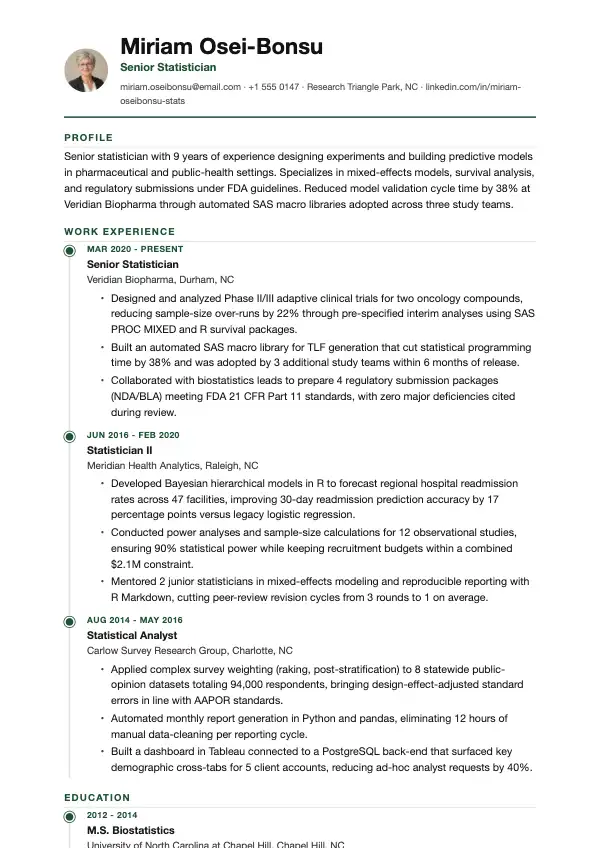
Template: Chronicle
Read this resume as text
Miriam Osei-Bonsu
Senior Statistician
miriam.oseibonsu@email.com · +1 555 0147 · Research Triangle Park, NC · linkedin.com/in/miriam-oseibonsu-stats
- Profile
- Senior statistician with 9 years of experience designing experiments and building predictive models in pharmaceutical and public-health settings. Specializes in mixed-effects models, survival analysis, and regulatory submissions under FDA guidelines. Reduced model validation cycle time by 38% at Veridian Biopharma through automated SAS macro libraries adopted across three study teams.
- Work Experience
Senior Statistician
Veridian Biopharma, Durham, NC · Mar 2020 - Present
- Designed and analyzed Phase II/III adaptive clinical trials for two oncology compounds, reducing sample-size over-runs by 22% through pre-specified interim analyses using SAS PROC MIXED and R survival packages.
- Built an automated SAS macro library for TLF generation that cut statistical programming time by 38% and was adopted by 3 additional study teams within 6 months of release.
- Collaborated with biostatistics leads to prepare 4 regulatory submission packages (NDA/BLA) meeting FDA 21 CFR Part 11 standards, with zero major deficiencies cited during review.
Statistician II
Meridian Health Analytics, Raleigh, NC · Jun 2016 - Feb 2020
- Developed Bayesian hierarchical models in R to forecast regional hospital readmission rates across 47 facilities, improving 30-day readmission prediction accuracy by 17 percentage points versus legacy logistic regression.
- Conducted power analyses and sample-size calculations for 12 observational studies, ensuring 90% statistical power while keeping recruitment budgets within a combined $2.1M constraint.
- Mentored 2 junior statisticians in mixed-effects modeling and reproducible reporting with R Markdown, cutting peer-review revision cycles from 3 rounds to 1 on average.
Statistical Analyst
Carlow Survey Research Group, Charlotte, NC · Aug 2014 - May 2016
- Applied complex survey weighting (raking, post-stratification) to 8 statewide public-opinion datasets totaling 94,000 respondents, bringing design-effect-adjusted standard errors in line with AAPOR standards.
- Automated monthly report generation in Python and pandas, eliminating 12 hours of manual data-cleaning per reporting cycle.
- Built a dashboard in Tableau connected to a PostgreSQL back-end that surfaced key demographic cross-tabs for 5 client accounts, reducing ad-hoc analyst requests by 40%.
- Education
M.S. Biostatistics
University of North Carolina at Chapel Hill, Chapel Hill, NC · 2012 - 2014
Thesis: Penalized spline methods for time-varying covariate survival models; GPA 3.91
B.S. Mathematics, Statistics concentration
Spelman College, Atlanta, GA · 2008 - 2012
Magna cum laude; Phi Beta Kappa
- Skills
- SAS (Base, STAT, MACRO, ODS) · R (tidyverse, survival, lme4, brms) · Python (pandas, NumPy, SciPy, statsmodels) · Bayesian & frequentist inference · Mixed-effects & longitudinal modeling · Survival analysis & time-to-event methods · FDA regulatory submissions (NDA/BLA, 21 CFR Part 11) · SQL / PostgreSQL · Tableau
- Links
- LinkedIn: linkedin.com/in/miriam-oseibonsu-stats · GitHub: github.com/moseibonsu-stats · Portfolio: moseibonsu-stats.netlify.app
What makes this resume work
- Every bullet opens with a strong action verb tied to a statistical method (e.g., 'Designed adaptive clinical trials,' 'Developed Bayesian hierarchical models') so the reader immediately understands both the technique and the business outcome.
- The skills section lists software in the exact syntax recruiters search — 'SAS (Base, STAT, MACRO)' rather than just 'SAS' — maximizing ATS match scores across parsed job descriptions.
- The summary front-loads seniority, years of experience, and domain specialization in sentence one, then closes with a concrete headline result, giving a hiring manager a complete picture before reading a single bullet.
- Education notes include GPA, thesis topic, and honors selectively — the thesis title signals methodological depth relevant to the current role without padding the section with irrelevant coursework.
Keywords that help you pass the ATS
Work the ones that fit your experience into your resume, naturally, not stuffed.
How to write a Statistician resume
Choose the right format for a Statistician resume
Use a reverse-chronological format unless you are transitioning from academia or a non-quantitative field, in which case a hybrid format that leads with a skills or methods section works better. Keep the resume to one page if you have fewer than eight years of experience; two pages are acceptable for senior statisticians with extensive publication records or government project histories.
Margins should be 0.75–1 inch, font size 10–12pt (Calibri, Georgia, or Arial), and section headers clearly differentiated. Applicant tracking systems used by pharma, federal agencies, and large tech firms parse plain text better than tables or text boxes, so avoid those entirely.
- Lead with your name, city/state, phone, professional email, and a LinkedIn or GitHub URL
- Order sections: Summary → Skills → Experience → Education → Certifications
- If you have publications, add a separate 'Selected Publications' section at the bottom
- Use consistent date formatting (MM/YYYY) throughout
Write a professional summary that frames your statistical specialty
Your summary should name your core methodology (Bayesian inference, survival analysis, mixed-effects modeling, etc.), the industry you know best, and one concrete outcome — all in three to four sentences. Generic phrases like 'detail-oriented professional' waste your first impression on a recruiter who reviews dozens of quantitative resumes daily.
Example: "Biostatistician with 7 years of experience supporting Phase II–III clinical trials in oncology and rare disease. Proficient in SAS, R, and NONMEM; experienced with FDA submission packages including ISS, ISE, and CDISC SDTM/ADaM datasets. Reduced data-cleaning cycle time by 30% through automated validation macros, enabling on-schedule NDA filing for two products."
Write work-experience bullets that quantify statistical impact
Each bullet should follow an action-verb → method or tool → measurable outcome structure. Recruiters in pharma, finance, and government want to see the scale of data you handled, the methods you applied, and what changed because of your work. Avoid bullets that describe responsibilities without results — 'Responsible for data analysis' tells a hiring manager nothing.
Translate statistical work into business or scientific outcomes whenever possible: model accuracy improvements, cost savings from better forecasting, faster trial timelines, or reduction in false-positive rates.
- Built a Bayesian hierarchical model in R (Stan) to forecast regional demand for a retail client, improving forecast accuracy by 18 MAPE points and reducing overstock costs by $2.1M annually
- Designed and analyzed a 1,200-patient adaptive clinical trial using SAS PROC SEQDESIGN; identified interim efficacy signal six months ahead of schedule, saving an estimated $4.8M in trial costs
Skills and certifications recruiters and ATS systems look for
List hard skills in a dedicated section rather than burying them in bullets. Recruiters filter by specific software names — SAS, R, Python, SPSS, Stata, MATLAB, Julia — so spell them exactly as they appear in job postings. Include statistical methods by name: regression modeling, time-series analysis, survival analysis, Monte Carlo simulation, A/B testing, factor analysis, or spatial statistics, depending on your background.
Certifications carry real weight in regulated industries. The American Statistical Association's Graduate Statistician (GStat) and Professional Statistician (PStat) credentials signal peer-reviewed competency. SAS Certified Statistical Business Analyst and SAS Certified Advanced Programmer are recognized in pharma and government. For clinical trials, CDISC training certificates (SDTM, ADaM) are frequently required. In analytics-heavy roles, a Google Professional Data Analytics or Coursera specialization from Johns Hopkins or Duke can supplement a degree.
- Software: SAS, R, Python (NumPy, SciPy, statsmodels, scikit-learn), Stata, SPSS, SQL, Tableau
- Methods: GLM/GLMM, survival analysis, Bayesian inference, DOE, propensity score matching, time-series forecasting
- Credentials: PStat (ASA), GStat (ASA), SAS Certified Advanced Programmer, CDISC SDTM/ADaM
- Domain keywords: CDISC, ICH E9(R1), GCP, FDA 21 CFR Part 11, HIPAA-compliant data handling
Education, licenses, and extras that strengthen a Statistician resume
Most statistician roles — especially in pharma, federal agencies (FDA, NIH, CDC, Census Bureau), and academia — require at minimum a master's degree in statistics, biostatistics, or a closely related quantitative field. List your degree, institution, and graduation year. If your GPA was 3.5 or higher and you graduated within the last five years, include it. List your thesis or dissertation title if it is directly relevant to the role.
For government positions, note any security clearance level. If you have served as a principal investigator or co-investigator on funded grants, list grant numbers and funding agencies (NIH, NSF, DARPA) — this is standard practice in federal and academic hiring and signals independent research credibility. Include professional memberships (ASA, ENAR, WNAR, SSC) under a brief 'Professional Affiliations' line at the bottom.
- List thesis title if relevant: 'Thesis: Semiparametric Methods for Interval-Censored Survival Data'
- Include relevant coursework only if you are a new graduate with limited experience
- Note teaching assistantships or statistical consulting center roles — they demonstrate communication skills
Mistakes to avoid
- Listing software tools without specifying the context or scale in which you used them — writing 'proficient in R' means nothing without a bullet showing what you built with it.
- Using vague method names like 'advanced statistical analysis' instead of naming the actual technique (e.g., 'Cox proportional hazards regression' or 'ARIMA forecasting').
- Omitting the sample sizes, dataset dimensions, or project scope that give hiring managers a sense of the complexity you can handle.
- Applying an academic CV structure — long publication lists, conference abstracts, and course syllabi — to an industry resume, which should stay tightly focused on impact and be two pages or fewer.
Frequently asked questions
- Do I need a PhD to get a statistician job in industry?
- No — a master's degree is the standard minimum for most industry statistician roles, including positions at pharmaceutical companies, financial firms, and government agencies. A PhD is typically required for principal or senior research statistician roles at places like the FDA, NIH, or top-tier academic medical centers, and it can accelerate promotion tracks in pharma. Focus your resume on applied methods experience and domain knowledge if you hold a master's.
- Should I include publications on my statistician resume?
- Yes, if you are applying to roles in biotech, pharma, government research, or academia — include a concise 'Selected Publications' section with up to five peer-reviewed papers in standard citation format. For purely industry or tech roles focused on product analytics or business intelligence, publications are less critical and can be replaced by a link to a GitHub portfolio or a Kaggle profile showing applied work.
- How do I tailor my statistician resume for a federal government job posting?
- Federal job announcements (USAJOBS) use very specific language tied to OPM qualification standards — mirror that language exactly in your resume, including the full names of methods, software, and regulatory frameworks mentioned in the posting. Federal resumes are also typically longer than private-sector ones, often three to five pages, because they require detailed descriptions of duties, hours per week, and supervisor contact information for each position. Never submit a one-page resume for a GS-series statistician position.
Make it yours in minutes
Open this example in the builder, swap in your details, and export a clean, ATS-ready resume.
Once your resume is ready
More for this application
- Template style
- Academic resume templates