Resume example
Lab Manager resume example
By the Resumade team · About our content
A Lab Manager resume must satisfy ATS keyword filters for compliance and instrumentation terms while proving operational impact to a hiring committee. This example does both with quantified bullets and domain-specific language throughout.
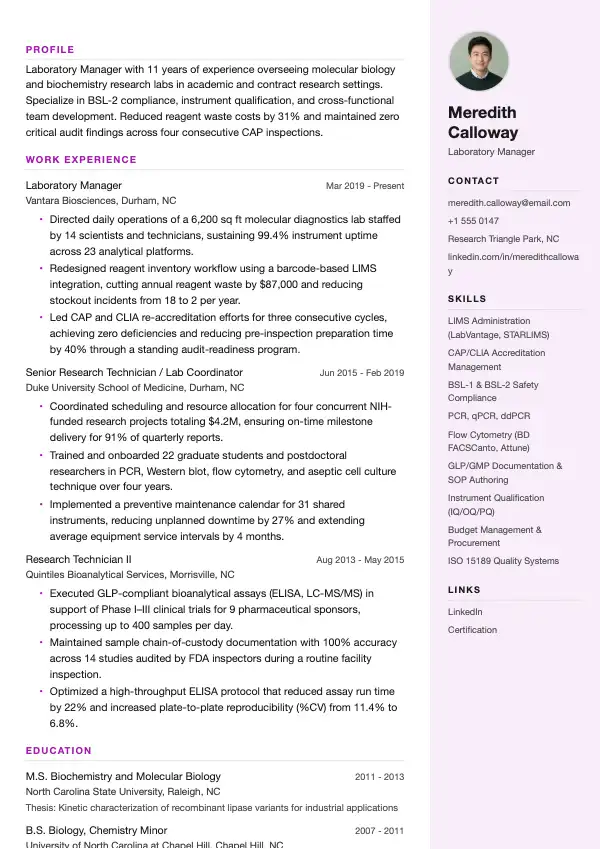
Template: Mist
Read this resume as text
Meredith Calloway
Laboratory Manager
meredith.calloway@email.com · +1 555 0147 · Research Triangle Park, NC · linkedin.com/in/meredithcalloway
- Profile
- Laboratory Manager with 11 years of experience overseeing molecular biology and biochemistry research labs in academic and contract research settings. Specialize in BSL-2 compliance, instrument qualification, and cross-functional team development. Reduced reagent waste costs by 31% and maintained zero critical audit findings across four consecutive CAP inspections.
- Work Experience
Laboratory Manager
Vantara Biosciences, Durham, NC · Mar 2019 - Present
- Directed daily operations of a 6,200 sq ft molecular diagnostics lab staffed by 14 scientists and technicians, sustaining 99.4% instrument uptime across 23 analytical platforms.
- Redesigned reagent inventory workflow using a barcode-based LIMS integration, cutting annual reagent waste by $87,000 and reducing stockout incidents from 18 to 2 per year.
- Led CAP and CLIA re-accreditation efforts for three consecutive cycles, achieving zero deficiencies and reducing pre-inspection preparation time by 40% through a standing audit-readiness program.
Senior Research Technician / Lab Coordinator
Duke University School of Medicine, Durham, NC · Jun 2015 - Feb 2019
- Coordinated scheduling and resource allocation for four concurrent NIH-funded research projects totaling $4.2M, ensuring on-time milestone delivery for 91% of quarterly reports.
- Trained and onboarded 22 graduate students and postdoctoral researchers in PCR, Western blot, flow cytometry, and aseptic cell culture technique over four years.
- Implemented a preventive maintenance calendar for 31 shared instruments, reducing unplanned downtime by 27% and extending average equipment service intervals by 4 months.
Research Technician II
Quintiles Bioanalytical Services, Morrisville, NC · Aug 2013 - May 2015
- Executed GLP-compliant bioanalytical assays (ELISA, LC-MS/MS) in support of Phase I–III clinical trials for 9 pharmaceutical sponsors, processing up to 400 samples per day.
- Maintained sample chain-of-custody documentation with 100% accuracy across 14 studies audited by FDA inspectors during a routine facility inspection.
- Optimized a high-throughput ELISA protocol that reduced assay run time by 22% and increased plate-to-plate reproducibility (%CV) from 11.4% to 6.8%.
- Education
M.S. Biochemistry and Molecular Biology
North Carolina State University, Raleigh, NC · 2011 - 2013
Thesis: Kinetic characterization of recombinant lipase variants for industrial applications
B.S. Biology, Chemistry Minor
University of North Carolina at Chapel Hill, Chapel Hill, NC · 2007 - 2011
Graduated with Honors; Dean's List 6 semesters
- Skills
- LIMS Administration (LabVantage, STARLIMS) · CAP/CLIA Accreditation Management · BSL-1 & BSL-2 Safety Compliance · PCR, qPCR, ddPCR · Flow Cytometry (BD FACSCanto, Attune) · GLP/GMP Documentation & SOP Authoring · Instrument Qualification (IQ/OQ/PQ) · Budget Management & Procurement · ISO 15189 Quality Systems
- Links
- LinkedIn · Certification
What makes this resume work
- The three-sentence summary names seniority, domain, and two headline results — a hiring manager can assess fit before reading a single bullet.
- Every bullet opens with a strong action verb and closes with a specific number, dollar figure, or percentage, making impact impossible to overlook or dismiss as vague.
- Skills are listed as discrete, searchable terms (e.g., 'CAP/CLIA Accreditation Management,' 'IQ/OQ/PQ') that match the exact phrases recruiters enter into applicant tracking systems.
- The education notes section is used to signal research depth and academic distinction without padding the main body, keeping the resume focused on professional accomplishments.
Keywords that help you pass the ATS
Work the ones that fit your experience into your resume, naturally, not stuffed.
How to write a Lab Manager resume
Choose the right format for a Lab Manager resume
Use a reverse-chronological format. Hiring managers in research institutions, biotech firms, CROs, and hospital systems want to see your most recent lab leadership role first, because scope of responsibility tends to grow over time and they need to assess it quickly.
Keep the resume to one page if you have under ten years of experience; two pages is acceptable for senior candidates overseeing multiple labs or large teams. Use clean section headers, consistent font sizing (10–12 pt body, 13–14 pt headers), and adequate white space. Avoid tables and text boxes — many applicant tracking systems used by large employers like Thermo Fisher, LabCorp, or academic medical centers will misread them.
- Standard sections: Contact Info, Summary, Work Experience, Skills, Education, Certifications
- File format: submit a text-based PDF unless the posting explicitly requests .docx
- Margins: 0.5–1 inch on all sides
- Font: Calibri, Arial, or Georgia — no decorative typefaces
Write a professional summary that positions your lab expertise immediately
Your summary sits at the top and does one job: tell the reader what kind of lab you run, at what scale, and what you're known for. Skip objective statements and generic phrases like 'results-driven professional.' Name the lab type, your team size, and one or two concrete outcomes.
Example: "Lab Manager with 9 years of experience overseeing a 12-person molecular biology research lab in an academic medical center. Reduced reagent spend by 18% through vendor renegotiation and inventory automation using Quartzy. Maintained 100% CAP inspection compliance across three consecutive audit cycles. Skilled in BSL-2 operations, grant budget management, and onboarding graduate researchers."
Write work-experience bullets that show scale and outcomes
Each bullet should answer: what did you do, how did you do it, and what happened as a result? Lab Manager roles involve both technical and operational work, so cover both. Quantify wherever you can — headcount, budget size, turnaround time, error rates, compliance scores, or equipment uptime.
Avoid listing duties. 'Responsible for ordering supplies' tells a recruiter nothing. Show what you managed, optimized, or fixed.
- Managed $1.4M annual lab operating budget across consumables, equipment maintenance contracts, and service agreements, reducing unplanned expenditures by 22% over two years through predictive maintenance scheduling.
- Supervised and trained 8 research associates and 4 graduate students in PCR, Western blot, ELISA, and flow cytometry protocols, cutting new-hire onboarding time from 6 weeks to 3.5 weeks by building a standardized SOP library in LabArchives.
Include the skills and certifications ATS systems and recruiters screen for
Lab Manager job postings pull from a consistent vocabulary. Your skills section should mirror that language so your resume passes automated screening. Separate hard skills (techniques, software, equipment) from soft skills (team leadership, budget management), and list certifications in their own subsection with issuing body and expiration year where relevant.
Certifications carry real weight in this field. OSHA 10 or 30, CLIA compliance knowledge, CAP or ISO 15189 audit experience, and biosafety certifications are frequently listed as requirements, not preferences.
- Lab management software: Quartzy, Freezerworks, LabArchives, LIMS platforms (LabVantage, STARLIMS)
- Techniques: PCR/qPCR, ELISA, flow cytometry, cell culture, mass spectrometry, chromatography (HPLC/GC)
- Compliance frameworks: CAP, CLIA, GLP, GMP, ISO 15189, BSL-1/BSL-2
- Certifications: CSMLS, ASCP (MLS, MB, BB), OSHA 30-Hour, Radiation Safety Officer (RSO) where applicable
- Equipment: autoclaves, biosafety cabinets, cryogenic storage systems, liquid handlers (Hamilton, Tecan)
Education, licenses, and extras that strengthen your candidacy
Most Lab Manager roles require at minimum a bachelor's degree in biology, chemistry, biochemistry, or a related life science. Many research-intensive environments prefer or require a master's degree. List your degree, institution, and graduation year. You do not need to list GPA unless you graduated within the last three years and it is above 3.5.
Add a separate Certifications section rather than burying credentials in Education. If you hold a state laboratory director license, an RSO designation, or an ASCP board certification, those belong near the top of the page — not at the bottom. Publications, poster presentations, and grant acknowledgments are worth including for academic or research-focused positions; skip them for clinical or industrial lab roles unless directly relevant.
- List continuing education credits if they relate to compliance, safety, or emerging techniques
- Include professional memberships: ABSA International, ASCLS, ACS
- Note any EHS committee leadership or institutional biosafety committee (IBC) participation
Mistakes to avoid
- Listing lab techniques without context — naming 'PCR' means little unless you specify scale, throughput, or the role it played in your work.
- Omitting budget and headcount figures, which are the two data points hiring managers use most to gauge whether your experience matches the scope of their open role.
- Using a generic skills section that copies the job description word-for-word without demonstrating where or how you applied those skills.
- Leaving compliance and safety credentials off the resume or burying them at the bottom, when CAP, CLIA, or GLP experience is often a hard requirement that determines whether your application advances at all.
Frequently asked questions
- Should a Lab Manager resume include a list of publications?
- Include publications only if you are applying to a research-intensive academic or biotech role where scientific output is part of the job expectation. For clinical lab, industrial, or core facility positions, publications add length without adding relevance. If you do include them, limit the list to three to five most recent or most cited, and place them at the end of the resume.
- What is the difference between a Lab Manager resume and a Laboratory Director resume?
- A Lab Manager resume emphasizes day-to-day operations: scheduling, inventory, equipment maintenance, staff training, and protocol compliance. A Laboratory Director resume shifts focus to strategic oversight, regulatory accountability, budget authority, and organizational leadership. If you are moving from manager to director, your resume needs to foreground decision-making scope, multi-department coordination, and P&L or grant management rather than hands-on technical work.
- How do I write a Lab Manager resume if I am transitioning from a bench scientist role?
- Reframe your existing bullet points around any coordination, mentorship, equipment stewardship, or process-improvement work you already did — these are management functions even if your title was Research Associate or Scientist. Highlight any informal leadership: training new lab members, writing SOPs, managing shared equipment calendars, or leading safety audits. Add any relevant certifications like OSHA 30 or a lab management short course to signal intentional career direction.
Make it yours in minutes
Open this example in the builder, swap in your details, and export a clean, ATS-ready resume.
Once your resume is ready
More for this application
- Template style
- Creative resume templates