Resume example
Scrum Master resume example
By the Resumade team · About our content
A Scrum Master resume must surface the right certification acronyms for ATS filters while proving to a hiring manager that you move teams — not just meetings. This example does both: tiered credentials up top, bullets anchored to velocity, cycle time, and cost data.
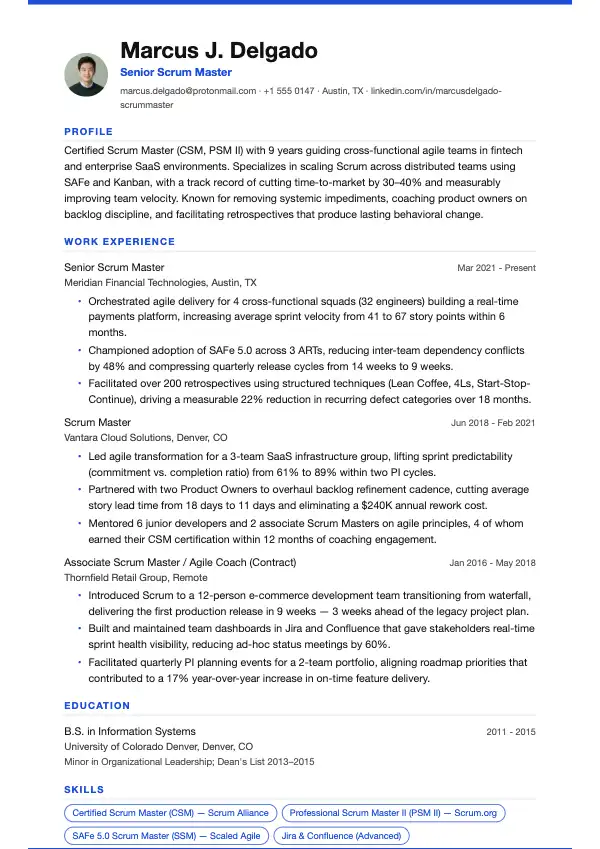
Template: Ribbon
Read this resume as text
Marcus J. Delgado
Senior Scrum Master
marcus.delgado@protonmail.com · +1 555 0147 · Austin, TX · linkedin.com/in/marcusdelgado-scrummaster
- Profile
- Certified Scrum Master (CSM, PSM II) with 9 years guiding cross-functional agile teams in fintech and enterprise SaaS environments. Specializes in scaling Scrum across distributed teams using SAFe and Kanban, with a track record of cutting time-to-market by 30–40% and measurably improving team velocity. Known for removing systemic impediments, coaching product owners on backlog discipline, and facilitating retrospectives that produce lasting behavioral change.
- Work Experience
Senior Scrum Master
Meridian Financial Technologies, Austin, TX · Mar 2021 - Present
- Orchestrated agile delivery for 4 cross-functional squads (32 engineers) building a real-time payments platform, increasing average sprint velocity from 41 to 67 story points within 6 months.
- Championed adoption of SAFe 5.0 across 3 ARTs, reducing inter-team dependency conflicts by 48% and compressing quarterly release cycles from 14 weeks to 9 weeks.
- Facilitated over 200 retrospectives using structured techniques (Lean Coffee, 4Ls, Start-Stop-Continue), driving a measurable 22% reduction in recurring defect categories over 18 months.
Scrum Master
Vantara Cloud Solutions, Denver, CO · Jun 2018 - Feb 2021
- Led agile transformation for a 3-team SaaS infrastructure group, lifting sprint predictability (commitment vs. completion ratio) from 61% to 89% within two PI cycles.
- Partnered with two Product Owners to overhaul backlog refinement cadence, cutting average story lead time from 18 days to 11 days and eliminating a $240K annual rework cost.
- Mentored 6 junior developers and 2 associate Scrum Masters on agile principles, 4 of whom earned their CSM certification within 12 months of coaching engagement.
Associate Scrum Master / Agile Coach (Contract)
Thornfield Retail Group, Remote · Jan 2016 - May 2018
- Introduced Scrum to a 12-person e-commerce development team transitioning from waterfall, delivering the first production release in 9 weeks — 3 weeks ahead of the legacy project plan.
- Built and maintained team dashboards in Jira and Confluence that gave stakeholders real-time sprint health visibility, reducing ad-hoc status meetings by 60%.
- Facilitated quarterly PI planning events for a 2-team portfolio, aligning roadmap priorities that contributed to a 17% year-over-year increase in on-time feature delivery.
- Education
B.S. in Information Systems
University of Colorado Denver, Denver, CO · 2011 - 2015
Minor in Organizational Leadership; Dean's List 2013–2015
- Skills
- Certified Scrum Master (CSM) — Scrum Alliance · Professional Scrum Master II (PSM II) — Scrum.org · SAFe 5.0 Scrum Master (SSM) — Scaled Agile · Jira & Confluence (Advanced) · Azure DevOps (Boards, Pipelines) · Kanban & WIP Limit Optimization · Agile Metrics: Velocity, CFD, Cycle Time, Lead Time · Facilitation: PI Planning, Sprint Events, Retrospectives · Stakeholder Communication & Executive Reporting
- Links
- LinkedIn: linkedin.com/in/marcusdelgado-scrummaster · Certification: Certified ScrumMaster (CSM), Scrum Alliance (verifiable via Scrum Alliance) · Portfolio / Case Studies: marcusdelgado.io/case-studies
What makes this resume work
- The summary leads with exact certification codes (CSM, PSM II) and a quantified range of outcomes, giving ATS scanners a match and hiring managers a reason to keep reading.
- Every bullet opens with a strong action verb (Orchestrated, Championed, Facilitated) and closes with a specific number — percentages, dollar figures, or time deltas — so impact is never implied, always stated.
- The skills section names tools and frameworks at the level recruiters actually search (SAFe 5.0, PSM II, Azure DevOps Boards) rather than vague terms like 'agile methodology.'
- Career progression is visible at a glance: contract-to-full-time growth across fintech, SaaS, and retail verticals shows domain range without requiring the reader to do the math.
Keywords that help you pass the ATS
Work the ones that fit your experience into your resume, naturally, not stuffed.
How to write a Scrum Master resume
Choose the right format for a Scrum Master resume
Use a reverse-chronological format. Hiring managers and ATS systems both expect it, and Scrum Master roles are experience-heavy — your most recent work is your strongest argument. A functional or hybrid format raises red flags unless you are making a significant career pivot.
Keep it to one page if you have fewer than ten years of experience; two pages are acceptable beyond that. Use clean section headers (Summary, Experience, Skills, Certifications, Education), 10–12pt font, and at least 0.5-inch margins. Avoid tables, text boxes, and columns — many ATS parsers scramble them.
- Standard sections in order: Contact Info → Summary → Experience → Skills → Certifications → Education
- File format: PDF unless the job posting explicitly requests .docx
- Job title in your header should match the posting exactly (e.g., 'Scrum Master' not 'Agile Coach' if that is what they advertised)
- Tailor the resume per application — Scrum Masters are hired across industries with very different expectations
Write a professional summary that earns a closer read
Your summary sits at the top and has to answer three questions immediately: How experienced are you? What kind of teams or environments have you served? What measurable value do you bring? Skip phrases like 'passionate servant leader' — they appear on thousands of resumes and say nothing.
Here is a concrete example of a summary that works: "Certified Scrum Master (CSM, PSM I) with seven years facilitating Scrum and Kanban teams in fintech and healthcare SaaS. Reduced average sprint carry-over from 22% to 8% across three product teams at a 400-person scale-up. Experienced coaching Product Owners on backlog refinement, running PI Planning in SAFe environments, and onboarding distributed teams across US and India time zones."
Write work-experience bullets that show impact, not just activity
Every bullet should follow an action → method → result structure. Scrum Masters often describe process without outcomes — that is the fastest way to lose a hiring manager's attention. Quantify wherever possible: velocity improvements, team size, cycle time, defect rates, release frequency, or impediment resolution time. If you facilitated ceremonies, say how many teams and at what cadence. If you coached, say what changed.
Avoid bullets like 'Facilitated daily standups and retrospectives.' That describes the job description, not your performance.
- Coached four cross-functional squads (32 engineers total) through a Jira-to-Azure DevOps migration, cutting sprint planning sessions from 4 hours to 90 minutes within two quarters
- Identified and resolved 47 organizational impediments over 18 months — including a procurement bottleneck that had blocked two teams for six sprints — reducing average impediment age from 19 days to 4 days
Skills and certifications recruiters and ATS systems actually look for
List your certifications prominently — they are often used as hard filters. The most recognized are CSM (Certified Scrum Master, Scrum Alliance), PSM I/II (Professional Scrum Master, Scrum.org), SAFe Scrum Master (SSM), and PMI-ACP. CSM is the most common baseline requirement; PSM II and SAFe RTE signal seniority. Include the issuing body and year.
Your skills section should reflect the actual tools and frameworks in the job posting. Generic lists hurt more than they help.
- Frameworks: Scrum, Kanban, SAFe 5.0/6.0, LeSS, Nexus
- Tools: Jira, Confluence, Azure DevOps, Rally (CA Agile Central), Miro, Trello, Monday.com
- Practices: backlog refinement, sprint planning, retrospective facilitation, impediment removal, OKR alignment, Definition of Done/Ready
- Soft skills worth naming explicitly: conflict resolution, servant leadership, stakeholder communication — but only if you back them up in your bullets
- Certifications to list: CSM, PSM I/II, SSM, SAFe RTE, PMI-ACP, ICP-ACC (for coaching-track roles)
Education, licenses, and extras that round out the picture
A bachelor's degree is listed as required in most Scrum Master job postings, but the field is rarely strict about major — Computer Science, Business, Communications, and Psychology all appear in this role. List your degree, institution, and graduation year. Do not include GPA unless you graduated within the last two years and it is above 3.5.
Below education, add a short Additional section for relevant extras: Scrum Alliance membership, active contributions to agile communities (e.g., Agile Alliance, local meetup organizer), published case studies, or second languages if the role involves distributed international teams. Keep this section to three lines maximum — it is supporting evidence, not a focal point.
Mistakes to avoid
- Listing certifications without the issuing body or year makes them unverifiable and easy for recruiters to discount.
- Describing Scrum ceremonies as responsibilities rather than outcomes — 'ran retrospectives' tells a hiring manager nothing about whether the team improved.
- Using the same resume for every application when Scrum Master job postings vary significantly between a startup running one Scrum team and an enterprise using SAFe across 20 ARTs.
- Omitting team size, number of teams served, and product domain, which are the three fastest ways a recruiter calibrates whether your experience matches the role's scope.
Frequently asked questions
- Do I need a CSM certification to get a Scrum Master job?
- In most cases, yes — the CSM or PSM I is treated as a baseline requirement at many companies, and recruiters often search for it by name. Without at least one recognized certification, your resume is less likely to come up in those searches. If you do not have one yet, pursue the PSM I from Scrum.org first; it is exam-only, lower cost, and widely respected.
- How do I write a Scrum Master resume if I am transitioning from a developer or project manager role?
- Lead with a summary that explicitly names your target role and frames your prior experience as relevant context — for example, years working within Scrum teams gives you credibility on team dynamics that external hires lack. Highlight any informal Scrum Master duties you performed, such as facilitating retrospectives or removing blockers, and get certified before applying. Reframe project management experience around servant leadership and team enablement rather than delivery ownership.
- Should I include SAFe experience on my Scrum Master resume even if the job posting does not mention it?
- Yes, include it — SAFe experience signals that you can operate in complex, multi-team environments, which is a differentiator even when a company is not currently using SAFe. List it in your skills section and reference it in relevant experience bullets. If the company is smaller or explicitly Scrum-only, do not lead with it in your summary, since it can make you appear overqualified or misaligned with their culture.
Make it yours in minutes
Open this example in the builder, swap in your details, and export a clean, ATS-ready resume.
Once your resume is ready
More for this application
- Template style
- Creative resume templates