Resume example
Actuary resume example
By the Resumade team · About our content
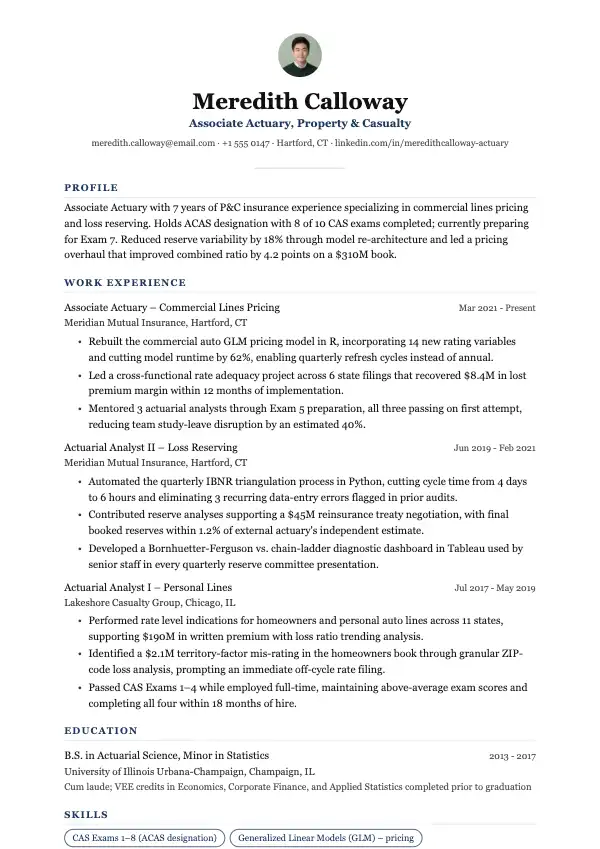
An actuary resume must clear keyword filters for exam status and technical tools while proving to the hiring manager that you move the needle on pricing accuracy and reserve quality. This example does both.
Template: Classic
Read this resume as text
Meredith Calloway
Associate Actuary, Property & Casualty
meredith.calloway@email.com · +1 555 0147 · Hartford, CT · linkedin.com/in/meredithcalloway-actuary
- Profile
- Associate Actuary with 7 years of P&C insurance experience specializing in commercial lines pricing and loss reserving. Holds ACAS designation with 8 of 10 CAS exams completed; currently preparing for Exam 7. Reduced reserve variability by 18% through model re-architecture and led a pricing overhaul that improved combined ratio by 4.2 points on a $310M book.
- Work Experience
Associate Actuary – Commercial Lines Pricing
Meridian Mutual Insurance, Hartford, CT · Mar 2021 - Present
- Rebuilt the commercial auto GLM pricing model in R, incorporating 14 new rating variables and cutting model runtime by 62%, enabling quarterly refresh cycles instead of annual.
- Led a cross-functional rate adequacy project across 6 state filings that recovered $8.4M in lost premium margin within 12 months of implementation.
- Mentored 3 actuarial analysts through Exam 5 preparation, all three passing on first attempt, reducing team study-leave disruption by an estimated 40%.
Actuarial Analyst II – Loss Reserving
Meridian Mutual Insurance, Hartford, CT · Jun 2019 - Feb 2021
- Automated the quarterly IBNR triangulation process in Python, cutting cycle time from 4 days to 6 hours and eliminating 3 recurring data-entry errors flagged in prior audits.
- Contributed reserve analyses supporting a $45M reinsurance treaty negotiation, with final booked reserves within 1.2% of external actuary's independent estimate.
- Developed a Bornhuetter-Ferguson vs. chain-ladder diagnostic dashboard in Tableau used by senior staff in every quarterly reserve committee presentation.
Actuarial Analyst I – Personal Lines
Lakeshore Casualty Group, Chicago, IL · Jul 2017 - May 2019
- Performed rate level indications for homeowners and personal auto lines across 11 states, supporting $190M in written premium with loss ratio trending analysis.
- Identified a $2.1M territory-factor mis-rating in the homeowners book through granular ZIP-code loss analysis, prompting an immediate off-cycle rate filing.
- Passed CAS Exams 1–4 while employed full-time, maintaining above-average exam scores and completing all four within 18 months of hire.
- Education
B.S. in Actuarial Science, Minor in Statistics
University of Illinois Urbana-Champaign, Champaign, IL · 2013 - 2017
Cum laude; VEE credits in Economics, Corporate Finance, and Applied Statistics completed prior to graduation
- Skills
- CAS Exams 1–8 (ACAS designation) · Generalized Linear Models (GLM) – pricing · Loss reserving: chain-ladder, BF, Cape Cod · R (tidyverse, glmnet, ggplot2) · Python (pandas, NumPy, reserving automation) · Tableau – actuarial dashboards · Regulatory rate & form filings · Reinsurance treaty support · SQL – large-scale claims data extraction
- Links
- LinkedIn: linkedin.com/in/meredithcalloway-actuary · Credential: ACAS, Casualty Actuarial Society (verifiable via CAS)
What makes this resume work
- Exam progress is surfaced in the summary ('8 of 10 CAS exams, sitting for Exam 7') so recruiters immediately know candidacy tier without hunting through a credentials section.
- Every bullet pairs a technical action (rebuilt GLM, automated triangulation) with a business result (recovered $8.4M, cut cycle time 93%), satisfying both actuarial and finance-side reviewers.
- Skills are written in the exact terminology CAS recruiters search — 'Bornhuetter-Ferguson,' 'chain-ladder,' 'GLM pricing' — not generic phrases like 'data analysis' or 'modeling.'
- The two-role progression within one employer signals retention and internal credibility, while the earlier role at a different company shows breadth across personal and commercial lines.
Keywords that help you pass the ATS
Work the ones that fit your experience into your resume, naturally, not stuffed.
How to write an Actuary resume
Choose the right format for an Actuary resume
Use a reverse-chronological format. Actuarial hiring managers move fast and want to see your exam progress and employer history at a glance. A functional or hybrid format buries the credential timeline that matters most in this field.
Keep the resume to one page if you have fewer than ten years of experience; two pages are acceptable for credentialed Fellows (FSA, FCAS) with broad project histories. Use clean section headers, consistent font sizing (10–12pt body, 14pt name), and generous white space. Avoid tables and text boxes — many applicant tracking systems used by large insurers and consulting firms parse these incorrectly.
- Recommended fonts: Calibri, Georgia, or Garamond — nothing decorative
- Margins: 0.75–1 inch on all sides
- File format: PDF unless the job posting explicitly requests .docx
- Section order: Contact → Summary → Exams/Credentials → Experience → Skills → Education
Write a professional summary that signals your actuarial level
Your summary should do three things in two to three sentences: state your credential level (exam count or designation), your practice area (life, P&C, health, pension, ERM), and your highest-impact contribution. Recruiters at consulting firms and insurers screen dozens of resumes; they need your actuarial level in the first line.
Example: "ASA-credentialed actuary with seven years in group health reserving and pricing, including three years leading a team responsible for $2.4B in annual premium. Currently pursuing the FSA; proficient in R, SAS, and Prophet. Experienced in ACA risk adjustment modeling and IBNR reserve analysis under GAAP and statutory frameworks."
Write work-experience bullets that quantify actuarial output
Every bullet should answer: what did you do, with what tool or method, and what was the measurable result? Generic phrases like 'assisted with pricing' tell a hiring manager nothing. Name the software, the line of business, the dollar or percentage figure, and the business outcome. If your work is confidential, use ranges or describe scope instead of exact figures.
- Rebuilt the long-term disability reserve model in Prophet, reducing quarterly close cycle from 12 days to 7 and improving reserve accuracy by 4.2% against actual-to-expected benchmarks.
- Developed a generalized linear model in R to re-price a $180M personal auto book, resulting in a 1.8-point improvement in the combined ratio within two policy years.
Skills and certifications recruiters and ATS systems look for
List your SOA or CAS exam status explicitly — number passed, exams in progress, and your current designation (Exam P through FSA, or Exam 1 through FCAS). Recruiters filter on these terms directly. Beyond exams, include technical tools and methodologies by name; do not lump them into vague categories.
For health and life roles, Prophet, AXIS, and MoSes appear frequently in job descriptions. P&C roles emphasize Radar, Emblem, and ResQ. Enterprise risk roles value familiarity with COSO frameworks and Solvency II concepts. Data-heavy shops increasingly require R, Python, or SQL alongside traditional actuarial software.
- Designations: ASA, FSA, ACAS, FCAS, EA (Enrolled Actuary for pension work)
- Actuarial software: Prophet, AXIS, MoSes, Emblem, Radar, ResQ, ARIUS
- Programming and data: R, Python, SAS, SQL, VBA, Excel (with advanced modeling)
- Methodologies: GLM, credibility theory, stochastic reserving, DFA, IBNR, ULAE
- Regulatory knowledge: GAAP, Statutory, IFRS 17, ACA risk adjustment, PBR
Education, licenses, and extras that complete the picture
List your degree, institution, graduation year, and GPA if it was 3.5 or above. Actuarial science, mathematics, statistics, and economics are the most common majors, but any quantitative degree is acceptable. If you graduated more than ten years ago, drop the GPA.
Below education, add a short section for professional development and affiliations: SOA or CAS membership, attendance at annual meetings, leadership in an Actuarial Club, or completion of the SOA's Associateship Professionalism Course (APC). These signal engagement with the profession beyond exam-passing and matter to credentialing committees at employers who sponsor exam fees.
- Include your VEE (Validation by Educational Experience) credits: Economics, Accounting and Finance, Mathematical Statistics
- Note if you are an SOA Candidate or CAS Candidate — it shows you are actively working toward a credential
- Note your MAAA and that you meet the American Academy of Actuaries' qualification standards if you sign actuarial opinions (e.g., appointed actuary roles)
Mistakes to avoid
- Listing exams passed without specifying which exams — write 'Passed Exam P, FM, FAM, SRM, PA' not 'Passed 5 actuarial exams,' because recruiters and ATS systems search for specific exam codes.
- Using vague software references like 'actuarial modeling software' instead of naming Prophet, AXIS, or Emblem, which causes your resume to fail keyword filters on major job boards.
- Omitting the dollar or premium volume your work touched, which makes it impossible for a hiring manager to gauge whether your experience matches the scale of their book of business.
- Burying your credential status halfway down the page — actuarial designation or exam count should appear in the summary or in a clearly labeled section near the top, since it is the primary screening criterion.
Frequently asked questions
- Should I include failed actuarial exams on my resume?
- No. Only list exams you have passed and note any you are currently sitting. If a recruiter asks about your exam history in an interview, you can address it directly, but a resume is not the place to document attempts.
- How do I write an actuarial resume if I have no work experience yet?
- Lead with your exam progress and GPA, then highlight any internships, actuarial club leadership, or capstone projects that involved real data analysis. Quantify whatever you can — for example, the size of the dataset you modeled or the percentage improvement in a class project's predictive accuracy.
- Do actuarial employers care about the order I list my exams?
- List them in the order you passed them or in the standard SOA/CAS sequence, not by perceived difficulty. Hiring managers and credentialing staff are familiar with both tracks and will immediately notice if the sequence looks out of order, which can raise questions about your timeline.
Make it yours in minutes
Open this example in the builder, swap in your details, and export a clean, ATS-ready resume.
Once your resume is ready
More for this application
- Template style
- Professional resume templates