Resume example
Coach resume example
By the Resumade team · About our content
A Coach resume must clear ATS keyword filters on certifications and sport domains, then prove impact through numbers. This example does both — leading with a quantified summary and stacking metric-driven bullets throughout.
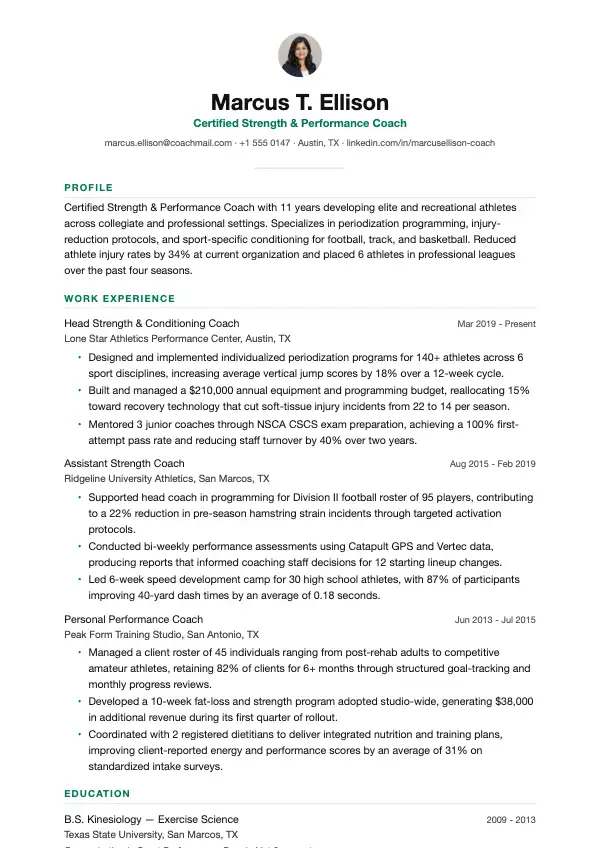
Template: Windsor
Read this resume as text
Marcus T. Ellison
Certified Strength & Performance Coach
marcus.ellison@coachmail.com · +1 555 0147 · Austin, TX · linkedin.com/in/marcusellison-coach
- Profile
- Certified Strength & Performance Coach with 11 years developing elite and recreational athletes across collegiate and professional settings. Specializes in periodization programming, injury-reduction protocols, and sport-specific conditioning for football, track, and basketball. Reduced athlete injury rates by 34% at current organization and placed 6 athletes in professional leagues over the past four seasons.
- Work Experience
Head Strength & Conditioning Coach
Lone Star Athletics Performance Center, Austin, TX · Mar 2019 - Present
- Designed and implemented individualized periodization programs for 140+ athletes across 6 sport disciplines, increasing average vertical jump scores by 18% over a 12-week cycle.
- Built and managed a $210,000 annual equipment and programming budget, reallocating 15% toward recovery technology that cut soft-tissue injury incidents from 22 to 14 per season.
- Mentored 3 junior coaches through NSCA CSCS exam preparation, achieving a 100% first-attempt pass rate and reducing staff turnover by 40% over two years.
Assistant Strength Coach
Ridgeline University Athletics, San Marcos, TX · Aug 2015 - Feb 2019
- Supported head coach in programming for Division II football roster of 95 players, contributing to a 22% reduction in pre-season hamstring strain incidents through targeted activation protocols.
- Conducted bi-weekly performance assessments using Catapult GPS and Vertec data, producing reports that informed coaching staff decisions for 12 starting lineup changes.
- Led 6-week speed development camp for 30 high school athletes, with 87% of participants improving 40-yard dash times by an average of 0.18 seconds.
Personal Performance Coach
Peak Form Training Studio, San Antonio, TX · Jun 2013 - Jul 2015
- Managed a client roster of 45 individuals ranging from post-rehab adults to competitive amateur athletes, retaining 82% of clients for 6+ months through structured goal-tracking and monthly progress reviews.
- Developed a 10-week fat-loss and strength program adopted studio-wide, generating $38,000 in additional revenue during its first quarter of rollout.
- Coordinated with 2 registered dietitians to deliver integrated nutrition and training plans, improving client-reported energy and performance scores by an average of 31% on standardized intake surveys.
- Education
B.S. Kinesiology — Exercise Science
Texas State University, San Marcos, TX · 2009 - 2013
Concentration in Sport Performance; Dean's List 3 semesters
- Skills
- NSCA Certified Strength & Conditioning Specialist (CSCS) · USA Weightlifting Level 1 Coach · Periodization & Program Design · Catapult GPS & Force Plate Analysis · FMS (Functional Movement Screen) Level 2 · CPR/AED Certified — American Red Cross · Athlete Load Monitoring & Recovery Protocols · TeamBuildr & Excel-Based Programming Software · Sport-Specific Conditioning (Football, Basketball, Track)
- Links
- LinkedIn: linkedin.com/in/marcusellison-coach · Portfolio: marcusellison.com/coaching-portfolio
What makes this resume work
- The summary names seniority, specialization, and two headline results in three sentences, giving recruiters an immediate reason to keep reading rather than scanning for context buried in bullets.
- Every bullet opens with a distinct action verb and closes with a specific, verifiable number — percentages, dollar figures, athlete counts — which prevents the vague language that kills coaching resumes at the screening stage.
- Certifications are listed as full official names (NSCA CSCS, USA Weightlifting Level 1) in the skills section, matching the exact strings ATS systems search for rather than informal abbreviations that fail keyword matching.
- The three roles are sequenced to show a clear upward arc — studio coach to university assistant to head coach — demonstrating deliberate career progression rather than lateral movement, which strengthens the narrative for senior hiring committees.
Keywords that help you pass the ATS
Work the ones that fit your experience into your resume, naturally, not stuffed.
How to write a Coach resume
Choose the right format for a Coach resume
Most coaching roles — whether athletic, fitness, life, or executive — call for a reverse-chronological format. Hiring managers want to see your most recent clients, teams, or programs first, because coaching credibility is built on a track record of measurable outcomes, not on a list of credentials alone.
Keep the document to one page if you have fewer than ten years of experience; two pages are acceptable for head coaches or executive coaches with extensive client rosters. Use clean section headers, consistent 10–12pt font, and at least half-inch margins. Avoid graphics or icons — many athletic departments and corporate HR systems use applicant tracking software that strips them out.
- Reverse-chronological order: current or most recent role at the top
- One page for early-career coaches; two pages maximum for senior roles
- Standard fonts: Calibri, Georgia, or Arial — nothing decorative
- File format: PDF unless the job posting specifies .docx
Write a professional summary that sells your coaching identity
Your summary sits directly below your contact information and gives a hiring committee three to four sentences to decide whether to keep reading. Name your coaching specialty, your years of experience, the population you serve, and one or two hard outcomes. Skip objective statements — they tell employers what you want, not what you deliver.
Example: "NCAA Division I strength and conditioning coach with 9 years developing elite athletes across football and track programs. Reduced in-season soft-tissue injury rates by 22% over three seasons through periodized programming and movement-screen protocols. Certified CSCS and USAW Level 1; proficient in Catapult GPS load-monitoring and Smartabase athlete-management software."
Write work-experience bullets that show results, not duties
Every bullet should follow an action verb + task + measurable result structure. Coaching resumes that list responsibilities — 'responsible for running practice' — get passed over fast. Quantify wins, retention rates, client progress, program growth, or revenue if you work in private coaching. Use numbers even when they feel small; specificity signals credibility.
- Designed and delivered a 12-week speed development program for 34 varsity athletes, cutting average 40-yard dash times by 0.18 seconds and contributing to a conference championship title
- Grew private client roster from 8 to 41 clients within 18 months by launching a referral incentive program, increasing monthly recurring revenue by $6,200
Skills and certifications recruiters and ATS systems look for
Coaching is a credentialed field. Listing the right certifications in full — spelled out and abbreviated — helps you clear ATS filters and signals professional standing to human reviewers. Below are the credentials and tools that appear most frequently in coaching job postings across athletic, fitness, and performance sectors. Match what you actually hold; fabricating certifications is grounds for immediate dismissal.
Beyond certifications, include hard skills like program design, video analysis, athlete monitoring, and any software platforms you use regularly. Soft skills like 'communication' are table stakes — skip them unless you can attach a result.
- Certifications: CSCS (NSCA), CPT (NASM, ACE, or ACSM), USAW Level 1 or 2, PES, CES, ICF ACC/PCC/MCC (executive/life coaching), ISSA
- Sport-specific: USA Track & Field Level 1/2, USAC Cycling, USAS (swimming), NFHS Fundamentals of Coaching
- Software and tools: Catapult Sports, Smartabase, Hudl, CoachNow, TrainHeroic, TrueCoach, Excel-based periodization tracking
- First aid: CPR/AED certification (list expiration date or renewal year)
- Hard skills: periodization programming, movement screening (FMS), video breakdown, load monitoring, nutrition periodization basics
Education, licenses, and extras that round out your resume
List your highest degree first: institution, degree, major, and graduation year. Kinesiology, Exercise Science, Sports Management, and Psychology are common majors, but hiring managers in coaching care more about your certification stack and track record than your GPA. Omit GPA unless it was 3.7 or above and you graduated within the last three years.
Add a separate 'Licenses & Affiliations' line if you hold a state coaching license or belong to professional organizations like the NSCA, NATA, or ICF. If you have published programming, contributed to a clinic, or presented at a conference, add a brief 'Professional Development' section at the bottom — it differentiates you from candidates with identical credentials.
- State coaching licenses: list the state and sport (e.g., 'California Single Subject Credential — Physical Education')
- Professional memberships: NSCA, NATA, ICF, ACSM, NFHS
- Continuing education: clinics, workshops, or courses completed in the last three years
Mistakes to avoid
- Listing certifications only by abbreviation — spell out 'Certified Strength and Conditioning Specialist (CSCS)' so ATS software matches both versions.
- Using generic duty language like 'coached athletes' instead of specifying the sport, level, roster size, and a measurable outcome.
- Omitting software proficiency — platforms like Hudl, TrainHeroic, or Catapult are increasingly listed as requirements, and leaving them off costs you interviews.
- Including an outdated or lapsed certification without noting the status — hiring committees verify credentials, and a discrepancy kills your candidacy immediately.
Frequently asked questions
- Do I need a degree to get a coaching job and should I put it on my resume?
- For most school-based and collegiate positions, a bachelor's degree is required and should appear prominently on your resume. For private coaching, personal training, or life coaching roles, certifications often carry more weight than a degree, but you should still list any completed degree because it signals commitment and meets background-check requirements at many employers.
- How do I write a coaching resume if I only have volunteer or unpaid experience?
- Treat volunteer coaching roles the same as paid positions — list the organization, your title, dates, and quantified results. A volunteer head coach who ran a 20-person youth soccer program and improved win rate from 30% to 60% in one season has a stronger bullet than a paid assistant with no numbers. What matters to hiring managers is the scope of responsibility and the outcome, not whether a paycheck was attached.
- Should a life coach or executive coach resume look different from an athletic coach resume?
- Yes, in emphasis. Life and executive coaching resumes should lead with client transformation metrics — retention rates, goal-attainment percentages, session volume, or revenue generated — and feature ICF credentials prominently. Athletic coaching resumes prioritize sport-specific certifications, win-loss records, and athlete development data. Both formats use reverse-chronological structure, but the language and proof points differ significantly based on the audience reviewing them.
Make it yours in minutes
Open this example in the builder, swap in your details, and export a clean, ATS-ready resume.
Once your resume is ready
More for this application
- Template style
- Teacher resume templates