Resume example
Credit Analyst resume example
By the Resumade team · About our content
A Credit Analyst resume must clear ATS filters on risk and underwriting terms while proving to the hiring manager that you protect the portfolio — not just process loans. This example does both with role-specific metrics and a clean, scannable structure.
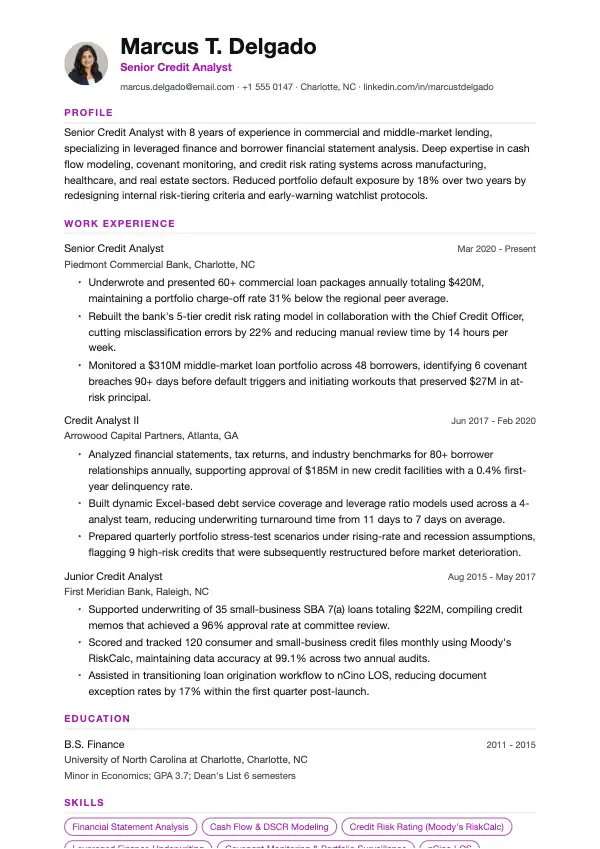
Template: Modern
Read this resume as text
Marcus T. Delgado
Senior Credit Analyst
marcus.delgado@email.com · +1 555 0147 · Charlotte, NC · linkedin.com/in/marcustdelgado
- Profile
- Senior Credit Analyst with 8 years of experience in commercial and middle-market lending, specializing in leveraged finance and borrower financial statement analysis. Deep expertise in cash flow modeling, covenant monitoring, and credit risk rating systems across manufacturing, healthcare, and real estate sectors. Reduced portfolio default exposure by 18% over two years by redesigning internal risk-tiering criteria and early-warning watchlist protocols.
- Work Experience
Senior Credit Analyst
Piedmont Commercial Bank, Charlotte, NC · Mar 2020 - Present
- Underwrote and presented 60+ commercial loan packages annually totaling $420M, maintaining a portfolio charge-off rate 31% below the regional peer average.
- Rebuilt the bank's 5-tier credit risk rating model in collaboration with the Chief Credit Officer, cutting misclassification errors by 22% and reducing manual review time by 14 hours per week.
- Monitored a $310M middle-market loan portfolio across 48 borrowers, identifying 6 covenant breaches 90+ days before default triggers and initiating workouts that preserved $27M in at-risk principal.
Credit Analyst II
Arrowood Capital Partners, Atlanta, GA · Jun 2017 - Feb 2020
- Analyzed financial statements, tax returns, and industry benchmarks for 80+ borrower relationships annually, supporting approval of $185M in new credit facilities with a 0.4% first-year delinquency rate.
- Built dynamic Excel-based debt service coverage and leverage ratio models used across a 4-analyst team, reducing underwriting turnaround time from 11 days to 7 days on average.
- Prepared quarterly portfolio stress-test scenarios under rising-rate and recession assumptions, flagging 9 high-risk credits that were subsequently restructured before market deterioration.
Junior Credit Analyst
First Meridian Bank, Raleigh, NC · Aug 2015 - May 2017
- Supported underwriting of 35 small-business SBA 7(a) loans totaling $22M, compiling credit memos that achieved a 96% approval rate at committee review.
- Scored and tracked 120 consumer and small-business credit files monthly using Moody's RiskCalc, maintaining data accuracy at 99.1% across two annual audits.
- Assisted in transitioning loan origination workflow to nCino LOS, reducing document exception rates by 17% within the first quarter post-launch.
- Education
B.S. Finance
University of North Carolina at Charlotte, Charlotte, NC · 2011 - 2015
Minor in Economics; GPA 3.7; Dean's List 6 semesters
- Skills
- Financial Statement Analysis · Cash Flow & DSCR Modeling · Credit Risk Rating (Moody's RiskCalc) · Leveraged Finance Underwriting · Covenant Monitoring & Portfolio Surveillance · nCino LOS · Bloomberg Terminal · Excel (advanced: VBA, pivot tables, scenario analysis) · CFA Level II Candidate
- Links
- LinkedIn: linkedin.com/in/marcustdelgado
What makes this resume work
- The summary leads with seniority and years of experience, then names two specific domains — leveraged finance and middle-market lending — so a recruiter immediately knows the candidate's lane without reading further.
- Every bullet opens with a strong action verb (Underwrote, Rebuilt, Monitored) and closes with a dollar figure, percentage, or time saved, giving the hiring manager concrete evidence of impact rather than a list of duties.
- The skills section mixes technical tools (nCino, Bloomberg, Moody's RiskCalc) with analytical competencies (DSCR Modeling, Covenant Monitoring) to satisfy both ATS keyword matching and human reviewer expectations in one pass.
- The education note surfaces GPA, honors, and a relevant minor in a single line — adding credibility without consuming space that should belong to professional accomplishments.
Keywords that help you pass the ATS
Work the ones that fit your experience into your resume, naturally, not stuffed.
How to write a Credit Analyst resume
Choose the right format for a Credit Analyst resume
Use a reverse-chronological format. Hiring managers at banks, credit unions, and corporate treasury departments want to see your most recent role first and trace your progression through increasingly complex credit decisions. A functional or hybrid format raises red flags unless you are making a significant industry switch.
Keep the resume to one page if you have fewer than eight years of experience; two pages are acceptable for senior analysts with portfolio management or team leadership history. Use clean section headers, consistent font sizing (10–12 pt body, 13–14 pt name), and enough white space so an ATS can parse each section cleanly. Avoid tables, text boxes, and graphics — most bank ATS platforms strip them.
- Sections in order: Contact Info → Summary → Work Experience → Skills → Education → Certifications
- File format: PDF unless the job posting explicitly requests .docx
- Margins: 0.5–0.75 inches on all sides to maximize readable space
- Font: Calibri, Georgia, or Garamond — nothing decorative
Write a professional summary that signals credit expertise immediately
Your summary sits below your name and contact info and should run three to four sentences. Name your years of experience, the credit product types you know (commercial real estate, C&I lending, consumer installment, leveraged finance), the industries or borrower segments you have covered, and one standout achievement. Do not open with 'Hardworking professional' or any variation of it.
"Credit Analyst with 6 years of experience underwriting middle-market C&I and commercial real estate loans up to $25M for a $4B regional bank. Proficient in spreading financials in Moody's CreditLens, building debt-service-coverage models in Excel, and preparing credit approval memos for senior loan committee. Reduced average underwriting turnaround from 18 days to 11 days by standardizing the spreading template across a four-person team. CFA Level II candidate."
Write work-experience bullets that show underwriting impact
Each bullet should follow an action-verb → task → quantified result structure. Generic phrases like 'responsible for analyzing financial statements' waste space. Recruiters want to know deal size, portfolio volume, default rates, turnaround times, and approval rates. If your employer prohibits exact dollar figures, use ranges or percentages.
Pull numbers from your annual reviews, loan pipeline reports, or portfolio dashboards. Common metrics include portfolio size (number of accounts and aggregate exposure), average loan size, delinquency or charge-off rates you helped keep below target, and productivity figures like memos completed per month.
- Underwrote 85 commercial loan requests totaling $310M in annual exposure, maintaining a portfolio delinquency rate of 0.4% against a peer-group average of 1.1%.
- Built a three-statement projection model in Excel that cut financial spreading time by 35%, enabling the team to increase memo output from 12 to 19 per analyst per month.
Skills and certifications recruiters and ATS systems look for
Credit Analyst job postings are heavily keyword-driven. List hard skills in a dedicated Skills section so the ATS registers them even if they also appear in your bullets. Separate technical tools from analytical competencies and soft skills — recruiters scan this section first to confirm baseline qualifications.
Certifications matter more in credit than in many finance roles. The CFA (any level), the Credit Risk Certification (CRC) from RMA, and the Chartered Financial Analyst designation all carry weight. For commercial real estate analysts, the CCIM or a CRE-specific underwriting certificate is recognized. Include the issuer, level, and status (earned vs. candidate).
- Tools: Moody's CreditLens, Sageworks (Abrigo), nCino, S&P Capital IQ, Bloomberg Terminal, Excel (advanced), Argus Enterprise (CRE)
- Technical skills: financial statement spreading, DCF modeling, debt-service-coverage analysis, covenant compliance monitoring, borrower risk rating, stress testing
- Certifications: CFA (Levels I–III), CRC (RMA), CAIA, CCIM, FRM
- Regulatory knowledge: Basel III, Call Report familiarity, BSA/AML basics — list these if the job posting references them
Education, licenses, and extras that strengthen your candidacy
A bachelor's degree in Finance, Accounting, or Economics is the baseline expectation at most commercial banks. An MBA or master's in Finance helps for senior or corporate banking roles but is not required at the analyst level. List your degree, institution, graduation year, and GPA only if it is 3.5 or above. Do not list high school.
Add a separate Certifications or Professional Development section if you have completed formal credit training programs — many regional banks run internal credit schools (e.g., Omega Performance, Moody's Analytics credit training) that are worth listing. If you have completed continuing education through RMA (Risk Management Association), include it. A brief Additional section for language proficiency or relevant volunteer board service (e.g., CDFI loan committee) rounds out a senior analyst resume without padding it.
Mistakes to avoid
- Listing loan types you have 'exposure to' without specifying whether you actually underwrote, reviewed, or just processed them — recruiters will ask, and vagueness kills credibility.
- Omitting portfolio size and deal size figures entirely, which forces hiring managers to guess your complexity level and usually leads them to assume the lower end.
- Using the same generic summary for commercial credit, consumer credit, and corporate FP&A roles instead of tailoring it to the specific credit product in the job posting.
- Burying certifications like the CRC or CFA candidacy in the Education section rather than giving them a dedicated line where ATS keyword parsing and human scanners can find them instantly.
Frequently asked questions
- Do I need the CFA to get a Credit Analyst job?
- No — the CFA is valued but not required for most commercial or consumer credit analyst roles. The RMA's Credit Risk Certification (CRC) is often more directly relevant to bank lending positions. That said, being a CFA Level I or II candidate signals analytical commitment and can differentiate you for corporate credit or leveraged finance roles.
- How do I write a Credit Analyst resume with no direct credit experience?
- Lead with transferable skills: financial statement analysis from an accounting or audit role, Excel modeling from an FP&A position, or loan processing experience from a banking operations job. In your summary, name the credit products you want to underwrite and connect them to what you have already done. Completing a formal credit training program through Moody's Analytics or RMA before you apply also signals readiness.
- Should I include the specific loan sizes I worked on?
- Yes, whenever your employer's confidentiality policy allows it. Loan size is the fastest signal of the complexity you can handle — a $500K SBA loan and a $20M syndicated C&I credit require very different skill sets. If exact figures are restricted, use ranges (e.g., '$5M–$30M') or describe the portfolio in aggregate (e.g., '$180M commercial real estate portfolio').
Make it yours in minutes
Open this example in the builder, swap in your details, and export a clean, ATS-ready resume.
Once your resume is ready
More for this application
- Template style
- Professional resume templates