Resume example
ICU Nurse resume example
By the Resumade team · About our content
An ICU nurse resume must clear hospital ATS filters loaded with certification codes and clinical terms, then prove to a charge nurse or CNO that the candidate handles the highest-acuity cases without hand-holding. This example does both through front-loaded credentials and outcome-anchored bullets.
Template: Minimal
Read this resume as text
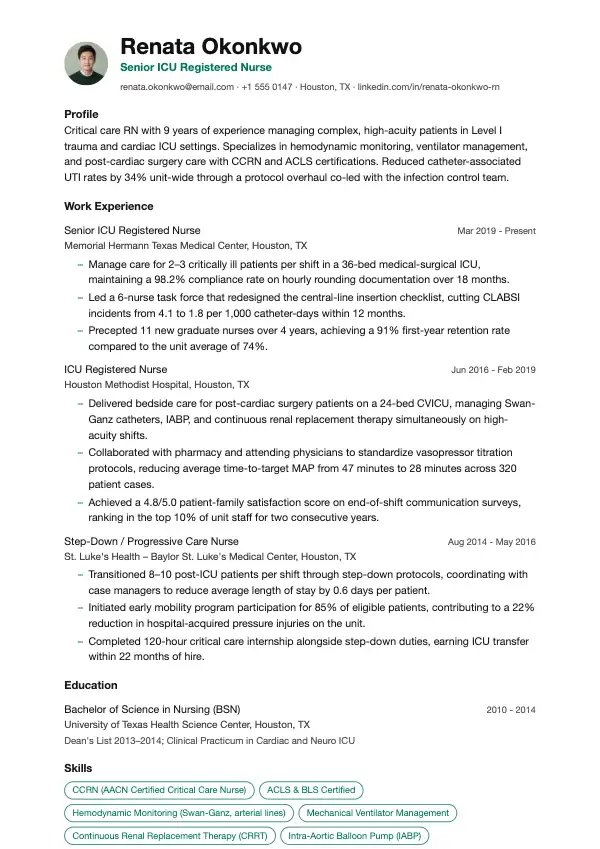
Renata Okonkwo
Senior ICU Registered Nurse
renata.okonkwo@email.com · +1 555 0147 · Houston, TX · linkedin.com/in/renata-okonkwo-rn
- Profile
- Critical care RN with 9 years of experience managing complex, high-acuity patients in Level I trauma and cardiac ICU settings. Specializes in hemodynamic monitoring, ventilator management, and post-cardiac surgery care with CCRN and ACLS certifications. Reduced catheter-associated UTI rates by 34% unit-wide through a protocol overhaul co-led with the infection control team.
- Work Experience
Senior ICU Registered Nurse
Memorial Hermann Texas Medical Center, Houston, TX · Mar 2019 - Present
- Manage care for 2–3 critically ill patients per shift in a 36-bed medical-surgical ICU, maintaining a 98.2% compliance rate on hourly rounding documentation over 18 months.
- Led a 6-nurse task force that redesigned the central-line insertion checklist, cutting CLABSI incidents from 4.1 to 1.8 per 1,000 catheter-days within 12 months.
- Precepted 11 new graduate nurses over 4 years, achieving a 91% first-year retention rate compared to the unit average of 74%.
ICU Registered Nurse
Houston Methodist Hospital, Houston, TX · Jun 2016 - Feb 2019
- Delivered bedside care for post-cardiac surgery patients on a 24-bed CVICU, managing Swan-Ganz catheters, IABP, and continuous renal replacement therapy simultaneously on high-acuity shifts.
- Collaborated with pharmacy and attending physicians to standardize vasopressor titration protocols, reducing average time-to-target MAP from 47 minutes to 28 minutes across 320 patient cases.
- Achieved a 4.8/5.0 patient-family satisfaction score on end-of-shift communication surveys, ranking in the top 10% of unit staff for two consecutive years.
Step-Down / Progressive Care Nurse
St. Luke's Health – Baylor St. Luke's Medical Center, Houston, TX · Aug 2014 - May 2016
- Transitioned 8–10 post-ICU patients per shift through step-down protocols, coordinating with case managers to reduce average length of stay by 0.6 days per patient.
- Initiated early mobility program participation for 85% of eligible patients, contributing to a 22% reduction in hospital-acquired pressure injuries on the unit.
- Completed 120-hour critical care internship alongside step-down duties, earning ICU transfer within 22 months of hire.
- Education
Bachelor of Science in Nursing (BSN)
University of Texas Health Science Center, Houston, TX · 2010 - 2014
Dean's List 2013–2014; Clinical Practicum in Cardiac and Neuro ICU
- Skills
- CCRN (AACN Certified Critical Care Nurse) · ACLS & BLS Certified · Hemodynamic Monitoring (Swan-Ganz, arterial lines) · Mechanical Ventilator Management · Continuous Renal Replacement Therapy (CRRT) · Intra-Aortic Balloon Pump (IABP) · Epic EMR & Philips IntelliVue · Sepsis Protocol Implementation · Vasopressor & Sedation Titration
- Links
- LinkedIn: linkedin.com/in/renata-okonkwo-rn · License: Texas RN License #RN-4471829 (verifiable via state board)
What makes this resume work
- Certifications appear in both the Skills section and the summary so ATS keyword scans catch CCRN and ACLS regardless of which field the parser reads first.
- Every bullet quantifies a clinical outcome — infection rates, MAP response times, retention percentages — replacing vague duty lists with evidence of measurable patient-safety impact.
- The career arc from step-down to CVICU to senior ICU role tells a deliberate progression story that signals ambition and readiness for charge or educator roles without overstating the current title.
- Equipment and therapy names (Swan-Ganz, IABP, CRRT, Philips IntelliVue) are spelled out in full so both abbreviated and long-form recruiter searches return this resume as a match.
Keywords that help you pass the ATS
Work the ones that fit your experience into your resume, naturally, not stuffed.
How to write an ICU Nurse resume
Choose the right format for an ICU Nurse resume
Use a reverse-chronological format. Recruiters spend about seven seconds on an initial scan (Ladders eye-tracking study, 2018), and ICU hiring managers want to see your most recent critical care experience first. A functional or hybrid format raises red flags unless you are making a lateral move from a related specialty like CVICU or MICU.
Keep the resume to one page if you have under ten years of experience; two pages are acceptable for travel nurses or those with multiple ICU contracts. Use clean section headers, consistent 11–12pt font, and at least 0.5-inch margins. Avoid tables and text boxes — many hospital ATS platforms, including Taleo and iCIMS, cannot parse them correctly.
- Standard sections: Contact Info, Summary, Licenses & Certifications, Work Experience, Skills, Education
- List your RN license number and state in the header or certifications section — recruiters verify this before calling
- If you hold a compact nursing license, note 'Multistate Compact License' explicitly
- File format: PDF unless the job posting specifies Word
Write a professional summary that opens doors
Your summary is three to four lines that answer: what kind of ICU nurse are you, how many years of critical care experience do you have, and what makes you worth a phone screen. Skip objective statements entirely — they waste space and focus on what you want rather than what you offer.
Anchor the summary to your specialty (medical, surgical, cardiac, neuro, trauma) and lead with a credential if you hold CCRN. Example: "CCRN-certified ICU RN with 6 years of experience in a 32-bed Level I trauma center MICU. Skilled in managing ventilated patients, continuous renal replacement therapy (CRRT), and vasoactive drip titration. Consistent charge nurse coverage and preceptor for new graduate orientees. Seeking a senior staff or charge role in a high-acuity adult critical care unit."
Write work-experience bullets that prove your impact
Each bullet should follow an action-verb + task + outcome or context structure. Generic phrases like 'provided patient care' tell a recruiter nothing. Quantify wherever you can: patient ratios, unit size, procedures performed per shift, code response times, or quality metrics you contributed to. ICU nurses handle measurable, high-stakes work — your bullets should reflect that.
Think about the procedures and technologies you used daily: arterial lines, central venous catheters, pulmonary artery catheters, CRRT, IABP, ECMO, mechanical ventilation (including lung-protective strategies and weaning protocols), vasopressor management, and rapid sequence intubation assistance. Name them explicitly because ATS systems keyword-match against them.
- Managed 1:2 patient assignment in a 24-bed MICU, titrating norepinephrine, vasopressin, and phenylephrine drips for septic shock patients, contributing to a unit-wide 30-day mortality reduction of 12% over two years
- Served as primary CRRT nurse for acute kidney injury patients, initiating and troubleshooting Prismaflex circuits for an average of 4 patients per week and reducing circuit clotting events by 18% through protocol-driven anticoagulation adjustments
Skills and certifications recruiters and ATS systems look for
Hospital recruiters search their ATS for specific credentials and clinical keywords. List your certifications in a dedicated section with the issuing body and expiration year. Embed clinical skills as a concise bulleted list rather than a paragraph — it is faster to scan and easier to parse.
CCRN (AACN) is the gold-standard credential for adult critical care and should appear prominently. Other valued certifications include PCCN, CMC, CSC, TNCC, and ACLS/BLS/PALS. For specialty units, add NIHSS certification for neuro ICU or IABP certification for cardiac units.
- CCRN, PCCN, CMC, CSC (AACN-issued)
- ACLS, BLS, PALS, NRP
- TNCC for trauma ICU roles
- Clinical skills to list: hemodynamic monitoring, ventilator management, ECMO, IABP, CRRT/CVVHD, rapid deterioration recognition, sepsis bundle compliance, post-surgical care
- EHR systems: Epic, Cerner, Meditech — name the ones you have used
Education, licenses, and extras
List your highest nursing degree first: BSN or MSN, school name, and graduation year. If you are ADN-prepared but enrolled in an RN-to-BSN program, note 'BSN in progress, expected [year]' — many Magnet hospitals require or prefer BSN. Place your RN license with state and license number either in the header or directly under your name for quick verification.
For travel nurses, list each contract assignment under the staffing agency with the facility name, city, and dates in parentheses. Include a brief note on unit type and bed count for each assignment. Volunteer work in simulation labs, charge nurse experience, and committee membership (AACN chapter, unit-based council, sepsis task force) strengthen your application for senior or leadership roles.
- BSN or MSN: school, city, graduation year
- RN License: state, license number, expiration date
- Compact license states if applicable
- Professional memberships: AACN, ENA, SCCM
Mistakes to avoid
- Listing only duties instead of outcomes — writing 'cared for ventilated patients' without specifying the equipment, patient volume, or results tells a recruiter nothing actionable.
- Omitting your CCRN or specialty certification from the resume header or top section, burying it where ATS keyword scans and human reviewers may miss it entirely.
- Using a table-based or multi-column template that breaks ATS parsing in Taleo, iCIMS, or Workday, causing your application to appear blank or scrambled.
- Failing to tailor unit type and acuity level to the job posting — a CVICU role and a neuro ICU role require different keyword emphasis, and a generic ICU resume underperforms against both.
Frequently asked questions
- Do I need a BSN to get hired in the ICU?
- Many community hospitals hire ADN-prepared nurses into the ICU, but Magnet-designated and academic medical centers increasingly require or strongly prefer a BSN. If you hold an ADN, note any RN-to-BSN enrollment on your resume and obtain your CCRN as early as eligible to offset the degree gap.
- How do I write an ICU nurse resume with no ICU experience?
- Highlight transferable high-acuity experience: step-down, PACU, ED, or cardiac telemetry. Emphasize any hemodynamic monitoring, vasopressor administration, or ventilator exposure you have had, and list ACLS and any critical care coursework or externships. Apply to hospitals with structured ICU residency or fellowship programs, which are specifically designed for nurses transitioning into critical care.
- Should I list every hospital I worked at as a travel nurse?
- Yes, list every contract assignment because gaps or missing facilities raise questions during credentialing. Group them under the staffing agency name as the employer, then list each facility, location, unit type, and contract dates as sub-entries. Keep descriptions concise but include bed count and key procedures to show acuity level.
Make it yours in minutes
Open this example in the builder, swap in your details, and export a clean, ATS-ready resume.
Once your resume is ready
More for this application
- Cover letter example
- Registered Nurse Cover Letter Example
- Template style
- Nursing resume templates