Resume example
Machine Learning Engineer resume example
By the Resumade team · About our content
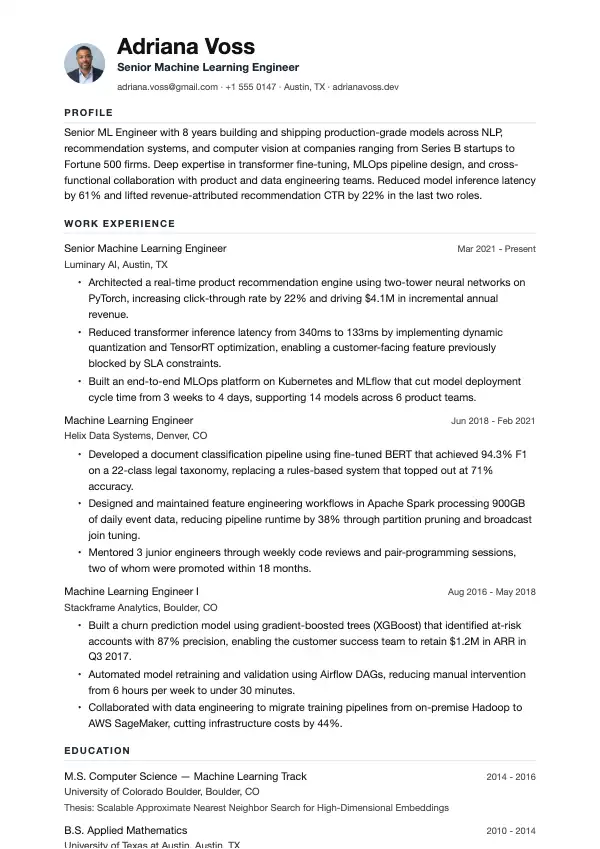
A Machine Learning Engineer resume must prove model ownership and production impact, not just familiarity with frameworks. This example leads with measurable outcomes, layers skills for ATS parsing, and shows the full ML lifecycle from experimentation to deployment.
Template: Signet
Read this resume as text
Adriana Voss
Senior Machine Learning Engineer
adriana.voss@gmail.com · +1 555 0147 · Austin, TX · adrianavoss.dev
- Profile
- Senior ML Engineer with 8 years building and shipping production-grade models across NLP, recommendation systems, and computer vision at companies ranging from Series B startups to Fortune 500 firms. Deep expertise in transformer fine-tuning, MLOps pipeline design, and cross-functional collaboration with product and data engineering teams. Reduced model inference latency by 61% and lifted revenue-attributed recommendation CTR by 22% in the last two roles.
- Work Experience
Senior Machine Learning Engineer
Luminary AI, Austin, TX · Mar 2021 - Present
- Architected a real-time product recommendation engine using two-tower neural networks on PyTorch, increasing click-through rate by 22% and driving $4.1M in incremental annual revenue.
- Reduced transformer inference latency from 340ms to 133ms by implementing dynamic quantization and TensorRT optimization, enabling a customer-facing feature previously blocked by SLA constraints.
- Built an end-to-end MLOps platform on Kubernetes and MLflow that cut model deployment cycle time from 3 weeks to 4 days, supporting 14 models across 6 product teams.
Machine Learning Engineer
Helix Data Systems, Denver, CO · Jun 2018 - Feb 2021
- Developed a document classification pipeline using fine-tuned BERT that achieved 94.3% F1 on a 22-class legal taxonomy, replacing a rules-based system that topped out at 71% accuracy.
- Designed and maintained feature engineering workflows in Apache Spark processing 900GB of daily event data, reducing pipeline runtime by 38% through partition pruning and broadcast join tuning.
- Mentored 3 junior engineers through weekly code reviews and pair-programming sessions, two of whom were promoted within 18 months.
Machine Learning Engineer I
Stackframe Analytics, Boulder, CO · Aug 2016 - May 2018
- Built a churn prediction model using gradient-boosted trees (XGBoost) that identified at-risk accounts with 87% precision, enabling the customer success team to retain $1.2M in ARR in Q3 2017.
- Automated model retraining and validation using Airflow DAGs, reducing manual intervention from 6 hours per week to under 30 minutes.
- Collaborated with data engineering to migrate training pipelines from on-premise Hadoop to AWS SageMaker, cutting infrastructure costs by 44%.
- Education
M.S. Computer Science — Machine Learning Track
University of Colorado Boulder, Boulder, CO · 2014 - 2016
Thesis: Scalable Approximate Nearest Neighbor Search for High-Dimensional Embeddings
B.S. Applied Mathematics
University of Texas at Austin, Austin, TX · 2010 - 2014
Minor in Statistics; Graduated with Honors
- Skills
- PyTorch & TensorFlow · Transformer Fine-Tuning (BERT, LLaMA) · MLOps: MLflow, Kubeflow, SageMaker · Python, SQL, Scala · Apache Spark & Kafka · Model Quantization & TensorRT · Kubernetes & Docker · Experiment Design & A/B Testing · AWS Certified Machine Learning — Specialty
- Links
- Portfolio: adrianavoss.dev · GitHub: github.com/adrianavoss · LinkedIn: linkedin.com/in/adrianavoss
What makes this resume work
- Every bullet opens with a strong action verb and closes with a hard number — revenue figures, latency reductions, or accuracy gains — so hiring managers can immediately gauge scope and impact without reading between the lines.
- The skills section lists tools and certifications in the exact terminology recruiters and ATS systems search for, such as 'Transformer Fine-Tuning,' 'MLflow,' and 'AWS Certified Machine Learning — Specialty,' avoiding vague labels like 'AI' or 'deep learning.'
- The summary front-loads seniority, domain breadth, and two headline results in three sentences, giving a recruiter on a quick first scan a complete picture before they reach the experience section.
- The career progression from Engineer I to Senior Engineer at three distinct companies signals growth trajectory and adaptability, while the thesis line in education reinforces foundational ML depth without consuming bullet real estate in the work section.
Keywords that help you pass the ATS
Work the ones that fit your experience into your resume, naturally, not stuffed.
How to write a Machine Learning Engineer resume
Choose the right format for a Machine Learning Engineer resume
Use a reverse-chronological format. Recruiters spend about seven seconds on a first pass (Ladders eye-tracking study, 2018), and hiring managers want to see your most recent work immediately. A functional or hybrid format signals gaps or inexperience, neither of which you want to imply.
Keep the resume to one page if you have fewer than eight years of experience; two pages are acceptable beyond that. Use a clean single-column or two-column layout with consistent section headers. Avoid tables and graphics — many applicant tracking systems (ATS) used by Google, Meta, and Amazon still parse text linearly and will scramble embedded visuals.
- Margins: 0.5–0.75 inches; font size 10–12pt in a readable face like Calibri or Garamond
- Section order: Contact → Summary → Experience → Skills → Education → Certifications
- Save and submit as a PDF unless the job posting explicitly requests a .docx file
- File name: FirstLast_MLEngineer_Resume.pdf — never 'resume_final_v3.pdf'
Write a professional summary that positions you as an ML specialist
Your summary is three to four sentences that answer one question: why should this team hire you over a strong software engineer or a data scientist? Name your years of experience, your primary domain (NLP, computer vision, recommender systems, time-series forecasting), your go-to stack, and one concrete outcome. Skip phrases like 'passionate' or 'results-driven' — they consume space without adding signal.
Example: "Machine Learning Engineer with six years of experience building and deploying production recommendation systems at scale. Proficient in PyTorch, TensorFlow, and Kubeflow; experienced with MLflow for experiment tracking and Feast for feature store management. Reduced model serving latency by 38% at a 500M-request-per-day scale by migrating inference pipelines from Flask to Triton Inference Server. Seeking a senior IC role focused on large-scale ranking or personalization."
Write work-experience bullets that show impact, not just activity
Each bullet should follow an action verb → task → measurable result structure. Vague bullets like 'worked on model training pipelines' tell a recruiter nothing. Quantify model performance improvements (F1, AUC, BLEU, RMSE), infrastructure wins (latency, throughput, cost), and business impact (revenue lift, churn reduction, annotation cost saved). If a number is under NDA, use a percentage or relative improvement.
Specify the exact tools and frameworks you used within the bullet, not just in the skills section. This helps ATS keyword matching and gives technical interviewers immediate context.
- Trained and deployed a gradient-boosted fraud detection model using XGBoost and SageMaker Pipelines, achieving a 91% precision at 5% false-positive rate and preventing an estimated $4.2M in annual chargebacks.
- Rebuilt the offline feature engineering pipeline in Apache Spark on Databricks, cutting nightly compute costs by 27% and reducing feature generation time from 6 hours to 90 minutes for a 200-feature, 50M-user dataset.
List the skills and certifications recruiters and ATS systems look for
Group your skills into clear subcategories rather than dumping 30 keywords into one block. Typical subcategories: ML Frameworks, Cloud & MLOps, Data Engineering, Programming Languages, and Monitoring & Observability. Recruiters at companies like Apple and Netflix filter by specific tools, so match your skills section to the job description without fabricating experience.
Certifications carry real weight in ML hiring when they are from recognized sources. List the issuer and year obtained. Expired certifications should be removed or marked as such.
- ML Frameworks: PyTorch, TensorFlow, Keras, Hugging Face Transformers, scikit-learn, XGBoost, LightGBM
- MLOps & Cloud: MLflow, Kubeflow, Weights & Biases, SageMaker, Vertex AI, Azure ML, Docker, Kubernetes
- Data Engineering: Apache Spark, Kafka, Airflow, dbt, BigQuery, Snowflake, Feast
- High-value certifications: AWS Certified Machine Learning – Specialty, Google Professional ML Engineer, Databricks Certified ML Professional, TensorFlow Developer Certificate
- Languages: Python (primary), SQL, Scala, C++ (for inference optimization roles)
Education, licenses, and extras that strengthen your candidacy
List your highest degree first with institution, degree, field of study, and graduation year. For ML roles, a master's or PhD in Computer Science, Statistics, Electrical Engineering, or a related quantitative field is common but not mandatory — strong experience and a portfolio can substitute. If you attended a bootcamp or completed a nanodegree, list it below your formal degree, not above it.
Add an 'Other' or 'Projects' section if you have open-source contributions (link your GitHub), Kaggle rankings (include your tier and any top-10 finishes), or published research (conference name, year, and DOI). These extras are disproportionately influential in ML hiring because they demonstrate you work on hard problems outside of a job requirement.
- Include your GitHub URL in the contact header if your repos contain ML projects with READMEs and reproducible results
- Kaggle Master or Grandmaster rank is worth listing explicitly — many ML hiring managers check it
- Publications: list NeurIPS, ICML, ICLR, ACL, or CVPR papers with your author position noted
Mistakes to avoid
- Listing every ML framework you have ever touched at the same level of proficiency instead of distinguishing between expert, proficient, and familiar tiers.
- Writing model metrics in isolation — stating 'achieved 94% accuracy' without providing baseline accuracy, dataset size, or business context makes the number meaningless to a reviewer.
- Omitting the deployment and production side of your work, which signals to engineering-focused teams that you only build models in notebooks and cannot own the full ML lifecycle.
- Using a generic software engineer resume structure that buries ML-specific work under broad engineering tasks, causing ATS systems to score the resume too low for ML-specific requisitions.
Frequently asked questions
- Should a Machine Learning Engineer resume include a portfolio or GitHub link?
- Yes — include a GitHub link in your contact header if your repositories contain documented ML projects with clear READMEs, training scripts, and results. Hiring managers and technical interviewers regularly review candidate repos before the first call, and strong project work can offset a less prestigious employer or degree.
- How do I show MLOps experience on a Machine Learning Engineer resume?
- Call out specific tools and the scale at which you used them: model registries (MLflow, SageMaker Model Registry), orchestration (Kubeflow Pipelines, Airflow), monitoring (Evidently, Arize, WhyLabs), and serving infrastructure (Triton, TorchServe, BentoML). Pair each tool with a concrete outcome such as reduced deployment time or improved model drift detection latency.
- Is a one-page resume realistic for a senior Machine Learning Engineer with ten years of experience?
- No — two pages are standard and expected at the senior and staff level in this field. Focus the first page on your most recent two or three roles with full bullet detail, and use the second page for earlier experience, education, certifications, and publications. Never shrink font size below 10pt or remove white space just to hit one page.
Make it yours in minutes
Open this example in the builder, swap in your details, and export a clean, ATS-ready resume.
Once your resume is ready
More for this application
- Cover letter example
- Data Scientist Cover Letter Example
- Template style
- Software Engineer resume templates