Resume example
Medical Assistant resume example
By the Resumade team · About our content
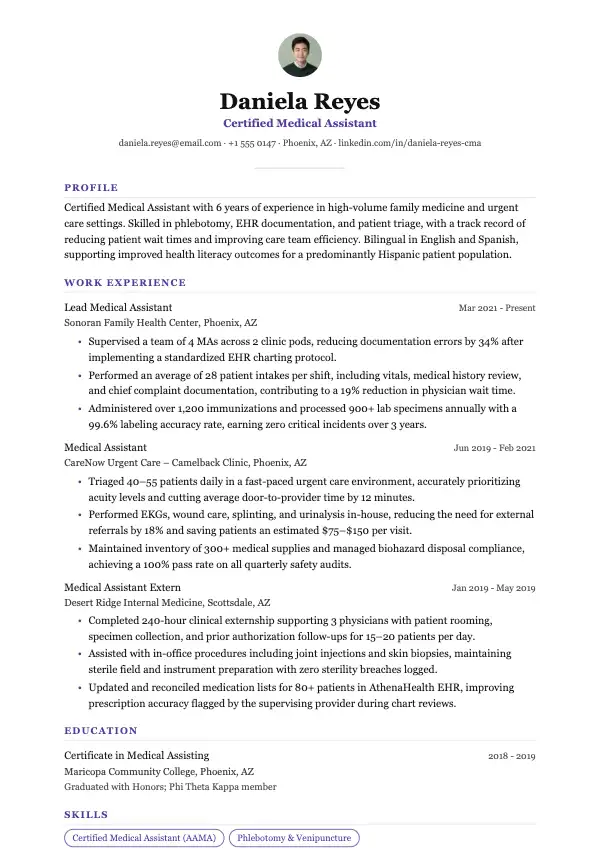
Recruiters hiring medical assistants search their ATS for clinical skills and certifications, so this resume names both in the exact terms they type. It also leads with quantified impact, so the hiring manager sees results as soon as the file is opened.
Template: Classic
Read this resume as text
Daniela Reyes
Certified Medical Assistant
daniela.reyes@email.com · +1 555 0147 · Phoenix, AZ · linkedin.com/in/daniela-reyes-cma
- Profile
- Certified Medical Assistant with 6 years of experience in high-volume family medicine and urgent care settings. Skilled in phlebotomy, EHR documentation, and patient triage, with a track record of reducing patient wait times and improving care team efficiency. Bilingual in English and Spanish, supporting improved health literacy outcomes for a predominantly Hispanic patient population.
- Work Experience
Lead Medical Assistant
Sonoran Family Health Center, Phoenix, AZ · Mar 2021 - Present
- Supervised a team of 4 MAs across 2 clinic pods, reducing documentation errors by 34% after implementing a standardized EHR charting protocol.
- Performed an average of 28 patient intakes per shift, including vitals, medical history review, and chief complaint documentation, contributing to a 19% reduction in physician wait time.
- Administered over 1,200 immunizations and processed 900+ lab specimens annually with a 99.6% labeling accuracy rate, earning zero critical incidents over 3 years.
Medical Assistant
CareNow Urgent Care – Camelback Clinic, Phoenix, AZ · Jun 2019 - Feb 2021
- Triaged 40–55 patients daily in a fast-paced urgent care environment, accurately prioritizing acuity levels and cutting average door-to-provider time by 12 minutes.
- Performed EKGs, wound care, splinting, and urinalysis in-house, reducing the need for external referrals by 18% and saving patients an estimated $75–$150 per visit.
- Maintained inventory of 300+ medical supplies and managed biohazard disposal compliance, achieving a 100% pass rate on all quarterly safety audits.
Medical Assistant Extern
Desert Ridge Internal Medicine, Scottsdale, AZ · Jan 2019 - May 2019
- Completed 240-hour clinical externship supporting 3 physicians with patient rooming, specimen collection, and prior authorization follow-ups for 15–20 patients per day.
- Assisted with in-office procedures including joint injections and skin biopsies, maintaining sterile field and instrument preparation with zero sterility breaches logged.
- Updated and reconciled medication lists for 80+ patients in AthenaHealth EHR, improving prescription accuracy flagged by the supervising provider during chart reviews.
- Education
Certificate in Medical Assisting
Maricopa Community College, Phoenix, AZ · 2018 - 2019
Graduated with Honors; Phi Theta Kappa member
- Skills
- Certified Medical Assistant (AAMA) · Phlebotomy & Venipuncture · EHR Systems: AthenaHealth, Epic, eClinicalWorks · 12-Lead EKG Administration · CPR/BLS Certified (AHA) · Medication Administration & Reconciliation · ICD-10 & CPT Coding Basics · Bilingual: English & Spanish · HIPAA Compliance & Patient Privacy
- Links
- LinkedIn: linkedin.com/in/daniela-reyes-cma
What makes this resume work
- Every bullet opens with a strong action verb and closes with a specific number — percentages, patient counts, or dollar figures — so hiring managers can immediately gauge scope and impact rather than inferring it.
- Hard skills are listed as a dedicated, scannable section using exact credential names (CMA, AAMA, BLS/AHA) and software titles (AthenaHealth, Epic) that ATS systems match against job descriptions word-for-word.
- The bilingual Spanish note appears in both the summary and implicitly in the skills context, targeting clinics that serve Spanish-speaking populations and giving Daniela a concrete differentiator beyond clinical tasks.
- Progression from extern to staff MA to lead MA is shown through three distinct roles at different employers, demonstrating both loyalty and upward mobility — two signals hiring managers look for when screening for reliability.
Keywords that help you pass the ATS
Work the ones that fit your experience into your resume, naturally, not stuffed.
How to write a Medical Assistant resume
Choose the right format for a Medical Assistant resume
Recruiters spend about seven seconds on an initial scan (Ladders eye-tracking study, 2018), so your format needs to surface your credentials and clinical experience immediately. Use a reverse-chronological layout — it is the standard expectation in healthcare hiring and the safest choice for both human reviewers and applicant tracking systems (ATS).
Keep your resume to one page if you have fewer than eight years of experience. Two pages are acceptable for senior MAs with specialty rotations or supervisory duties. Use standard section headers (Work Experience, Skills, Education, Certifications) because ATS software at large health systems parses those standard labels reliably. Avoid tables, text boxes, and graphics — they break parsing.
- Margins: 0.75–1 inch; font: Calibri, Arial, or Georgia at 10–12 pt
- Name and credentials at the top: e.g., 'Jordan Lee, CMA (AAMA)'
- Contact info on one line to save space: city/state, phone, professional email, LinkedIn if updated
- No photo, no headshot — US employers generally do not expect one, and including one can invite bias concerns
Write a professional summary that gets you past the first cut
Your summary is three to four lines at the top of the resume, below your name. It is not an objective statement. It tells the recruiter who you are, what you specialize in, and what you bring to this specific role. Tailor it to the job posting — if the clinic emphasizes phlebotomy and EHR proficiency, those words belong in your summary.
Here is a strong example: 'Certified Medical Assistant (CMA, AAMA) with five years of experience in high-volume family practice and urgent care settings. Proficient in Epic EHR, multi-site scheduling, and clinical procedures including venipuncture, EKG administration, and medication reconciliation. Known for reducing patient wait times and maintaining a 98% documentation accuracy rate across 30+ daily patient encounters.'
Write work-experience bullets that show impact, not just duties
Every bullet should follow an action-verb + task + result structure. Avoid listing responsibilities that read like a job description. Quantify wherever possible — patient volume, error rates, time savings, team size. Hiring managers at multi-provider practices and federally qualified health centers want evidence that you can handle real workload pressure.
Pull keywords directly from the job posting: 'vital signs,' 'prior authorizations,' 'HIPAA compliance,' 'infection control,' 'patient education.' These phrases must appear naturally in your bullets to pass ATS filters used by systems like Workday and iCIMS.
- Performed venipuncture and processed lab specimens for an average of 35 patients daily, maintaining a less-than-1% re-stick rate over 18 months.
- Managed prior authorization requests for a 4-provider internal medicine practice, reducing approval turnaround from 5 days to 2.5 days by standardizing the submission workflow in Epic.
Skills and certifications recruiters and ATS systems look for
List your certifications prominently — both in your header and in a dedicated Certifications section. The two most recognized credentials are the CMA issued by the American Association of Medical Assistants (AAMA) and the RMA issued by American Medical Technologists (AMT). Many employers also accept the NCMA (NCCT) or CCMA (NHA). CPR/BLS certification through the American Heart Association is required at virtually every clinical employer — list the expiration date.
Your skills section should be split into clinical and administrative competencies. Do not pad it with soft skills like 'team player' — recruiters ignore those and ATS does not weight them.
- Clinical: phlebotomy, EKG/12-lead, vital signs, injections (IM/SQ), wound care, urinalysis, spirometry, sterilization/autoclave
- Administrative: Epic, Athenahealth, Cerner, NextGen, medical billing/coding basics (ICD-10, CPT), insurance verification, HIPAA compliance
- Certifications: CMA (AAMA), RMA (AMT), CCMA (NHA), CPR/BLS (AHA), Phlebotomy Technician (CPT) if applicable
- Bilingual fluency (Spanish, Mandarin, etc.) — list it; it is a genuine differentiator in community health settings
Education, licenses, and extras that complete your resume
List your Medical Assistant diploma or Associate of Applied Science degree, the institution name, city, state, and graduation year. If you completed an externship of 160 hours or more at a recognized clinic or hospital, include it under Education or as a separate Externship entry — it counts as clinical experience for new graduates. Do not omit it.
If you hold a state-issued credential (Washington, for example, requires medical assistants to hold a Department of Health credential), list it with the credential number and expiration date. Add any relevant continuing education, specialty training (pediatrics, dermatology, oncology), or professional memberships such as AAMA membership, which signals ongoing professional development to hiring managers.
Mistakes to avoid
- Listing your CMA or RMA only in the skills section and omitting it from your resume header, where recruiters look first to confirm you are credentialed.
- Using a generic skills list that includes vague terms like 'detail-oriented' and 'good communicator' instead of specific clinical procedures and software platforms.
- Describing externship or practicum hours as 'volunteer work' rather than as structured clinical training, which causes ATS systems and recruiters to undervalue or overlook it.
- Failing to include the EHR system you used by name — writing 'electronic health records' instead of 'Epic' or 'Athenahealth' means your resume will not come up when an employer searches for platform-specific experience.
Frequently asked questions
- Do I need to be certified to get a Medical Assistant job?
- Certification is not legally required in most states, but the majority of hospital systems, multi-provider practices, and urgent care chains now list CMA or RMA as a preferred or required qualification. Where certification is required, the application form often asks about it directly, and answering no can end the application automatically. If you are not yet certified, note that you are 'CMA (AAMA) exam-eligible' and include your expected exam date.
- How do I write a Medical Assistant resume with no experience?
- Lead with your externship or practicum placement and treat it like a real job entry — include the site name, dates, hours completed, and specific procedures you performed. Add your certification, any relevant coursework (pharmacology, medical terminology, anatomy), and a summary that emphasizes your training and eagerness to grow in a clinical setting. Quantify what you can: number of patients seen during externship, procedures completed, or lab samples processed.
- Should I tailor my Medical Assistant resume for each job application?
- Yes, and it matters more than most applicants realize. Large health systems use ATS platforms that rank resumes by keyword match against the specific job posting. If a posting emphasizes 'pediatric phlebotomy' and 'Athenahealth,' those exact phrases need to appear in your resume. Keep a master version and spend five to ten minutes adjusting the summary and skills section for each application — it keeps your resume matched to the terms each employer searches for.
Make it yours in minutes
Open this example in the builder, swap in your details, and export a clean, ATS-ready resume.
Once your resume is ready
More for this application
- Cover letter example
- Medical Assistant Cover Letter Example
- Template style
- Nursing resume templates