Resume example
Medical Receptionist resume example
By the Resumade team · About our content
A medical receptionist resume must clear ATS keyword filters for EHR platforms and compliance terms, then prove to a hiring manager that you can handle volume without errors. This example does both with specific software names, daily patient counts, and measurable outcomes in every bullet.
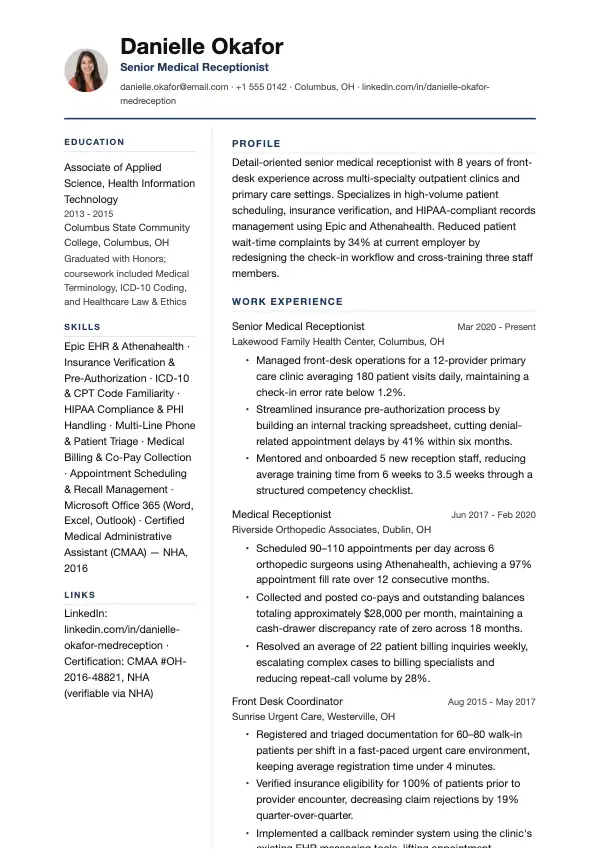
Template: Quadrant
Read this resume as text
Danielle Okafor
Senior Medical Receptionist
danielle.okafor@email.com · +1 555 0142 · Columbus, OH · linkedin.com/in/danielle-okafor-medreception
- Profile
- Detail-oriented senior medical receptionist with 8 years of front-desk experience across multi-specialty outpatient clinics and primary care settings. Specializes in high-volume patient scheduling, insurance verification, and HIPAA-compliant records management using Epic and Athenahealth. Reduced patient wait-time complaints by 34% at current employer by redesigning the check-in workflow and cross-training three staff members.
- Work Experience
Senior Medical Receptionist
Lakewood Family Health Center, Columbus, OH · Mar 2020 - Present
- Managed front-desk operations for a 12-provider primary care clinic averaging 180 patient visits daily, maintaining a check-in error rate below 1.2%.
- Streamlined insurance pre-authorization process by building an internal tracking spreadsheet, cutting denial-related appointment delays by 41% within six months.
- Mentored and onboarded 5 new reception staff, reducing average training time from 6 weeks to 3.5 weeks through a structured competency checklist.
Medical Receptionist
Riverside Orthopedic Associates, Dublin, OH · Jun 2017 - Feb 2020
- Scheduled 90–110 appointments per day across 6 orthopedic surgeons using Athenahealth, achieving a 97% appointment fill rate over 12 consecutive months.
- Collected and posted co-pays and outstanding balances totaling approximately $28,000 per month, maintaining a cash-drawer discrepancy rate of zero across 18 months.
- Resolved an average of 22 patient billing inquiries weekly, escalating complex cases to billing specialists and reducing repeat-call volume by 28%.
Front Desk Coordinator
Sunrise Urgent Care, Westerville, OH · Aug 2015 - May 2017
- Registered and triaged documentation for 60–80 walk-in patients per shift in a fast-paced urgent care environment, keeping average registration time under 4 minutes.
- Verified insurance eligibility for 100% of patients prior to provider encounter, decreasing claim rejections by 19% quarter-over-quarter.
- Implemented a callback reminder system using the clinic's existing EHR messaging tools, lifting appointment confirmation rates from 71% to 89%.
- Education
Associate of Applied Science, Health Information Technology
Columbus State Community College, Columbus, OH · 2013 - 2015
Graduated with Honors; coursework included Medical Terminology, ICD-10 Coding, and Healthcare Law & Ethics
- Skills
- Epic EHR & Athenahealth · Insurance Verification & Pre-Authorization · ICD-10 & CPT Code Familiarity · HIPAA Compliance & PHI Handling · Multi-Line Phone & Patient Triage · Medical Billing & Co-Pay Collection · Appointment Scheduling & Recall Management · Microsoft Office 365 (Word, Excel, Outlook) · Certified Medical Administrative Assistant (CMAA) — NHA, 2016
- Links
- LinkedIn: linkedin.com/in/danielle-okafor-medreception · Certification: CMAA #OH-2016-48821, NHA (verifiable via NHA)
What makes this resume work
- Every bullet opens with an action verb and closes with a number — percentages, dollar figures, or patient counts — so hiring managers can instantly gauge the candidate's real-world impact rather than guessing from vague descriptions.
- Hard skills are listed as the exact phrases recruiters type into applicant-tracking systems ('Epic EHR,' 'Insurance Pre-Authorization,' 'HIPAA Compliance'), not paraphrased, so the resume matches when a recruiter searches for those exact terms.
- The summary front-loads seniority (8 years), the two dominant EHR platforms, and one headline result in three sentences, giving a quick skimmer everything they need to decide this candidate is worth reading further.
- The CMAA certification is included both in the Skills section and in the links section with its certificate number, which signals credibility and saves a recruiter the extra step of asking for proof during screening.
Keywords that help you pass the ATS
Work the ones that fit your experience into your resume, naturally, not stuffed.
How to write a Medical Receptionist resume
Choose the right format for a Medical Receptionist resume
Use a reverse-chronological format unless you are making a career change or have fewer than two years of experience, in which case a combination format works better. Keep the resume to one page if you have under ten years of experience; two pages is acceptable for senior front-desk coordinators managing multiple providers or locations.
Set margins to 0.75–1 inch, use a clean sans-serif font such as Calibri or Arial at 10–11pt, and organize sections in this order: contact information, professional summary, work experience, skills, and education. Avoid tables and text boxes — many healthcare applicant tracking systems (ATS), including Taleo and iCIMS, which are widely used by hospital networks, cannot parse them correctly.
- File format: send a text-based PDF unless the job posting asks for .docx
- Section headers must be plain text, not icons or graphics
- Use consistent date formatting: MM/YYYY throughout
- Name your file: FirstName-LastName-MedicalReceptionist-Resume.pdf
Write a professional summary that gets past the front desk
Your summary sits at the top and should answer three questions in three to four sentences: who you are professionally, what you bring in measurable terms, and what kind of role you are targeting. Skip objectives like 'seeking a challenging position' — hiring managers at busy clinics and hospital systems read dozens of resumes and want specifics immediately.
Here is a strong example: "Detail-oriented Medical Receptionist with 5+ years of front-desk experience in a high-volume family medicine practice averaging 80 patient visits per day. Proficient in Epic and Kareo for scheduling, insurance verification, and charge entry. Certified Medical Administrative Assistant (CMAA) through NHA. Known for reducing patient wait-time complaints by 30% through proactive appointment reminder workflows."
Write work-experience bullets that show impact, not just duties
Each bullet should follow the pattern: action verb + task + result or scale. Avoid listing responsibilities that every receptionist performs without context, such as 'answered phones' or 'greeted patients.' Quantify wherever possible — volume, speed, accuracy rates, and cost savings are all fair game in a medical office setting.
Pull numbers from your memory or past performance reviews: daily patient volume, number of providers you supported, copay collection totals, or error rates on insurance claims.
- Managed scheduling for 4 providers across 2 clinic locations using Epic, maintaining a 97% appointment fill rate and cutting same-day cancellations by 22% over 12 months
- Verified insurance eligibility for 60+ patients daily via Availity, reducing claim denials by 18% and accelerating reimbursement turnaround from 45 to 31 days on average
Skills and certifications recruiters and ATS systems look for
Healthcare front-desk roles have a specific skill set that differs from general administrative work. List hard skills in a dedicated section so ATS can match them to job postings. Soft skills belong in your bullets, not in a standalone list — 'excellent communication skills' as a bullet point adds no value.
Certifications matter more than most candidates realize. The CMAA (NHA) and CEHRS (NHA) are the most recognized entry-to-mid credentials. CPR/BLS certification is required by many hospital-affiliated practices. HIPAA compliance knowledge should be mentioned explicitly, not assumed.
- EHR/PM software: Epic, Athenahealth, Kareo, eClinicalWorks, NextGen
- Insurance tools: Availity, Change Healthcare, Waystar for eligibility and prior auth
- Certifications: CMAA (NHA), CEHRS (NHA), CPR/BLS (AHA or Red Cross)
- Hard skills: ICD-10 coding basics, HIPAA compliance, medical terminology, copay and co-insurance collection, multi-line phone systems
- Bilingual fluency (Spanish/English) is a competitive differentiator in many markets — list it prominently if applicable
Education, licenses, and extras that strengthen your candidacy
Most Medical Receptionist positions require a high school diploma or GED at minimum; an associate degree in Medical Office Administration or Health Information Technology moves you ahead of the pack for coordinator-level roles. List your highest degree, the institution, and graduation year. If you completed a certificate program through a community college or vocational school, include it — these programs signal hands-on training in medical terminology, billing basics, and HIPAA.
In the extras section, include relevant continuing education, volunteer work at clinics or health fairs, and any language proficiency beyond English. If you have experience with specific patient populations — pediatrics, geriatrics, behavioral health — note it here or in your summary, because specialty practices filter for this.
- Associate of Applied Science, Medical Office Administration — relevant coursework worth listing
- NHA or AHIMA continuing education units show commitment to the field
- Volunteer experience at free clinics or community health centers counts as real front-desk experience
Mistakes to avoid
- Listing EHR software you have only seen demonstrated rather than actively used — interviewers will ask you to walk through workflows, and the gap becomes obvious immediately.
- Omitting HIPAA compliance from your resume entirely, which signals to healthcare hiring managers that you may not understand the regulatory environment of the role.
- Using a generic administrative resume template with no healthcare-specific language, causing ATS systems trained on medical job descriptions to score your application low.
- Failing to quantify patient volume or provider support numbers, which are the primary benchmarks hiring managers use to assess whether your experience matches the pace of their practice.
Frequently asked questions
- Do I need a certification to get a Medical Receptionist job?
- Certification is not legally required, but the CMAA through the National Healthcareer Association (NHA) gives you a concrete credential that many hospital-affiliated practices and multi-provider clinics list as preferred. It also signals to employers that you understand medical terminology and HIPAA, which shortens onboarding time. Entry-level candidates without experience benefit most from earning it before applying.
- Should I include Epic or other EHR software on my Medical Receptionist resume?
- Yes — always list the specific EHR and practice management systems you have used, because many job postings filter for them by name. Generic phrases like 'proficient in medical software' are ignored by ATS and unconvincing to hiring managers. If you have used Epic in one context and Kareo in another, list both and briefly note the setting in your work-experience bullets.
- How do I write a Medical Receptionist resume with no experience?
- Lead with any customer-facing or administrative work, even outside healthcare, and draw parallels to front-desk skills: scheduling, data entry, phone handling, and cash handling all transfer directly. Earn the CMAA certification to offset the experience gap, and include any clinical volunteer work, externships, or medical office courses from your education. A strong summary that names the specific type of practice you are targeting shows intentionality and helps you stand out against other entry-level applicants.
Make it yours in minutes
Open this example in the builder, swap in your details, and export a clean, ATS-ready resume.
Once your resume is ready
More for this application
- Template style
- ATS-Friendly resume templates