Resume example
Psychologist resume example
By the Resumade team · About our content
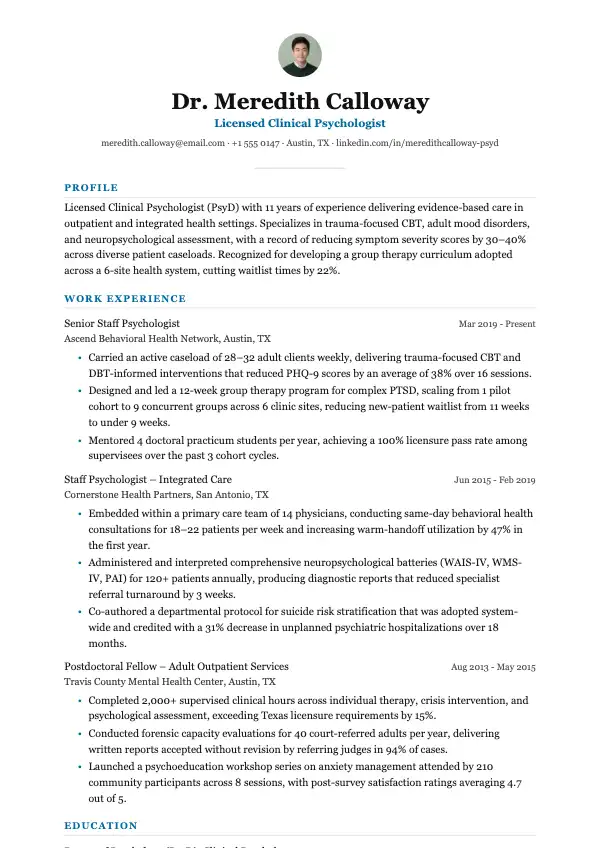
A Psychologist resume must surface licensure, therapeutic modalities, and population specialties within the first scan—both for ATS keyword matching and to give hiring managers immediate clinical confidence. This example leads with credentials, quantifies patient outcomes, and structures each role around scope, impact, and leadership.
Template: Classic
Read this resume as text
Dr. Meredith Calloway
Licensed Clinical Psychologist
meredith.calloway@email.com · +1 555 0147 · Austin, TX · linkedin.com/in/meredithcalloway-psyd
- Profile
- Licensed Clinical Psychologist (PsyD) with 11 years of experience delivering evidence-based care in outpatient and integrated health settings. Specializes in trauma-focused CBT, adult mood disorders, and neuropsychological assessment, with a record of reducing symptom severity scores by 30–40% across diverse patient caseloads. Recognized for developing a group therapy curriculum adopted across a 6-site health system, cutting waitlist times by 22%.
- Work Experience
Senior Staff Psychologist
Ascend Behavioral Health Network, Austin, TX · Mar 2019 - Present
- Carried an active caseload of 28–32 adult clients weekly, delivering trauma-focused CBT and DBT-informed interventions that reduced PHQ-9 scores by an average of 38% over 16 sessions.
- Designed and led a 12-week group therapy program for complex PTSD, scaling from 1 pilot cohort to 9 concurrent groups across 6 clinic sites, reducing new-patient waitlist from 11 weeks to under 9 weeks.
- Mentored 4 doctoral practicum students per year, achieving a 100% licensure pass rate among supervisees over the past 3 cohort cycles.
Staff Psychologist – Integrated Care
Cornerstone Health Partners, San Antonio, TX · Jun 2015 - Feb 2019
- Embedded within a primary care team of 14 physicians, conducting same-day behavioral health consultations for 18–22 patients per week and increasing warm-handoff utilization by 47% in the first year.
- Administered and interpreted comprehensive neuropsychological batteries (WAIS-IV, WMS-IV, PAI) for 120+ patients annually, producing diagnostic reports that reduced specialist referral turnaround by 3 weeks.
- Co-authored a departmental protocol for suicide risk stratification that was adopted system-wide and credited with a 31% decrease in unplanned psychiatric hospitalizations over 18 months.
Postdoctoral Fellow – Adult Outpatient Services
Travis County Mental Health Center, Austin, TX · Aug 2013 - May 2015
- Completed 2,000+ supervised clinical hours across individual therapy, crisis intervention, and psychological assessment, exceeding Texas licensure requirements by 15%.
- Conducted forensic capacity evaluations for 40 court-referred adults per year, delivering written reports accepted without revision by referring judges in 94% of cases.
- Launched a psychoeducation workshop series on anxiety management attended by 210 community participants across 8 sessions, with post-survey satisfaction ratings averaging 4.7 out of 5.
- Education
Doctor of Psychology (PsyD), Clinical Psychology
Baylor University, Waco, TX · 2008 - 2013
Dissertation: Cognitive Flexibility and Emotion Regulation in Adult Survivors of Childhood Trauma — APA Division 12 Student Research Award
Bachelor of Science, Psychology (Summa Cum Laude)
University of Texas at Austin, Austin, TX · 2004 - 2008
Minor in Neuroscience; Psi Chi Honor Society
- Skills
- Trauma-Focused Cognitive Behavioral Therapy (TF-CBT) · Dialectical Behavior Therapy (DBT) · Neuropsychological Assessment (WAIS-IV, WMS-IV, PAI) · Integrated Primary Care / Collaborative Care Model · Suicide Risk Assessment & Safety Planning · DSM-5-TR Differential Diagnosis · Electronic Health Records: Epic, Valant · Texas Licensed Psychologist (Lic. #37842, exp. 2027) · APA Ethics Code & HIPAA Compliance
- Links
- LinkedIn: linkedin.com/in/meredithcalloway-psyd · License: Texas Psychologist License #37842 (verifiable via state board) · Publication: Suicide risk stratification protocol, Cornerstone Health Partners (2018)
What makes this resume work
- Licensure and credential details appear in the job title, skills section, and the links section, ensuring ATS systems flag the resume for licensed-only postings without requiring a recruiter to hunt for proof.
- Every bullet follows an action-verb + scope + measurable outcome structure—PHQ-9 reductions, waitlist decreases, and hospitalization rates replace vague descriptors and give clinical directors concrete evidence of effectiveness.
- The summary names two distinct specialisms (trauma-focused CBT and neuropsychological assessment) rather than a generic overview, immediately signaling fit for roles that require one or both without over-claiming breadth.
- The education note on the dissertation award and the published protocol in the links section demonstrate scholarly contribution and systems-level thinking, differentiating a senior clinician from candidates who list only clinical hours.
Keywords that help you pass the ATS
Work the ones that fit your experience into your resume, naturally, not stuffed.
How to write a Psychologist resume
Choose the right format for a Psychologist resume
Use a reverse-chronological format in almost every case. Hiring managers in clinical, school, and research settings expect to see your most recent position first, and applicant tracking systems (ATS) parse this layout most reliably. A functional or hybrid format is only worth considering if you are transitioning from a research-only role into direct practice, and even then, lead with a strong summary rather than burying your timeline.
Keep the resume to two pages if you have more than five years of experience; one page if you are a recent doctoral graduate or postdoctoral fellow. Use 0.75–1-inch margins, a clean serif or sans-serif font at 10–12 pt, and clear section headers. Avoid tables, text boxes, and graphics — many hospital and university HR portals strip them out.
- Reverse-chronological order for all positions, internships, and postdocs
- Two pages maximum for licensed practitioners; one page for pre-licensure candidates
- Standard file format: a text-based PDF for uploads and email, or .docx when a posting requests Word
- Section order: Summary → Licensure → Experience → Education → Skills → Publications (if applicable)
Write a professional summary that earns a second look
Your summary sits directly below your name and contact information. It should be three to four sentences that state your specialty area, years of experience, licensure status, and one concrete outcome or strength. Do not write a vague objective statement — recruiters in behavioral health and academic psychology skip them entirely.
Here is a strong example: "Licensed Clinical Psychologist (NY, NJ) with 9 years of experience delivering evidence-based treatment for PTSD, OCD, and complex trauma in outpatient and VA settings. Trained in Prolonged Exposure (PE), Cognitive Processing Therapy (CPT), and EMDR. Reduced patient no-show rates by 22% through a structured engagement protocol adopted department-wide. Seeking a senior clinician role with a focus on trauma-informed care and clinical supervision."
Write work-experience bullets that show measurable impact
Each bullet should follow an action verb → task/method → outcome structure. Psychologists often undersell their work by writing duties instead of results. Quantify caseload size, outcome improvement, grant funding, supervision hours, or program reach wherever you can. Reference the specific evidence-based modalities you used — DBT, CBT, ACT, MI, CPT — because these terms appear in job postings and ATS filters.
If you conducted assessments, name the instruments: MMPI-3, WAIS-IV, Rorschach, PAI, BASC-3. Hiring managers in neuropsychology, forensic, and school psychology roles treat instrument fluency as a hard requirement.
- Delivered individual and group CBT to a caseload of 45 adult outpatients weekly, achieving a 34% average reduction in PHQ-9 scores over 12-week treatment episodes as measured by routine outcome monitoring.
- Conducted 120+ neuropsychological evaluations annually using WAIS-IV, WMS-IV, and RBANS, producing written reports averaging 48-hour turnaround and contributing to a 15% increase in referral volume from partnering neurologists.
Skills and certifications recruiters and ATS systems look for
Build a dedicated skills section that mirrors language from the job posting. Split it into clinical competencies, assessment instruments, and technical or administrative tools. Many hospital systems and group practices use ATS platforms such as Workday, iCIMS, or Taleo, and keyword matching directly affects whether your resume surfaces for review.
Certifications beyond state licensure add real weight. CPT and PE certifications from the VA or STRONG STAR Training Initiative, EMDR certification through EMDRIA, board certification from ABPP (in clinical, neuropsychology, forensic, or another specialty), and Nationally Certified School Psychologist (NCSP) credential from NASP all signal advanced competency to hiring committees.
- Evidence-based modalities: CBT, DBT, ACT, CPT, PE, EMDR, MI, TF-CBT
- Assessment instruments: MMPI-3, PAI, WAIS-IV, WMS-IV, BASC-3, ADOS-2, RBANS, Conners-4
- Certifications: ABPP board certification, EMDRIA-certified, NCSP, CPT Provider, PE-certified
- Electronic health records: Epic, Cerner, SimplePractice, TherapyNotes, AVATAR
- Research and data tools: SPSS, R, REDCap, Qualtrics (relevant for academic or research roles)
Education, licenses, and extras that complete your resume
List your doctoral degree (PhD, PsyD, or EdD) first, followed by your predoctoral internship (APA-accredited status matters — include it), and any postdoctoral fellowship. Include institution, location, and completion year. Do not list GPA unless you graduated within the last two years and it is above 3.7.
Place your state license prominently — either in a standalone Licensure section just below your summary or within the Education section. Include license number, issuing state, and expiration year. If you hold licenses in multiple states, list each one. Add publications, presentations, and grants in a separate section if you are applying to academic medical centers, university training clinics, or research positions — these audiences expect to see scholarly output and will weigh it heavily.
- Format: PsyD, Clinical Psychology — Pepperdine University, Los Angeles, CA (2015)
- Predoctoral Internship: VA Long Beach Healthcare System, APA-accredited (2014–2015)
- License line: Licensed Psychologist, California PSY 28XXXX, exp. 2028
Mistakes to avoid
- Listing licensure only in the Education section buries the credential that hiring managers check first — give it its own labeled section near the top of the resume.
- Writing therapy modalities as generic phrases like 'evidence-based treatment' instead of naming CPT, DBT, or EMDR costs you ATS keyword matches and tells the reader nothing specific about your training.
- Omitting APA accreditation status for your internship is a red flag in clinical hiring, because accreditation is a baseline requirement for many hospital and VA positions.
- Using patient-identifying language or case details anywhere on a resume, even in anonymized form, raises confidentiality and ethics concerns and will disqualify you at ethics-conscious organizations.
Frequently asked questions
- Should a psychologist list publications on their resume or only on a CV?
- For academic medical centers, university positions, and research roles, include a Publications section on your resume and list your most relevant peer-reviewed articles. For private practice, community mental health, or hospital clinical roles, omit publications unless they are directly relevant to the position — a separate CV can be submitted if requested.
- How do I write a psychologist resume if I am not yet licensed?
- State your licensure candidacy clearly in your summary — for example, 'Doctoral-level psychologist completing supervised hours toward NY licensure, anticipated 2027.' List your completed internship and any postdoctoral fellowship, and emphasize supervised clinical hours, assessment competencies, and modality training. Do not imply you hold a license you do not yet have.
- What is the difference between a psychologist resume and a CV, and when do I use each?
- A resume is a targeted, concise document of one to two pages tailored to a specific job, used for clinical, applied, and most hospital or agency roles. A CV is a comprehensive record of your academic and professional history with no page limit, expected for faculty positions, research grants, and academic medical center applications. Many psychologists maintain both and submit whichever the employer requests.
Make it yours in minutes
Open this example in the builder, swap in your details, and export a clean, ATS-ready resume.
Once your resume is ready
More for this application
- Template style
- Professional resume templates