Resume example
COO resume example
By the Resumade team · About our content
A COO resume must prove operational scale, financial fluency, and cross-functional authority — fast. This example leads with dollar figures and percentages that a board or PE firm can immediately benchmark, while surfacing the exact terms ATS systems flag for senior ops leadership roles.
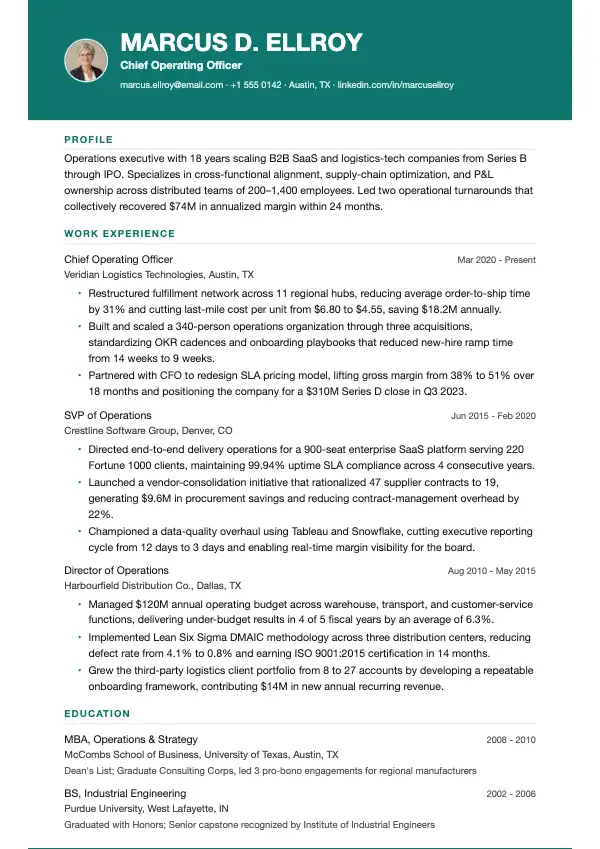
Template: Bold
Read this resume as text
Marcus D. Ellroy
Chief Operating Officer
marcus.ellroy@email.com · +1 555 0142 · Austin, TX · linkedin.com/in/marcusellroy
- Profile
- Operations executive with 18 years scaling B2B SaaS and logistics-tech companies from Series B through IPO. Specializes in cross-functional alignment, supply-chain optimization, and P&L ownership across distributed teams of 200–1,400 employees. Led two operational turnarounds that collectively recovered $74M in annualized margin within 24 months.
- Work Experience
Chief Operating Officer
Veridian Logistics Technologies, Austin, TX · Mar 2020 - Present
- Restructured fulfillment network across 11 regional hubs, reducing average order-to-ship time by 31% and cutting last-mile cost per unit from $6.80 to $4.55, saving $18.2M annually.
- Built and scaled a 340-person operations organization through three acquisitions, standardizing OKR cadences and onboarding playbooks that reduced new-hire ramp time from 14 weeks to 9 weeks.
- Partnered with CFO to redesign SLA pricing model, lifting gross margin from 38% to 51% over 18 months and positioning the company for a $310M Series D close in Q3 2023.
SVP of Operations
Crestline Software Group, Denver, CO · Jun 2015 - Feb 2020
- Directed end-to-end delivery operations for a 900-seat enterprise SaaS platform serving 220 Fortune 1000 clients, maintaining 99.94% uptime SLA compliance across 4 consecutive years.
- Launched a vendor-consolidation initiative that rationalized 47 supplier contracts to 19, generating $9.6M in procurement savings and reducing contract-management overhead by 22%.
- Championed a data-quality overhaul using Tableau and Snowflake, cutting executive reporting cycle from 12 days to 3 days and enabling real-time margin visibility for the board.
Director of Operations
Harbourfield Distribution Co., Dallas, TX · Aug 2010 - May 2015
- Managed $120M annual operating budget across warehouse, transport, and customer-service functions, delivering under-budget results in 4 of 5 fiscal years by an average of 6.3%.
- Implemented Lean Six Sigma DMAIC methodology across three distribution centers, reducing defect rate from 4.1% to 0.8% and earning ISO 9001:2015 certification in 14 months.
- Grew the third-party logistics client portfolio from 8 to 27 accounts by developing a repeatable onboarding framework, contributing $14M in new annual recurring revenue.
- Education
MBA, Operations & Strategy
McCombs School of Business, University of Texas, Austin, TX · 2008 - 2010
Dean's List; Graduate Consulting Corps, led 3 pro-bono engagements for regional manufacturers
BS, Industrial Engineering
Purdue University, West Lafayette, IN · 2002 - 2006
Graduated with Honors; Senior capstone recognized by Institute of Industrial Engineers
- Skills
- P&L Ownership & Margin Expansion · OKR & KPI Framework Design · Lean Six Sigma (Black Belt) · M&A Integration & Post-Merger Operations · Supply Chain Optimization · Salesforce, NetSuite, SAP S/4HANA · Tableau & Snowflake (BI/Data Pipelines) · Board-Level Reporting & Investor Relations · Series B–D Scaling & IPO Readiness
- Links
- LinkedIn: linkedin.com/in/marcusellroy
What makes this resume work
- Every bullet closes with a hard number — dollars saved, percentage improved, or headcount scaled — so hiring committees can assess impact without reading between the lines.
- The summary names seniority level, years of experience, company stage (Series B through IPO), and two headline results in three sentences, giving screeners an instant executive profile before they reach the body of the resume.
- Skills are written as recruiters actually search them — 'P&L Ownership,' 'M&A Integration,' 'Lean Six Sigma (Black Belt)' — rather than vague phrases that disappear in ATS keyword matching.
- Roles are ordered to show a clear progression from Director to SVP to COO, with each position's scope (budget size, team count, client volume) stated explicitly so the trajectory reads as earned, not assumed.
Keywords that help you pass the ATS
Work the ones that fit your experience into your resume, naturally, not stuffed.
How to write a COO resume
Choose the right format for a COO resume
Use a reverse-chronological format. COO hiring committees — typically a CEO, board members, or an executive search firm — want to trace your operational leadership trajectory quickly. A functional or hybrid format raises red flags at this level because it obscures tenure and scope.
Keep the resume to two pages. One page signals you lack depth; three pages signals you can't prioritize. Use 0.75-inch margins, a clean sans-serif font like Calibri or Garamond at 10–11pt, and clear section headers. ATS systems used by executive recruiters (Greenhouse, Workday, iCIMS) parse standard headers reliably, so avoid tables or text boxes.
- Two-page maximum, reverse-chronological order
- Standard section headers: Summary, Experience, Skills, Education
- No tables, columns, or graphics — ATS strips them
- File format: PDF unless the job posting specifies otherwise
- Contact line should include LinkedIn URL and city/state, not full street address
Write a professional summary that earns a second look
Your summary is three to four sentences. It should name your industry specialization, the scale of operations you've run (headcount, revenue, locations), and one or two defining outcomes. Generic phrases like 'dynamic leader' or 'results-driven executive' are noise — cut them.
Here is a concrete example: "Operations executive with 15 years scaling manufacturing and supply chain functions across North America and Southeast Asia. Built and led a 2,400-person organization at a $1.2B consumer goods company, reducing cost of goods sold by 18% over three years through lean transformation and vendor consolidation. Experienced in post-merger integration, ERP migrations (SAP S/4HANA), and building C-suite-ready leadership pipelines."
Write work-experience bullets that prove operational impact
Every bullet should follow an action-metric-context structure. COO roles are evaluated on throughput, cost, quality, speed, and people — your bullets need to reflect at least three of those dimensions. Avoid describing responsibilities; describe what changed because you were there.
Quantify with the metrics boards actually care about: EBITDA contribution, gross margin improvement, headcount managed, on-time delivery rates, customer churn, and capital expenditure managed. If an NDA prevents exact figures, use ranges or percentages.
- Restructured fulfillment network from 6 regional DCs to 3 automated hubs, cutting last-mile delivery costs by $14M annually and improving order accuracy from 91% to 99.4%.
- Led 22-month ERP migration from Oracle E-Business Suite to SAP S/4HANA across 9 business units, delivering the project 6 weeks ahead of schedule and $3.2M under the $41M budget.
Skills and certifications recruiters and ATS systems look for
Executive recruiters running COO searches still search their databases by keyword. Your skills section should reflect both hard operational competencies and the specific platforms and frameworks your target companies use. Don't list soft skills here — those belong in your summary and bullets.
Certifications matter more in some verticals than others. In manufacturing and supply chain, Six Sigma Black Belt or Lean Master credentials carry real weight. In healthcare operations, a FACHE designation or experience with CMS compliance is expected. In tech-adjacent companies, PMP or SAFe Agile certification signals credibility.
- Operational frameworks: Lean, Six Sigma (Black Belt / Green Belt), Kaizen, OKRs, Balanced Scorecard
- ERP and planning tools: SAP S/4HANA, Oracle ERP Cloud, NetSuite, Anaplan, Workday
- Certifications: Six Sigma Black Belt (ASQ), PMP (PMI), FACHE, APICS CSCP, SAFe 5 Agilist
- Financial fluency keywords: P&L ownership, EBITDA, working capital management, CapEx planning
- Industry-specific compliance: ISO 9001, FDA 21 CFR Part 11, SOX operational controls
Education, board roles, and additional credentials
List your highest degree first with institution, degree, and year. At the COO level, an MBA from a recognized program still carries weight, but it does not compensate for thin operational results. If you attended an executive education program at Wharton, Kellogg, Harvard Business School, or similar, list it separately under a 'Professional Development' subheading.
Board memberships, advisory roles, and nonprofit leadership belong on a COO resume — they signal governance exposure and network depth, both of which matter to boards evaluating internal succession candidates. Include speaking engagements at industry conferences (NRF, APICS Connect, Healthcare Operations Summit) if they're recent and relevant.
- List board or advisory roles with organization name, your title, and date range
- Include executive education only if the program is 3+ days and institution-branded
- Publications or keynote addresses at recognized industry events add credibility
Mistakes to avoid
- Listing job duties instead of outcomes makes your resume indistinguishable from a job description and gives hiring committees no reason to call you.
- Omitting the scale of your operations — total headcount managed, revenue overseen, number of facilities — forces recruiters to guess whether your experience fits their company size.
- Using a one-page resume at the COO level signals either limited experience or an inability to articulate the depth of your work across multiple functions.
- Neglecting to tailor your skills section to the specific industry vertical of the target company means your resume may rank low in the keyword searches recruiters run.
Frequently asked questions
- Should a COO resume include a board presentation or thought leadership section?
- Yes, if the content is substantive and recent. Board presentations, keynote addresses at recognized industry events, or published articles in trade publications (Harvard Business Review, Supply Chain Management Review) belong in an 'Additional' or 'Leadership' section. Keep entries to one line each with the venue and year.
- How far back should a COO resume go in work history?
- Cover the last 15 years in full detail and summarize anything earlier in a brief 'Early Career' line or omit it entirely. Experience from more than 15 years ago rarely affects a hiring decision at this level unless it includes a directly relevant company or a landmark achievement. Dates beyond that range also introduce unnecessary age-bias risk.
- Do COO candidates still need a resume if they're working with an executive search firm?
- Yes. Executive recruiters at firms like Spencer Stuart, Korn Ferry, or Heidrick & Struggles will ask for a current resume to share with client companies and to populate their proprietary databases. A polished resume also signals that you take the process seriously and makes the recruiter's job easier, which keeps you top of mind for future searches.
Make it yours in minutes
Open this example in the builder, swap in your details, and export a clean, ATS-ready resume.
Once your resume is ready
More for this application
- Template style
- Executive resume templates