Resume example
Social Worker resume example
By the Resumade team · About our content
A Social Worker resume must clear ATS keyword filters built around licensure codes and clinical modalities, then persuade a hiring manager that you can manage complex caseloads under pressure. This example does both by leading with license credentials, quantifying outcomes, and naming the exact frameworks and tools employers search for.
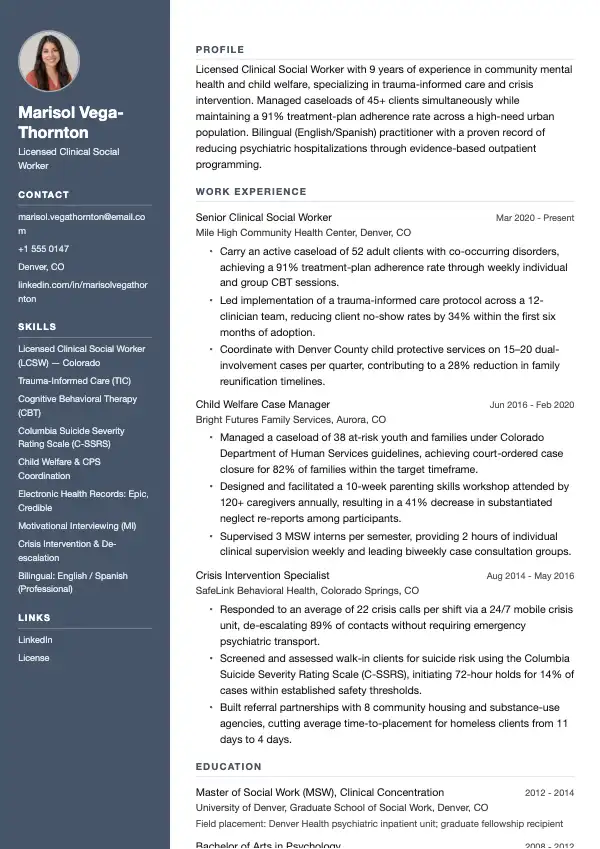
Template: Two column
Read this resume as text
Marisol Vega-Thornton
Licensed Clinical Social Worker
marisol.vegathornton@email.com · +1 555 0147 · Denver, CO · linkedin.com/in/marisolvegathornton
- Profile
- Licensed Clinical Social Worker with 9 years of experience in community mental health and child welfare, specializing in trauma-informed care and crisis intervention. Managed caseloads of 45+ clients simultaneously while maintaining a 91% treatment-plan adherence rate across a high-need urban population. Bilingual (English/Spanish) practitioner with a proven record of reducing psychiatric hospitalizations through evidence-based outpatient programming.
- Work Experience
Senior Clinical Social Worker
Mile High Community Health Center, Denver, CO · Mar 2020 - Present
- Carry an active caseload of 52 adult clients with co-occurring disorders, achieving a 91% treatment-plan adherence rate through weekly individual and group CBT sessions.
- Led implementation of a trauma-informed care protocol across a 12-clinician team, reducing client no-show rates by 34% within the first six months of adoption.
- Coordinate with Denver County child protective services on 15–20 dual-involvement cases per quarter, contributing to a 28% reduction in family reunification timelines.
Child Welfare Case Manager
Bright Futures Family Services, Aurora, CO · Jun 2016 - Feb 2020
- Managed a caseload of 38 at-risk youth and families under Colorado Department of Human Services guidelines, achieving court-ordered case closure for 82% of families within the target timeframe.
- Designed and facilitated a 10-week parenting skills workshop attended by 120+ caregivers annually, resulting in a 41% decrease in substantiated neglect re-reports among participants.
- Supervised 3 MSW interns per semester, providing 2 hours of individual clinical supervision weekly and leading biweekly case consultation groups.
Crisis Intervention Specialist
SafeLink Behavioral Health, Colorado Springs, CO · Aug 2014 - May 2016
- Responded to an average of 22 crisis calls per shift via a 24/7 mobile crisis unit, de-escalating 89% of contacts without requiring emergency psychiatric transport.
- Screened and assessed walk-in clients for suicide risk using the Columbia Suicide Severity Rating Scale (C-SSRS), initiating 72-hour holds for 14% of cases within established safety thresholds.
- Built referral partnerships with 8 community housing and substance-use agencies, cutting average time-to-placement for homeless clients from 11 days to 4 days.
- Education
Master of Social Work (MSW), Clinical Concentration
University of Denver, Graduate School of Social Work, Denver, CO · 2012 - 2014
Field placement: Denver Health psychiatric inpatient unit; graduate fellowship recipient
Bachelor of Arts in Psychology
University of Colorado Colorado Springs, Colorado Springs, CO · 2008 - 2012
Minor in Sociology; Dean's List 4 semesters
- Skills
- Licensed Clinical Social Worker (LCSW) — Colorado · Trauma-Informed Care (TIC) · Cognitive Behavioral Therapy (CBT) · Columbia Suicide Severity Rating Scale (C-SSRS) · Child Welfare & CPS Coordination · Electronic Health Records: Epic, Credible · Motivational Interviewing (MI) · Crisis Intervention & De-escalation · Bilingual: English / Spanish (Professional)
- Links
- LinkedIn · License
What makes this resume work
- The summary opens with the LCSW credential and years of experience in the first clause, satisfying both ATS parsers and a recruiter’s quick first skim before a single bullet is read.
- Every bullet pairs an action with a concrete number — adherence rates, percentage reductions, caseload counts — so the hiring manager can benchmark Marisol's output against their own program targets rather than guessing at impact.
- Skills are listed using the exact terminology found in job postings (C-SSRS, CBT, Motivational Interviewing, Epic) rather than paraphrased descriptions, which directly improves ATS match scores for clinical roles.
- The progression from Crisis Specialist to Case Manager to Senior Clinician tells a deliberate career story, and the supervision experience in the middle role signals readiness for lead or supervisory positions without overstating the current title.
Keywords that help you pass the ATS
Work the ones that fit your experience into your resume, naturally, not stuffed.
How to write a Social Worker resume
Choose the right format for a Social Worker resume
Most social workers do best with a reverse-chronological format. Employers in child welfare, healthcare, and community services want to see your most recent caseload experience first, not a skills-based layout that buries your work history.
Keep your resume to one page if you have fewer than eight years of experience; two pages are acceptable for licensed clinical social workers or those with extensive field placements and publications. Use clear section headers, 10–12 pt font (Calibri or Georgia work well), and half-inch margins. Avoid tables and text boxes — many applicant tracking systems used by county agencies and hospital systems will scramble them.
- One page for BSW and entry-level MSW candidates
- Two pages for LCSWs, program directors, or those with 8+ years
- Standard ATS-safe formatting: no columns, no icons, no headers in text boxes
- File as a PDF unless the job posting specifically requests a Word document
Write a professional summary that shows your specialty
Your summary sits at the top and gives hiring managers a three-sentence snapshot of your license level, population focus, and a standout result. Generic phrases like 'compassionate professional' waste that space. Name the setting (hospital, school district, child protective services), the population (pediatric oncology patients, justice-involved youth, older adults), and one concrete achievement.
Example: "Licensed Clinical Social Worker (LCSW) with 7 years in acute inpatient psychiatric settings, specializing in crisis stabilization for adults with co-occurring disorders. Reduced 30-day readmission rates by 18% through structured discharge planning and community linkage protocols. Proficient in electronic health record documentation using Epic and skilled in trauma-informed, motivational interviewing frameworks."
Write work-experience bullets that prove impact
Each bullet should follow an action-verb + task + outcome structure. Quantify wherever possible — caseload size, wait-time reductions, grant amounts, number of clients served. Avoid vague phrases like 'assisted clients' or 'worked with families.' Hiring managers at DCFS, VA medical centers, and nonprofit agencies see hundreds of those. Show scale and results instead.
Use terminology that matches the job description: 'biopsychosocial assessments,' 'safety planning,' 'IEP meetings,' 'Medicaid authorization,' 'mandated reporting,' or 'wraparound services,' depending on the role.
- Managed a caseload of 52 at-risk youth in foster care, achieving a 94% placement stability rate over 12 months by coordinating with CASA volunteers, school counselors, and court-appointed attorneys.
- Facilitated 6 weekly CBT-based group therapy sessions for veterans with PTSD at a VA outpatient clinic, reducing self-reported symptom severity scores (PCL-5) by an average of 11 points over 8 weeks.
Skills and certifications recruiters and ATS look for
Social work employers increasingly take applications through an ATS, where recruiters search by license and specialty. Include both your license abbreviation and the spelled-out version (e.g., 'LCSW' and 'Licensed Clinical Social Worker') so the system catches both. List hard skills separately from soft skills, and make sure clinical certifications appear prominently.
Employers in healthcare, school, and child welfare settings also look for familiarity with specific documentation and case management platforms.
- Licenses: LCSW, LSW, LMSW, LCSW-C, LICSW (list the one you hold plus your state)
- Certifications: CCM (Certified Case Manager), ACM (Accredited Case Manager), CPR/First Aid, Trauma-Focused CBT (TF-CBT), EMDR, Applied Suicide Intervention Skills Training (ASIST)
- Clinical skills: crisis intervention, biopsychosocial assessments, safety planning, motivational interviewing, DSM-5 diagnosis, mandated reporting
- Software: Epic, Cerner, Apricot, Efforts to Outcomes (ETO), myEvolv, Microsoft Teams
- Regulatory knowledge: HIPAA compliance, Title IV-E, IDEA (for school social workers), Medicaid/Medicare documentation
Education, licenses, and extras that strengthen your resume
List your MSW or BSW with the university name, graduation year, and your field practicum setting — that placement tells employers your clinical exposure. If you are pre-licensure, note your supervision status explicitly (e.g., 'Completing LCSW supervised hours under Dr. Jane Doe, LCSW'). Do not leave licensure status ambiguous.
Continuing education hours, bilingual ability (Spanish fluency is a significant differentiator in many markets), and relevant volunteer work — such as crisis hotline counseling or community health outreach — belong in a separate section at the bottom. If you have presented at NASW conferences or published in field journals, add a brief Publications or Presentations section.
- Include your NASW membership if current — some hospital HR departments check it
- Note bilingual or multilingual skills with honest proficiency levels (conversational vs. fluent)
- List field placements under education if you have fewer than three years of paid experience
Mistakes to avoid
- Leaving your license type and issuing state off the resume — employers verify licensure through state databases and need both details to look you up.
- Using the same generic resume for child welfare, clinical, and school social work roles will hurt you; each specialty has distinct terminology and required credentials that ATS and hiring managers screen for.
- Omitting caseload size or client volume makes your experience look smaller than it is — even an approximate number ('caseload of 40–55 clients') adds credibility and context.
- Describing duties instead of outcomes, for example writing 'responsible for discharge planning' rather than 'reduced average length of stay by 1.2 days through coordinated discharge planning for a 30-bed inpatient unit.'
Frequently asked questions
- Do I need to include my LCSW license number on my resume?
- No. You should list your license type and the state where it is active; add the number only if the posting or application asks for it. Employers confirm licensure through their state's online verification portal during the hiring process.
- How do I write a social work resume with no paid experience?
- Lead with your field placements under the Education section, treating each one like a job entry with setting, population served, and specific tasks such as conducting intake assessments or facilitating psychoeducation groups. Add relevant volunteer work, internships, and any crisis line or community outreach experience. Quantify hours wherever you can — for example, '900 supervised clinical hours across two placements.'
- Should a social worker use a functional or chronological resume format?
- Stick with reverse-chronological in almost every case. Functional resumes raise red flags for social work hiring managers because they obscure where and when you actually worked with clients, which matters for verifying supervised hours and relevant experience. The only exception might be a significant career pivot, and even then a hybrid format is safer than a purely functional one.
Make it yours in minutes
Open this example in the builder, swap in your details, and export a clean, ATS-ready resume.
Once your resume is ready
More for this application
- Template style
- Two-Column resume templates