Resume example
CEO resume example
By the Resumade team · About our content
Search committees read a CEO resume for capital stewardship, leadership, and revenue growth, so this example leads with scale and checkable specifics. It is also written in plain, searchable terms for the times it goes through an ATS.
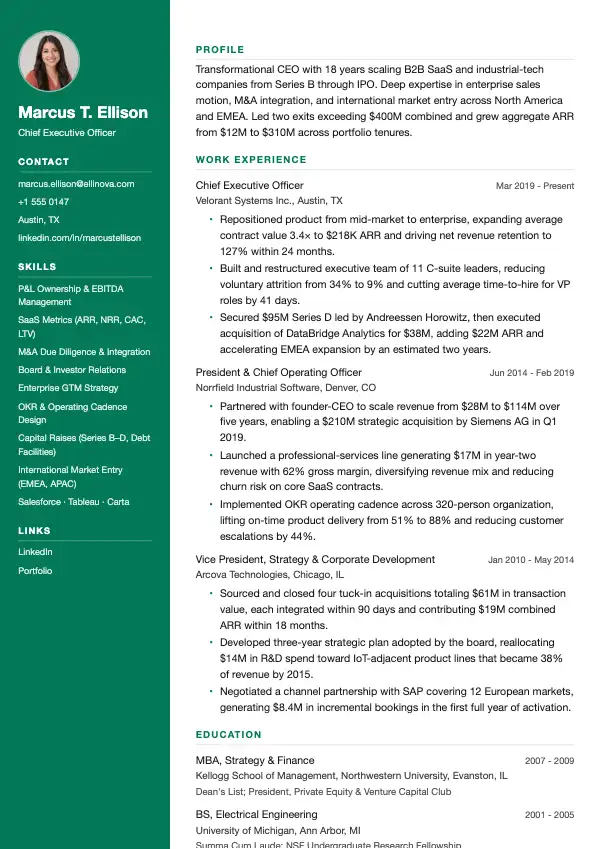
Template: Two column
Read this resume as text
Marcus T. Ellison
Chief Executive Officer
marcus.ellison@ellinova.com · +1 555 0147 · Austin, TX · linkedin.com/in/marcustellison
- Profile
- Transformational CEO with 18 years scaling B2B SaaS and industrial-tech companies from Series B through IPO. Deep expertise in enterprise sales motion, M&A integration, and international market entry across North America and EMEA. Led two exits exceeding $400M combined and grew aggregate ARR from $12M to $310M across portfolio tenures.
- Work Experience
Chief Executive Officer
Velorant Systems Inc., Austin, TX · Mar 2019 - Present
- Repositioned product from mid-market to enterprise, expanding average contract value 3.4× to $218K ARR and driving net revenue retention to 127% within 24 months.
- Built and restructured executive team of 11 C-suite leaders, reducing voluntary attrition from 34% to 9% and cutting average time-to-hire for VP roles by 41 days.
- Secured $95M Series D led by Andreessen Horowitz, then executed acquisition of DataBridge Analytics for $38M, adding $22M ARR and accelerating EMEA expansion by an estimated two years.
President & Chief Operating Officer
Norrfield Industrial Software, Denver, CO · Jun 2014 - Feb 2019
- Partnered with founder-CEO to scale revenue from $28M to $114M over five years, enabling a $210M strategic acquisition by Siemens AG in Q1 2019.
- Launched a professional-services line generating $17M in year-two revenue with 62% gross margin, diversifying revenue mix and reducing churn risk on core SaaS contracts.
- Implemented OKR operating cadence across 320-person organization, lifting on-time product delivery from 51% to 88% and reducing customer escalations by 44%.
Vice President, Strategy & Corporate Development
Arcova Technologies, Chicago, IL · Jan 2010 - May 2014
- Sourced and closed four tuck-in acquisitions totaling $61M in transaction value, each integrated within 90 days and contributing $19M combined ARR within 18 months.
- Developed three-year strategic plan adopted by the board, reallocating $14M in R&D spend toward IoT-adjacent product lines that became 38% of revenue by 2015.
- Negotiated a channel partnership with SAP covering 12 European markets, generating $8.4M in incremental bookings in the first full year of activation.
- Education
MBA, Strategy & Finance
Kellogg School of Management, Northwestern University, Evanston, IL · 2007 - 2009
Dean's List; President, Private Equity & Venture Capital Club
BS, Electrical Engineering
University of Michigan, Ann Arbor, MI · 2001 - 2005
Summa Cum Laude; NSF Undergraduate Research Fellowship
- Skills
- P&L Ownership & EBITDA Management · SaaS Metrics (ARR, NRR, CAC, LTV) · M&A Due Diligence & Integration · Board & Investor Relations · Enterprise GTM Strategy · OKR & Operating Cadence Design · Capital Raises (Series B–D, Debt Facilities) · International Market Entry (EMEA, APAC) · Salesforce · Tableau · Carta
- Links
- LinkedIn · Portfolio
What makes this resume work
- Every bullet names a before-or-after metric — contract value multiples, retention percentages, or dollar figures — so reviewers can immediately size the candidate's impact without reading between the lines.
- The summary front-loads seniority (18 years), domain (B2B SaaS and industrial-tech), and two headline outcomes ($400M exits, $310M ARR) rather than vague leadership philosophy, giving screeners a fast qualification signal.
- Skills are written as board-room and recruiter search terms — 'P&L Ownership,' 'NRR,' 'M&A Due Diligence' — not generic adjectives, which ensures the resume surfaces in executive-search database queries.
- The career arc is deliberately progressive: VP Strategy → President/COO → CEO, demonstrating a logical ascent that hiring boards and PE sponsors find credible rather than a résumé that claims executive scope without the ladder to support it.
Keywords that help you pass the ATS
Work the ones that fit your experience into your resume, naturally, not stuffed.
How to write a CEO resume
Choose the right format for a CEO resume
Use a reverse-chronological format. Boards, private equity firms, and executive search firms expect to read your career trajectory at a glance, and a functional or hybrid layout signals you are hiding something. Keep the document to two pages maximum — one page if you have fewer than 15 years of experience.
Set margins at 0.75–1 inch, use a clean serif or sans-serif font at 10–12 pt, and place your name in 16–18 pt at the top. Avoid tables, text boxes, and columns; many applicant tracking systems used by large boards and search firms — Spencer Stuart, Korn Ferry, Heidrick & Struggles — parse plain text only.
- Two pages maximum; three only if you are a public-company CEO with extensive board service
- Header: name, city/state, LinkedIn URL, direct phone, professional email
- No photo, no objective statement, no references section
- File format: PDF unless the portal specifically requests a .docx
Write a professional summary that positions you as a CEO, not a senior executive
Your summary sits directly below your contact information and runs three to five sentences. It must answer three questions immediately: what kind of company do you lead (stage, sector, revenue scale), what measurable outcomes define your tenure, and what is your leadership edge. Do not open with 'Results-driven leader' or any variation of it.
Here is a concrete example: "Chief Executive Officer with 18 years leading B2B SaaS and enterprise software companies from Series B through successful exit. Scaled two organizations past $200M ARR, completed a $340M acquisition of a European competitor, and took one company public on NASDAQ in 2019. Known for building high-retention executive teams and translating product vision into durable revenue growth in competitive markets."
Write work-experience bullets that prove P&L ownership and strategic impact
Every bullet under each role must start with a strong past-tense verb and include a number — revenue, headcount, percentage growth, cost reduction, deal size, or market share. Generic statements like 'oversaw company strategy' are invisible to search committees. Quantify the scope of what you ran: total revenue, employees managed, geographies covered, budget controlled.
Aim for four to six bullets per role. Lead with your two or three highest-impact achievements, then cover operational scope. Do not list responsibilities — list results.
- Grew annual recurring revenue from $42M to $187M over four years by expanding into EMEA and launching a mid-market product tier, increasing total customer count by 310%
- Led a $215M leveraged buyout integration, consolidating five back-office systems onto a single ERP platform (SAP S/4HANA) and reducing operating costs by $18M in year one
Include the skills and certifications executive recruiters and ATS systems look for
CEO resumes need a concise skills section — eight to twelve terms — that reflects both strategic and operational competency. ATS systems at large corporations and search platforms like LinkedIn Recruiter and Bullhorn scan for specific keywords. Tailor this section to the type of role you are targeting: a PE-backed turnaround CEO needs different keywords than a VC-backed growth-stage CEO.
Certifications matter more at the board level than many executives realize. The NACD Directorship Certification (NACD.DC) signals governance literacy to public-company boards. If you have completed Harvard Business School Executive Education programs, Kellogg's CEO program, or hold a CFA or CPA, list them — they carry weight in financial-services and PE contexts.
- Core competencies to include: P&L Management, M&A Integration, Capital Allocation, Organizational Design, Board Relations, Enterprise Sales, Go-to-Market Strategy, Investor Relations
- Technical fluency worth noting: Salesforce, SAP, NetSuite, Tableau, or specific ERP/CRM platforms relevant to your industry
- Governance credentials: NACD.DC, audit committee experience, SEC reporting familiarity
- Industry-specific: SOC 2 oversight, FDA regulatory experience, FINRA familiarity — only if genuinely applicable
Education, board service, and additional credentials
List your highest degree first: institution, degree, field of study, and year. If you attended a well-regarded MBA program — Wharton, Booth, Tuck, Haas — put it prominently. If your undergraduate institution is not notable, you can omit the year to reduce age bias. Do not list GPA unless you graduated within the last five years.
Below education, add a Board Service section if you sit or have sat on corporate, nonprofit, or advisory boards. List the organization, your role (Board Director, Audit Committee Chair, etc.), and dates. This section is often the deciding factor when a search committee is choosing between two otherwise equal candidates. Also include any speaking engagements at recognized industry conferences (Gartner, Davos, SaaStr, etc.) and major press mentions if they reinforce your positioning.
- Board Service: company name, role, years served
- Advisory Boards: relevant only if the company is recognized in your target industry
- Publications or thought leadership: WSJ op-eds, Harvard Business Review contributions, published books
Mistakes to avoid
- Listing job duties instead of outcomes makes your resume indistinguishable from every other executive who held your title.
- Omitting the revenue or headcount scale of each company forces search committees to guess whether you ran a $10M division or a $1B enterprise.
- Using a functional or skills-first format raises immediate red flags with executive search firms who interpret it as an attempt to obscure gaps or a lateral-heavy career.
- Neglecting board service, governance credentials, and investor relations experience is a critical omission because public-company and PE-backed roles weight these factors heavily in the selection process.
Frequently asked questions
- How long should a CEO resume be?
- Two pages is the standard for most CEO candidates. A third page is acceptable only if you have extensive public-company board service, multiple CEO tenures, or significant published thought leadership that is directly relevant to the role. Never exceed three pages regardless of experience.
- Should a CEO resume include a LinkedIn URL?
- Yes, and your LinkedIn profile must be consistent with your resume — same titles, same dates, same company names. Executive search firms cross-reference both documents before making first contact, and discrepancies create immediate doubt about your credibility. Make sure your LinkedIn headline reflects your current or most recent CEO role, not a generic phrase.
- Do CEO resumes need to pass ATS screening?
- It depends on how you are applying. If you are submitting directly to a corporate board or through an executive search firm, a human reads your resume first. However, if you are applying through a company's careers portal or LinkedIn Easy Apply, an ATS will parse and rank it before any person sees it. Maintain a plain-text-friendly version with relevant keywords from the job description to cover both scenarios.
Make it yours in minutes
Open this example in the builder, swap in your details, and export a clean, ATS-ready resume.
Once your resume is ready
More for this application
- Template style
- Executive resume templates